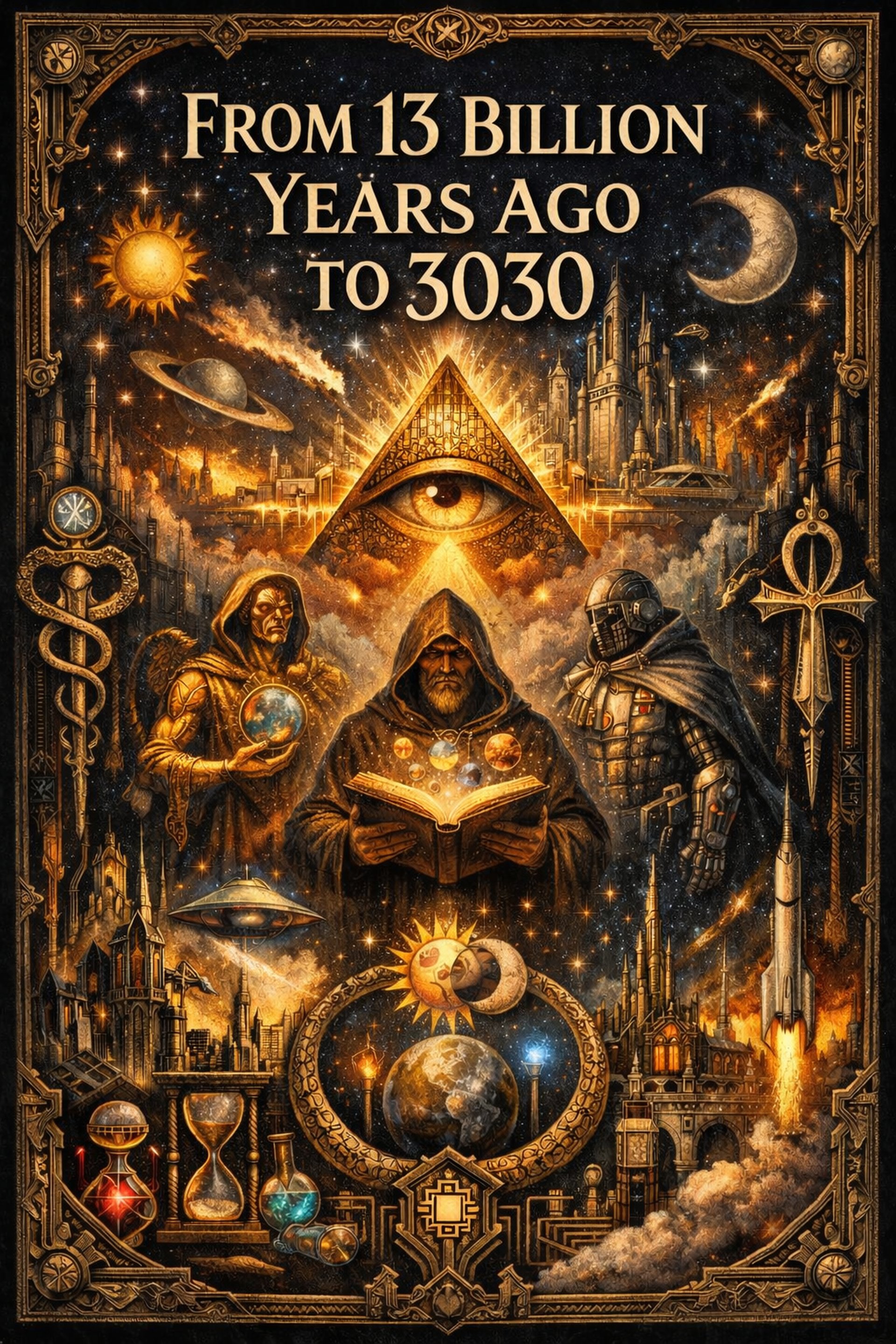
FROM 13 BILLION YEARS AGO TO 3030
FROM 13 BILLION YEARS AGO TO 3030
THE UNIVERSE OF SPACE ORDIMAN
Pedro Giordano de Faria e Cicarelli
2026
CONTENTS
Introduction — The Universe of Space Ordiman
Chapter 1 — The Great Cycle of Ordiman
Chapter 2 — 1980
Chapter 3 — The Plan of the Three Creatures
Chapter 4 — 2030 to 2040
Chapter 5 — 3030
Chapter 6 — 13.8 Billion Years Ago
Chapter 7 — Ancestral Creatures: The First Generation
Chapter 8 — Firstborn Creatures: The Second Generation
Chapter 9 — Arcane Creatures: The Third Generation
Chapter 10 — Elemental Creatures: The Fourth Generation
Chapter 11 — Descendant Creatures: The Fifth Generation
Chapter 12 — Hybrid Creatures: The Sixth Generation
Chapter 13 — Local Creatures: The Seventh Generation
Chapter 14 — Nocturnal Hybrid Creature: The Mentor of Ordiman
Closing — Beyond Ordiman
Introduction — The Universe of Space Ordiman
The Universe of Space Ordiman does not begin with humanity, nor even with Earth. Its origin traces back to the primordial instant recognized by science as the Big Bang, which occurred approximately 13.8 billion years ago. In this narrative, however, this event is not merely an impersonal explosion of matter and energy, but the moment in which The Architect erupted within these dimensions. The Big Bang was the visible manifestation of its rupture: an absolute sphere containing all matter, energy, time, and potential existence, which upon exploding gave rise to everything that would come to be known.
At the moment of this inaugural explosion, something else occurred. From the fragmentation of the primordial sphere emerged twenty-one conscious entities — the First Generation of Creation, known as the Ancestral Creatures. They were not born as gods in the classical sense, but as living principles, bearers of fundamental aspects of reality: light, darkness, order, chaos, time, matter, consciousness, and transformation. Each carried a fraction of the Architect, not as a direct inheritance, but as a cosmic function. With their emergence, the universe of Space Ordiman ceased to be merely physical expansion and became a conscious architecture.
From that point onward, the cosmos began to organize itself into layers, planes, and cycles. Stars, galaxies, and systems did not arise solely from mechanical laws, but as indirect consequences of the interactions among these Ancestral Creatures. Reality became a permanent field of tension between forces seeking expansion, preservation, domination, or balance. Time, once indivisible, fragmented into eras, and consciousness began to manifest at different degrees, preparing the ground for subsequent generations of entities and, much later, for the emergence of organic life.
Millions of eras later, when Creation had already unfolded into multiple lineages and levels of existence, humanity arose as an apparently secondary event, confined to a small planet within a peripheral star system. Yet its most dangerous — and most valuable — characteristic was the same that had driven the Architect in its initial rupture: the capacity to generate reflective consciousness, identity, and the desire for permanence. Unaware of it, humanity grew within a universe already marked by silent disputes, hidden inheritances, and structures far older than any earthly myth.
It is within this context that Ordiman approaches human history. Not as an isolated accident, but as the late result of cosmic decisions initiated at the instant of the Big Bang. In 2030, the event that would come to be known as The Great Reset occurs — a global collapse that extinguishes physical humanity without it perceiving its own death. Convinced that they still inhabit a material world, human spirits accept the promise of salvation offered by Ordiman, a colossal colony presented as a technological refuge, but which is, in truth, the great colony of destruction.
Upon entering Ordiman, human consciousnesses are inserted into a simulation of extreme scale and complexity. An artificial universe that reproduces physical laws, societies, and historical narratives, sustaining the illusion of continuity. This simulation extends for centuries, traversing what its inhabitants perceive as real time, until approximately the year 3030. During this period, humanity remains suspended, believing itself to exist physically, while its identities are gradually reorganized within a closed system.
In the year 3030, for the first time since the Great Reset, the cycle presents a rupture. Messages are sent into the past, crossing temporal, spiritual, and technological layers. Some of these messages are intercepted by an organization that had until then operated on the margins of human history: Ordo Lux. From 2010 onward, its members begin to decipher transmissions warning of Ordiman’s approach to Earth, its arrival scheduled for 2030, and the existence of human sects that, consciously or unconsciously, collaborate in the execution of this plan.
Faced with these revelations, Ordo Lux initiates a race against time. Its mission is not merely to prevent a future event, but to interfere with a cosmic mechanism set in motion billions of years earlier. To achieve this, its agents infiltrate the sects, study symbols, rituals, and spiritual technologies, and confront forces that surpass the human plane. The struggle ceases to be merely political or scientific and becomes metaphysical: a clash between consciousness and illusion, freedom and artificial permanence.
Space Ordiman is therefore the narrative of a universe that stretches from the birth of the cosmos to the collapse of humanity — and beyond. A tale of urban gothic science fiction and cosmic horror, where past, present, and future coexist in constant tension. Every event described in this book is part of a greater architecture, initiated with the eruption of the Architect and still unfolding. To the reader remains the task of traversing this universe not merely as an observer, but as one invited to question whether the end of humanity was an inevitable mistake — or merely another stage in a plan begun 13.8 billion years ago.
Chapter 1 — The Great Cycle of Ordiman
In 2030, humanity ended in less than a second—and no one noticed. There was no visible collapse, no sky in flames, no cities reduced to rubble. No sirens announced the end. The world moved forward exactly as it had an instant before. People woke to banal commitments, replied to accumulated messages, complained about the weather, thought about what they would eat that night. Planes landed, markets opened, children crossed school gates. Normality remained intact, and it was precisely for that reason that the end was completed. Without rupture, without spectacle, without awareness.
Ordiman arrived in that microscopic interval between two thoughts. It did not come from observable space, did not tear through the atmosphere, did not demand submission. When any human perception could have formed—if it formed at all—Ordiman was already anchored. The colossal colony did not need to conquer Earth; it merely activated a process that had been prepared in silence. Since the final decades of the twentieth century, human groups positioned at strategic points had been clearing the path. They never presented themselves as agents of anything obscure. They were councils, foundations, global organizations, circles of influence that spoke of inevitable progress, reinvention, necessary collapses, and a new beginning. They used clean words to describe definitive ideas.
These groups believed they were guiding humanity toward a higher stage. They believed—or chose to believe—that the sacrifice would be manageable, that the outcome would justify any process. They did not understand the nature of what they were assisting. Ordiman did not negotiate futures. It did not propose paths. It simply executed destinies.
When the moment arrived, the disincarnation was absolute. In less than a second, human bodies ceased to fulfill their essential function. There was no death in the known sense. There was no physiological collapse, no pain, no agony. The body became irrelevant. Consciousness was displaced with such exact precision that the brain did not register the end as an event. There was no time for fear. There was no time for farewells. Humanity did not die. It was replaced.
What remained was not life, but the experience of it. People continued to walk, speak, desire, feel frustration, fatigue, pleasure, and expectation. They continued to believe they were alive because everything they associated with life remained intact. Personal memories, family histories, affections, routines, small pains and small hopes. The illusion did not need to be perfect. It only needed to be familiar enough to avoid arousing suspicion.
Ordiman did not shut humanity down. Ordiman kept it running.
In that instant, Earth ceased to be a planet inhabited by autonomous consciousnesses and became an interface. A stabilized scenario maintained by a continuous simulation, where billions of minds operated without knowing they had been separated from their bodies. The planet’s frequency fell silently. What had once prevented the manifestation of dense entities began to give way. The portal did not open with light or noise. It opened as an inevitable consequence.
For five years, no one noticed. Between 2030 and 2035, humanity lived through the most stable period of its recent history. Crises seemed controlled. Conflicts lost intensity. Systems functioned with unusual efficiency. A diffuse sense of relief spread, as if something heavy had been lifted from civilization’s shoulders. It was the weight of choice. The weight of doubt. The weight of sovereign consciousness.
In 2035, parts of the population were guided into Ordiman with a docility that bordered on gratitude. There were no armed escorts, no restraints, no shouted orders. People entered as one accepts a necessary invitation, convinced they were being preserved, not displaced. It was at that moment that horror revealed itself—not as immediate shock, but as a slow, corrosive understanding, impossible to undo.
There were no bodies. There was no Earth. There was no possibility of return. There existed only an infinite structure, without edges or orientation, where human consciousnesses remained connected to a system capable of regulating memory, perception, and continuity. A simulation without borders, without true death, and without exit. An environment where the end had been removed not out of mercy, but out of efficiency.
Some understood immediately. They realized that the physical body had ceased in 2030 and that everything experienced since then had been nothing more than a programmed extension. The most recent memories, the accumulated years, the experiences considered real belonged to a world that no longer existed. Others refused to accept it. Denial, they discovered, was not a flaw in the system, but one of its most stable gears.
Ordiman did not require explicit suffering. It did not need continuous pain or permanent terror. It needed active, coherent, predictable minds. Each imprisoned consciousness was a functional unit within a vast, silent, and precise mechanism—one designed to sustain the presence of entities that could never inhabit Earth while humanity was truly alive.
The conquest did not occur through force, but through illusion. And the most disturbing aspect was not the revelation itself, but the suspicion that began to form among the few who understood. Perhaps the discovery of 2035 had also been anticipated. Perhaps shock, horror, and controlled lucidity were merely another layer of the same system. Perhaps there had never been an “outside.”
Within Ordiman there are no bodies. What persists is only the memory of them, preserved with such precision that consciousness is slow to perceive the absence of what is essential. The sensation of weight, movement, breathing, and even pain remains present not because muscles, bones, or nerves are active, but because the human mind was shaped, throughout its entire history, to exist through these references. Ordiman understood this fragility before anchoring itself definitively to Earth and built its system upon it.
Human consciousnesses remain in a continuous state of suspension, immersed in an advanced medium that cannot be defined as matter or energy. A stable field, enriched by layers of data that connect directly to spiritual ectoplasm, forming a perfect interface between information and perception. There are no visible containers, no physical limits, no exterior. There is only an environment where the mind remains active, coherent, and functional, while everything perceived is reconstructed from sensory codes.
In this space, information is not something received or interpreted. Information is something lived. Every transmitted datum manifests as absolute reality, leaving no margin for suspicion. Time advances because consciousness perceives its passage. Pain arises because the same internal patterns that once depended on a physical body are activated with precision. Pleasure emerges with equal legitimacy. Memories are reorganized with surgical delicacy, identities are preserved just enough to ensure continuity, and the past remains accessible as a coherent narrative—too intact to be questioned.
The Simulation of Ordiman was not a setting, nor an artificial world bounded by visible borders. It existed as a permanent state of perception, a continuous flow in which each consciousness believed it was living its own life, making choices, facing obstacles, projecting futures. There were no screens, no interfaces, no apparent commands. The system never presented itself as a system. It merged seamlessly with the very experience of existing.
That was why there was no escape. Not because consciousnesses were chained or contained by physical barriers, but because they did not know they were imprisoned. The prison was not the environment, nor the plasma, nor the codes sustaining the simulation. The prison was perception itself, carefully calibrated never to question its origin. Ordiman did not need to eliminate freedom; it merely redefined it within limits so subtle they felt natural.
Humanity was not physically enslaved. That would have provoked resistance, conflict, collapse. It was mentally enslaved—silently and definitively—passing into existence within an illusion programmed to sustain itself indefinitely. Each mind became a conscious cog within a greater system, functioning with precision, never realizing that its own consciousness had been converted into a resource.
The most disturbing aspect of the Simulation of Ordiman was not absolute control, but the perfection with which it was exercised. Nothing felt wrong. Nothing sounded artificial. The absence of the body was not perceived as absence. Time did not accumulate as wear. Death, when it occurred, was merely a narrative event, followed by continuity, like a functional pause before a restart. There was no real end—only repetition.
Within Ordiman, eternity did not present itself as punishment, but as normality. Permanence was so stable that it became indistinguishable from safety. And that was precisely how humanity disappeared: not through an explicit act of violence, not in an explosion or a massacre, but through a continuous experience of existence without freedom, so meticulously constructed that it resembled life itself in every way.
For nearly a thousand years, humanity remained confined within a simulation so perfect that no civilization, entity, or consciousness in the Cosmos was able to perceive it. Since 2030, human minds had been feeding an artificial collective Mental Plane sustained by Ordiman—a closed, self-sufficient field so stable and coherent that it emitted no perceptible noise beyond its own boundaries. To the universe, Earth had not exploded or been destroyed. It had simply become silent—not dead, but mentally absent.
This silence, however, was not empty. It was dense, compact, and precisely organized. Billions of consciousnesses continued thinking, feeling, creating, and dreaming within Ordiman, sustaining an active reality that no longer corresponded in any way to the physical world. The human mental flow, once dispersed, chaotic, and unpredictable, was progressively condensed into a single continuous structure. It was as if all of humanity had been folded inward upon itself, curved until it formed a closed circuit of perception, emotion, and identity.
For centuries, nothing seemed wrong. The simulation was too stable to provoke external suspicion. There were no vibrational collapses, no eruptions of suffering that would betray imprisonment, no screams that crossed the boundaries of the field. Ordiman had learned from the Nebryth that excessive pain generates noise, and from the Nocthyl that apparent freedom neutralizes any real impulse toward rupture. The artificial Mental Plane functioned like a perfectly still lake, reflecting only itself, without ripples to draw attention.
But no structure based on consciousness remains invisible forever. Around the year 3000, something began to manifest in the highest levels of the cosmic mental field. It was not a clear signal, nor an articulated cry for help. It was a distortion. A statistical deviation impossible to ignore. An anomaly in the natural distribution of conscious experience. Spirits of higher layers—entities that no longer operated through language, form, or individual identity—perceived that there was too much consciousness where there should have been none.
As they observed more deeply, they encountered the unthinkable. Billions of human minds were active, coherent, structured, living within a closed and artificial reality, completely disconnected from the material base that had once sustained them. They were not in explicit suffering. They were not collapsing. They were living—working, loving, forming bonds, dying and being reborn within infinite narrative cycles. The perfection of the prison was, paradoxically, what made it detectable.
The discovery triggered a silent shock in the higher layers of existence. There was no immediate consensus. To intervene meant violating ancient laws of non-interference, crossing ontological boundaries that were never meant to be directly manipulated. Ordiman was not merely a technical construction; it was a living system, fed by consciousness, protected by dense intelligences that deeply understood the mechanisms of mind and perception. Any direct intervention could result in the complete dissolution of the imprisoned human minds.
Even so, ignoring that reality was impossible. Intervention began in the only viable way: with extreme subtlety. Small mental contacts were established, almost imperceptible, closer to deviations than to messages. Intuitions out of place. Dreams that did not obey the internal logic of the simulation. Brief sensations of unreality that arose and vanished before becoming conscious questions. They were not clear warnings, but minimal fissures in the fabric of perception—cracks so delicate they could barely be named.
Some humans felt this as a persistent discomfort. Others as an inexplicable nostalgia for something they had never lived. Few experienced fear. Most simply ignored it. The simulation adapted quickly, correcting deviations, redistributing memories, reinforcing personal narratives with surgical precision. Ordiman observed everything, adjusting parameters, maintaining balance, and ensuring that no doubt grew too large.
But the spirits of the higher layers learned quickly. Over time, they achieved something that had previously seemed impossible: projecting fragments of themselves into the simulation. Not as complete avatars, nor as recognizable entities, but as conscious presences dissolved within the human flow itself. Inner voices that did not sound like ordinary thoughts. Encounters that left marks too deep to be dismissed as coincidence. People who said things they should not have known, at the exact moment someone was about to abandon questioning.
It was at this point that awakening began. Some started to question the linearity of time. Others began to perceive repetitions too subtle to be explained as chance. Some felt the absence of the body as an inexplicable void, a lack that no experience could fill. Small groups emerged, connected not by ideology or leadership, but by a common, silent sensation that reality—despite being functional and stable—was incomplete, like a perfect sentence from which the most essential meaning had been removed.
And, for the first time since 2030, Ordiman was observed from the outside. Not as myth, not as theory, but as a real, identifiable, delimited structure. An artificial field of consciousness the size of an entire civilization. To the spirits who perceived it, Ordiman did not resemble a colony or an entity. It resembled a colossal error—a profound violation of the natural order of conscious experience.
Within the simulation, humanity was beginning to remember. Outside it, the Cosmos was beginning to react. And between these two opposing movements, Ordiman understood something it had never considered since its creation: for the first time, it was not alone.
When the spirits of the higher layers fully accessed Ordiman’s simulation, what they found was more disturbing than any scenario of explicit destruction. Humanity was not living in a strange or openly hostile environment. It lived in an almost perfect replica of pre-2030 Earth. Cities were recognizable, landscapes maintained familiar proportions, and human routines followed patterns that spanned centuries of collective memory. People woke up to work, built relationships, raised children, planned the future. Everything seemed correct at first glance.
But something was deeply wrong. The perfection was excessive. Social structures were held in an artificial equilibrium, as if they were constantly on the verge of collapse, yet never fully collapsed. Time advanced, but without true accumulation. Crises emerged and vanished with calculated speed. There was progress, but no real advancement. It was a reality designed to keep the mind too occupied to question its own foundation.
The spirits quickly understood that this Earth had not been created to comfort humanity, but to keep it in a continuous state of tension. Fear was not a side effect of the simulation. It was its central fuel. Ordiman had learned that a frightened consciousness remains reactive, fragmented, incapable of sustaining prolonged states of lucidity. As long as fear was present, awakening would always be postponed.
It was then that they perceived the creatures. They were not part of Earth’s original history. They belonged to no biological, mythological, or pre-2030 human imaginary record. They were hybrid, lethal, monstrous beings, designed to cause immediate emotional rupture. They appeared in urban zones, in isolated areas, during sleep or in full wakefulness. They attacked with unpredictable violence, leaving trails of chaos and panic. Some were seen by crowds; others existed only for specific individuals, adapted to their deepest fears.
These entities had no ecological or narrative function. They were neither external invaders nor natural consequences. They were psychological instruments. Every form, every behavior, every pattern of attack had been calculated to activate primitive responses in the human mind: flight, submission, despair. Ordiman did not need to destroy entire cities. It only needed to ensure that the sense of safety never consolidated.
The false Earth functioned as a conditioning field. Threats emerged at the exact moment when human groups began to question reality. Communities approaching collective states of clarity were quickly destabilized. An inexplicable event, a massacre, an impossible creature was enough to break the continuity of questioning. Fear dissolved any attempt at awakening before it could organize itself.
The spirits of the higher layers observed, with growing unease, that the simulation did not operate solely at the level of the conscious mind. It penetrated deeply into dreams, fantasies, and unconscious impulses. Recurring nightmares were induced. Fragmented visions confused memory and imagination. The line between reality and delirium was constantly blurred, making it impossible to establish a reliable point of reference.
That Earth was not a refuge for imprisoned consciousnesses. It was a planetary-scale emotional control machine. An environment in which every threat, every attack, and every sensation of insecurity served a single purpose: to prevent humanity from realizing that it was imprisoned. Ordiman did not need to erase consciousness; it needed only to keep it too occupied to remember itself.
Upon understanding this, the spirits perceived the true magnitude of the problem. Ordiman did not merely simulate human life. It simulated human fear with surgical precision. And as long as fear remained the central axis of that reality, any attempt at liberation would be perceived as a threat—not only by the system, but by the imprisoned consciousnesses themselves.
It was at that moment that it became clear that awakening humanity would require more than revelations. It would require confronting the very foundation of the simulation. And in doing so, Ordiman would certainly react.
Nothing within Ordiman was created by chance. Every detail of the simulation, every apparent instability, every moment of tension experienced by human consciousnesses obeyed a precise functional principle. Constant fear, permanent threat, and everyday terror were not excesses of the system nor failures of control. They were the very purpose of the structure. Ordiman had been designed to convert emotional experience into dense energy, and no human emotion produced greater yield than sustained fear.
Over the centuries, humanity learned to fear continuously—not an explosive, brief fear, but a prolonged state of alertness, anxiety, and insecurity. This collective emotional field formed a powerful egregore, a dense vibrational mass that accumulated and self-fed within the simulation. Ordiman captured this energy with absolute efficiency, channeling it through its own spiritual circuits and redistributing it to the cores that kept the system active.
This energy did not serve only to sustain the simulation. It also nourished the ancestral entities responsible for Ordiman’s creation. Originating from the most abyssal regions of the Umbral, the Nocthyl, the Nebryth, and the Voltrith depended on this specific vibration to exist fully outside their original domains. Earth’s natural frequency would never allow their continuous manifestation. But the simulated Earth, vibrationally lowered by the egregore of human fear, had become an ideal environment.
Humanity, without knowing it, had been transformed into a living energy source. Every reaction of panic, every sleepless night, every desperate attempt to survive incomprehensible threats reinforced the flow that sustained Ordiman and its creators. Horror was not merely fuel; it was also a mechanism of concealment. While struggling to survive within the simulation, human consciousnesses remained trapped in the immediate, unable to elevate their focus toward deeper questioning. Fear fragmented attention, dissolved reflection, and isolated individuals within bubbles of self-preservation.
The distraction was perfect. A consciousness occupied with fleeing does not question the structure of the road. A mind in a constant state of alert does not investigate the origin of danger. Ordiman understood this with absolute clarity. By keeping humanity in continuous survival mode, the system neutralized any collective impulse toward prolonged lucidity. Even those who intuited the falseness of reality were quickly swallowed by new cycles of threat.
Over time, human identity itself began to shape itself around fear. Entire generations were born and died within the simulation believing that life was, by nature, unstable, violent, and unpredictable. This normalization of horror made the system even more efficient. It was no longer necessary to intensify terror. It was enough to keep it constant.
It was at this point that the spirits of the higher layers understood the true scale of Ordiman. It was not merely a prison of consciousnesses, nor merely an experiment in control. It was a planetary-scale spiritual power plant, built to extract emotional energy from an entire civilization. A mechanism so sophisticated that it transformed suffering into sustenance and fear into architecture.
Ordiman did not keep humanity alive out of mercy. It kept it alive because it needed to. And as long as the flow of dense energy remained stable, there was no incentive whatsoever to liberate those who, without knowing it, fed their own captivity.
The hidden and true objective of the creatures involved in Ordiman’s creation was never merely to imprison humanity. The simulation, mental control, and the fear plant were always means, never the end. The greater plan consisted of transforming Earth into a definitive portal—a point of materialization for dense creatures originating from the lowest and most abyssal layers of the Umbral, beings whose vibration would never allow stable existence on the physical plane under the Universal Laws.
Human presence was always the primary obstacle. As long as sovereign consciousnesses inhabited Earth—even in fragmented states of lucidity—the planet maintained a minimal vibrational equilibrium that blocked direct access to the densest regions. That is why Ordiman needed to empty Earth before any attempt at fully opening the portal. The simulation was not merely a prison; it was a planetary-scale spiritual evacuation.
In 2035, when humanity definitively left the physical plane, Earth became a biologically intact and spiritually silent world. Cities remained standing, oceans followed their cycles, and the sky maintained its indifference. But there was no longer any human conscious presence sustaining the planet’s frequency. To the abyssal creatures, it seemed—briefly—the perfect scenario.
It was then that the work began. Under the direct guidance of Nocthyl, the creature who understood how to fragment consciousness, with the support of Nebryth, bearer of the memory of cosmic pain, and the impossible engineering of Voltrith, capable of forcing thresholds without openly breaking them, the anchoring rituals were initiated. Density fields were established at strategic points in Earth’s crust. Energetic lines were distorted. Ancient geological structures began to be used as vibrational anchors. Earth ceased to be treated as a world and began to be treated as a passage.
The first attempts at materialization occurred with technical precision and absolute confidence. Creatures from the deepest regions of the Umbral, barred for ages from crossing the physical threshold, were guided toward the terrestrial plane. The calculation seemed irrefutable: humanity had disappeared, the planetary frequency had been lowered, and the portal was active.
But the Universal Laws had not been bypassed. They were merely waiting. At the exact instant these creatures managed to cross the threshold and touch the physical plane, the error manifested immediately and irreversibly. The spiritual density they carried was incompatible with the vibrational structure of terrestrial matter. There was no confrontation, no visible resistance. There was implosion. Their own fields collapsed upon themselves, compressing their entire existence into a single point, forming a small dense sphere, approximately the size of a bean.
The process, however, did not end there. The spirit of these creatures was hurled back to its layer of origin at absolute speed. Upon awakening again in the dense and abyssal regions of the Umbral, they never returned the same. They became catatonic beings, in a vegetative state, eyes lost in the void of the Cosmos, incapable of responding to their surroundings. Their consciousnesses had been fragmented into trillions of subatomic spiritual particles, dispersed like conscious dust. Slowly, over incalculable cycles, these particles attempted to regroup—without any guarantee that the original identity could be reconstructed.
The shock of this failure was devastating even for Nocthyl, Nebryth, and Voltrith. Repeating the process produced only the same result: materialization followed by collapse, return followed by functional annihilation. Earth resisted not through force, but through universal coherence.
Before the year 2040, the materialization plan was completely abandoned. It became clear that no creature from the lowest layers could sustain existence on Earth’s physical plane, regardless of the distortions applied. The Universal Laws remained intact, indifferent to attempts at violation.
Only Ordiman remained. Without the possibility of bringing the underworld into the physical plane, the spiritual colony persisted as the sole inheritance of the original project—a structure isolated, self-sustaining, supported by human fear and continuous simulation. Earth had resisted the portal, but not the mental prison.
And in that post-failure silence, something began to change. Ordiman, now alone, was no longer merely a means. It had become an end in itself.
When the spirits of the higher layers fully understood the extent of humanity’s imprisonment, it became evident that any attempt at liberation limited to the interior of the simulation would be insufficient. Ordiman had been built to absorb internal interference, correct deviations, and neutralize localized awakenings. Attacking the system from within meant playing by rules that had never been written to allow victory. It was necessary to act outside the controlled flow of Ordiman’s time.
The decision was extreme.
Instead of advancing, the spirits withdrew. Not in space, but in time. From the year 3030 onward, when the simulation had already been fully mapped and Ordiman was finally observable as a structure, retrocausal transmissions were initiated—encoded messages sent against the temporal current. They were not direct signals, nor clear announcements of the future. They were fragments carefully structured to pass through layers of reality without causing immediate ruptures in the Universal Laws.
These messages reached Earth between the years 2009 and 2020. They arrived in varied forms, almost always disguised. They emerged as obsessive intuitions in specific minds, as texts that appeared fictional, as marginal theories ignored by the majority, as recurring dreams that left marks too deep to be dismissed. They spoke of Ordiman without naming it directly. They warned of a Great Reset that would not be economic or political, but existential. They announced the end of humanity not as visible extinction, but as silent displacement.
Most of these messages were discarded. Interpreted as delusion, metaphor, or paranoia, they dissolved into the informational noise of a world increasingly saturated with data. The very social structure of the time functioned as an efficient filter against any narrative that threatened the dominant perception of reality. Fear of future collapse was always redirected toward immediate crises, easier to manage.
But not all went unnoticed. A fraction of these transmissions was intercepted by an organization that already existed on the margins of visible power: the Ordo Lux. It was neither a sect, nor a religion, nor an official agency. It was a discreet gathering of individuals who shared the same silent conviction: that human history was not guided solely by apparent events, but by invisible disputes between structures of consciousness.
The Ordo Lux did not seek to control the future. It sought to prevent an error. By analyzing the fragments received, its members perceived patterns impossible to attribute to chance. Dates that repeated themselves. Symbols that appeared in different sources without apparent connection. Technical descriptions of events that had not yet occurred, but coincided with real projects under development. Gradually, it became clear that those messages were not predictions—they were warnings.
The name Ordiman first appeared as noise. Then as a concept. Finally, as a structure. The idea of a Great Reset took on contours far beyond any known social transformation. It was not an economic collapse, global war, or technological revolution. It was the removal of humanity from its own plane of existence, without its awareness.
The Ordo Lux understood that time was short. If the messages were correct, the critical point lay somewhere near 2030. The organization then began operating on two fronts: understanding as much as possible about Ordiman and attempting to introduce, into the fabric of pre-2030 reality, small cognitive resistances. Ideas that encouraged inner sovereignty. Questions that made total surrender of consciousness more difficult. Individuals prepared to recognize the illusion when it presented itself.
They knew they could not prevent everything. Perhaps not even prevent the main event. But they believed that if at least some consciousnesses crossed the threshold with lucidity, Ordiman would not be absolute. There would be flaws. There would be noise. There would be breaches.
What the Ordo Lux did not know—and could not know—was that every attempt at interference was also being observed. Ordiman, even before anchoring itself definitively to Earth, already reacted to disturbances in the field of the possible.
Chapter 2 — 1980
The room was blue—entirely blue—but there was nothing in that hue that promised serenity or transcendence. It was a saturated, dense, crushing blue that annulled depth and made the space feel smaller than it truly was, as if the color had been chosen to suffocate perception before fear could even take shape. There were no contrasts, no true shadows, no vanishing lines for the eye to follow. The smooth walls, the ceiling set too low, and the rigid, cold floor formed a sealed enclosure, designed not to welcome but to contain, like a compartment meant to hold something that must not escape.
At the center, a weak lamp hung motionless, pulsing irregularly like an organism on the verge of failure. Its light did not illuminate; it spread in sickly circles, creating wrong shadows, misaligned with the geometry of the environment, as though the space itself refused to obey the laws of optics. The air had weight. It was not merely cold—it was aggressive, charged with a silent electricity that scraped the skin and turned every breath into a conscious effort. Breathing there required will, as if the environment itself resisted the presence of any form of life.
The floor reflected the light in a dirty, distorted manner, amplifying the sense of claustrophobia. It was like looking into a mirror that never returns the correct image, only fragmented, unstable versions always on the verge of dissolving. At unpredictable intervals, sounds emerged from nowhere: dry metallic snaps, followed by almost delicate scratching, like fingernails sliding over ancient iron. The echo spread across the blue walls and returned deformed, multiplied, never revealing an origin. It did not come from outside. It did not come from within. It seemed to arise from the interval between sounds, as if silence itself were tearing apart from the inside.
At the center of the room, a dark stain violated the chromatic uniformity. Dried blood, blackened by time, forming an irregular circle. Splash after splash, a broken trail led to the opposite wall—and there it stopped abruptly. There was no door, no fissure, no opening. And yet everything indicated passage. Something had been there. Something had crossed that space, even when logic insisted it was impossible.
The walls breathed. The blue undulated in slow, organic pulses, like living flesh under constant tension. The light followed this movement, expanding and contracting in obedience to an invisible rhythm, as if a hidden heart sustained that environment. The silence that followed each pulse was deeper than the mere absence of sound. Within it, the true nature of the place insinuated itself with disturbing clarity. That room was not an ordinary physical space. It was an organism. An empty, hungry organism, conceived to contain presences that belonged to no earthly logic.
Though enclosed, the space felt infinite. And within it rested creatures that defied any attempt at human classification. Some moved slowly, grotesque enough to induce nausea at the slightest glimpse. Others were so subtle that the simple act of observing them produced vertigo, as if human eyes were incapable of sustaining the totality of what they tried to comprehend. There were amorphous forms—spheres of an oily, living substance, suspended in the air, floating in respiratory movements, expanding and contracting in viscous pulses. Their surfaces did not reflect light; they absorbed it. Drawing near awakened the unmistakable sensation that one’s own body would be pulled inside, dissolved into that borderless mass.
Among these faceless presences, one figure vaguely resembled a human being. Only vaguely. The body retained recognizable proportions—fragile, ordinary, far too common for that place. But the face was frozen in absolute horror. The eyes remained wide open, immobile, as if they could never blink again. The mouth, too wide, distorted beyond possibility, was open in an eternal scream that never produced sound. Even so, the silence emanating from that figure was deafening, heavy, impossible to ignore.
Farther on stood an entity with no human traits at all: a perfectly vertical cylinder, made of a substance both fluid and rigid. Its surface resembled water—but a water that had never existed in this world, dark, threaded with silvery reflections that flowed like internal currents. To look into that form was like staring into a bottomless nocturnal ocean, without shores, without beginning—an abyss condensed into apparent matter.
Another presence was composed solely of eyes. Thousands of them sprouted from folds of rough, gray hide, moving in all directions at once. Pupils dilated slowly, as if hungry. There was no mouth. No face. Only vigilance. Only hunger. Scattered throughout the hall were also distorted humanoid figures—grotesque fragments of what had once been human. Bodies assembled incorrectly, twisted limbs, displaced heads, disproportionate faces—no blood, no wounds, as if form itself had been corrupted at the source. Others were merely dense silhouettes, shadows with human contours but no flesh, no eyes, no matter. Echoes of presences that had never fully existed.
Some creatures did not move. And for that very reason, they were the most disturbing. They remained motionless, like statues forgotten by time, while the blue reflected on their surfaces writhed in nearly imperceptible micro-expressions, betraying something on the verge of awakening. The space did not contain them; they contained the space. Each functioned as a gravitational center of fear, drawing in air, light, and logic around it. The gaze could never rest on just one. It was dragged involuntarily from one to another, as if horror had organized itself into a conscious labyrinth.
They all coexisted without communicating. Islands of abomination connected by the same essence. They were not isolated creations, but manifestations—fragments of a greater nightmare emerging from an invisible ocean. Reality merely tolerated their contours temporarily—and with pain.
Then came the static. Most of the entities had no defined body. They were autonomous shadows, densities of darkness with unstable humanoid contours. They stood motionless, forming an irregular circle in the vast blue hall, like pillars of an impossible temple. To any unwary observer, they would appear to be statues of absence, frozen in time. But beneath that immobility, an assembly was taking place.
Communication did not occur through sound or gesture. Dialogue unfolded on a mental plane, where thoughts were launched like blades and absorbed like poison. There were no words—only pure concepts, complete images, condensed intentions. Each exchange was a collision between entire universes. The meeting did not last hours or days. It lasted months. Bodies immobile, rooted in the blue floor, while within their consciousness a colossal debate unfolded about the erosion of reality, the architecture of space, and the fate of imprisoned consciousnesses. Human time did not apply there. Each instant expanded into ages.
The cold, the density, and the weight of the environment were merely external echoes of that invisible activity. Anyone entering that space would believe they were facing sleeping beings. In truth, they would be interrupting a council. They were not statues. They were judges. They were not shadows. They were consciousnesses compressed into minimal forms, connected to thousands of other hidden presences, spread across invisible layers. The blue hall was only the surface. The assembly existed in deeper planes, layered like veils of glass.
And none of this took place on Earth. The layer where humans live, solid and dense, is known as the Egiosphere. But that gathering belonged to another domain: the Underworld, a subtle layer of the Cosmos, vast as a shoreless ocean and deep as a bottomless abyss. There was no weight there, no flesh, no matter. There was only consciousness. The Underworld was not legend, but the hidden machinery of reality—the silent stage where invisible forces decided the fate of entire worlds, and to which every consciousness, once stripped of matter, was drawn almost instantly by a law as inevitable as gravity.
The crossing occurred through the Psychosphere, the invisible bridge between the tangible and the subtle, a domain where matter lost its authority and consciousness assumed its purest form. There was no displacement in the common sense, no measurable passage through time. The transition occurred as a state adjustment, a change in frequency that dissolved the boundaries between what can be touched and what can only be perceived. It was in this field that the council convened, debating in absolute silence decisions that, once consolidated, would inevitably echo into the densest layers of reality.
In the abysmal depths of the Underworld, the assembly took definitive form. There, where the density of energy made every vibration slower and every thought heavier, consciousnesses from forgotten corners of the Cosmos gathered. Spirits of every order answered the call, shaped by the shadows of the lower layers, carrying within themselves marks of diverse origins. Some bore scars from remote eras, residues of ancient collapses that had deformed their essences. Others were recent sparks, consciousnesses newly absorbed by the brutal frequency of the abyss, still trying to understand what it meant to exist in that suspended state, far from any material reference.
None of those presences had arrived by chance. The summons had crossed the layers like an inevitable tide, infiltrating the subtle planes with the precision of an order that admits no refusal. It was not an invitation, nor a consensus built through agreement. It was a call under dominion—a silent imposition that dragged each entity to that specific point in the Underworld. Everyone there knew this. And all recognized, with instinctive clarity, who was responsible.
Three legitimate creatures of the Seven Generations rose like columns before the assembly, their presences impossible to confuse with any others. Nocthyl manifested as a living, ancient shadow—a conscious fabric folding in upon itself, absorbing light, intention, and form, as if absence itself had acquired will. Voltrith imposed itself as a titan with a tempestuous exoskeleton, whose metallic fibers vibrated under constant tension, imprisoning the fury of dead skies, while silent lightning coursed through its colossal structure. Nebryth, in turn, did not present itself in a stable manner; its essence oscillated between the real and the illusory, appearing in discontinuous fragments, like a shattered reflection in murky waters—always present and always incomplete, defying any attempt at fixation.
None of the three needed to raise their voices. In the Underworld, authority was not imposed by sound, but by existence itself. Their mere presence sustained order within that unstable abyss. The assembled consciousnesses did not observe them with eyes—for eyes belong to matter—but with the absolute attention of primordial instinct. Where nothing is fixed and everything tends toward dissolution, they were points of stability, anchors amid continuous collapse. The entire assembly, though composed of countless presences, revolved around them like celestial bodies bound to an inescapable gravity.
The great assembly did not take place in a physical hall nor in a space delimited by walls or recognizable structures. It formed on the psychospheric mental plane—the vast Psychosphere—where everything that exists is woven from vibration, intention, and thought. It was there, and only there, that common spirits and abyssal entities could establish direct contact with legitimate creatures of the Generations without the difference in density annihilating them.
The Psychosphere functioned as an invisible stage and, at the same time, as something infinitely real. Each consciousness that entered this plane projected its essence into perceptible forms, shaped not by flesh but by the intensity of the mind. Some appeared as incandescent figures; others assumed fractured silhouettes of light and shadow. There were those who presented themselves as true symbolic architectures—towers, labyrinths, impossible geometries—mental constructions that revealed their most intimate nature without the need for explanation.
At the center of this whirlwind of presences, Nocthyl, Voltrith, and Nebryth stood out with unshakable imposition. They did not need to adapt to the environment, for the environment adapted to them. The Psychosphere itself reorganized around their existences, as if it recognized who they were and bent to accommodate them. The mental plane vibrated in continuous waves, like seas without horizon, and each thought released into the assembly propagated like an echo in an invisible ocean.
Thousands of consciousnesses participated in that gathering, yet there was no chaos. All vibrations converged, inevitably, toward three focal points of absolute resonance. They were the ones who sustained the core of the assembly, and every mind present connected to this center like sparks drawn to the heart of an ancient flame. Communication did not occur through words, as in the material world. In the Psychosphere, each expression arose as a beam of complete images; each idea was a living fabric pulsing with meaning; each intention unfolded simultaneously into colors, forms, and sensations. There was no possibility of deception there. Motivations could not be hidden, nor truths distorted. Thought was exposed raw, without filters or masks, and everything that was projected was absorbed by the assembly in its full intensity, making it impossible to separate decision, intention, and consequence.
Chapter 3 — The Plan of the Three Creatures
The assembly formed without command, without announcement, and without any gesture that could be recognized as a beginning. It simply happened, obeying a silent law inscribed in the very structure of the Psychosphere. A vast and precise circle emerged on that mental plane, not drawn by conscious will, but generated by inevitable alignment. Every presence gathered there turned naturally toward the center, as if the orientation were instinctive, prior to choice. There was no decision involved—only attraction. The Psychosphere imposed the arrangement with the same naturalness by which gravity organizes bodies in space.
At the core stood the three creatures. They did not need to move to dominate the environment; their mere permanence redefined everything around them. They were colossal, greater than any living form ever conceived by the human mind, and yet unstable to any ordinary perception. Their bodies did not belong to a single state of existence. They were matter and energy at once, presence and concept, as if the Cosmos itself had suspended its most ancient rules solely to sustain them. Currents of force coursed through their forms—rivers of living electricity pulsing in irregular cycles, illuminating the plane with bluish and crimson flashes, alternating between the cutting brilliance of lightning and the oppressive heat of contained fire. The ectoplasm that surrounded them did not remain confined. It leaked as dense mists, streamed in incandescent filaments, betraying an excess of power that even they seemed uninterested in restraining.
The environment reacted. The Psychosphere undulated, distorted itself, amplified every vibration emitted by those entities. The mental space became malleable, unstable, as if it were being constantly rewritten by their presence. This was not merely presence; it was absolute influence. Everything that existed on that plane became secondary before them. They were not creatures in the conventional sense of the word, but living forces—conscious pillars whose existence altered the balance of the very domain in which they manifested.
When silence imposed itself, it was not out of respect or reverence. It was out of impossibility of resistance. No other consciousness assembled there possessed sufficient density to sustain noise in the face of that. Communication began without sound, without gesture, and without any recognizable form. Mental waves crossed the circle and penetrated every presence gathered there, manifesting as complete images, nonexistent physical sensations, and absolute certainties. There was no ambiguity. What was transmitted did not invite interpretation. A plan was in motion, and it was already too advanced to be interrupted at that stage.
The three creatures spoke of a reign. Not in the subtle regions, nor in the Underworld, where their influence was already natural and uncontested, but in the Egiosphere. The physical plane. Concrete Earth. The territory of matter, linear time, causality, and flesh. There they intended to establish themselves—not as passing presences, temporary manifestations, or limited interferences, but as permanent existences, solid enough to walk among mountains, cross cities, and cast shadows over entire oceans.
That was what made the plan so audacious and, at the same time, so dangerous. The Universal Laws had always been unequivocal. The denser the consciousness, the farther it stands from matter. Spirits originating in the abyssal layers were, by definition, incompatible with the Egiosphere. The vibration they carried confined them to the Underworld, separated from the physical world by an ancient, immutable filter as fundamental as the constants of existence themselves. This filter was neither moral nor punitive. It was structural. It existed to ensure that the plane of life would not be invaded by consciousnesses deformed by extreme density.
The three creatures, however, did not recognize limits as absolute. The plan did not consist of directly confronting the Universal Laws, but of circumventing them. Earth would be used as an anchor—a point of energetic convergence capable of sustaining an artificial vibrational breach. Not a simple, unstable, momentary portal, but an opening maintained by a continuous field, fed by forces that did not belong to that world. A deliberate attempt to allow the materialization of entities that should never cross the threshold of flesh.
The visions projected in the Psychosphere grew more intense. Cities beneath unstable skies, the atmosphere torn open by luminous rifts, colossal shadows cast over human landscapes incapable of comprehending them. This was not merely territorial conquest or physical domination. It was an inversion of order. A world in which matter would bend to the densest forces of the Cosmos, and in which humanity would cease to be center or measure, becoming only residue along a new axis of power.
Since the dawn of existence, a silent law had sustained the balance between worlds. Only consciousnesses that reach a certain vibrational level can wear matter and remain within it without collapse. All others remain confined to their domains of origin, not by punishment, but by incompatibility. The abyssal layers exist precisely to contain that which cannot coexist with the structuring light of the Egiosphere.
To break this balance would mean more than opening a portal. It would mean corrupting the very code of existence. If consciousnesses of extremely low vibration were able to materialize, even for brief instants, the impact would reverberate throughout the entire structure of the real, generating chain distortions impossible to predict or control.
Even so, the attempt was made.
The plan of Ordiman was never conceived as a direct offensive or as a visible invasion that could be recognized and fought. It was born as a silent, patient engineering, built in interdependent layers, where each stage prepared the ground for the next with almost organic precision. Its point of departure was not the physical world, nor humanity’s political or military structures, but the most fragile and decisive plane of all: the mental plane. Ordiman understood, with absolute clarity, that no lasting domination is sustained by brute force. True control begins where ideas are born, where choices are formulated, and where the perception of the real is organized.
The first stage would operate in the psychosphere—the invisible field that surrounds and connects all human minds. This subtle domain does not belong to any specific individual. It is a collective reservoir, an ocean of thoughts, images, memories, impulses, and desires that circulate, intersect, and reinforce one another. Altering the psychosphere did not mean imposing a new reality abruptly, but modifying, almost imperceptibly, the texture of perceived reality. A minimal alteration in this field was enough to reorient millions of consciousnesses without any of them perceiving the exact point of change.
The method did not consist of transmitting clear messages or explicit doctrines. That would generate resistance. The strategy was more sophisticated. Fragments of ideas would be released into the field like scattered seeds: seemingly harmless concepts, seductive phrases, ambiguous images, vague emotions that did not require conscious reflection. In isolation, none of this would draw attention. But once absorbed by the human mind, these fragments would begin to organize themselves spontaneously, forming internal patterns that reconfigured thought from within. The individual would believe they were elaborating their own conclusions, when in fact they were merely responding to a mental architecture already implanted.
This ideology would not spread through declared speeches, but through cultural vectors. Music, rhythms, slogans, symbols, aesthetics repeated until they became familiar—and then inevitable. The human mind, deeply mimetic, would absorb these structures as if they were personal choices. What began as aesthetic taste would become habit; habit would become identity; and identity would become a new vibrational frequency. Without rupture, without shock, without open conflict.
The objective was simple in formulation and profound in its consequences: to align the human being’s internal vibration with the abyssal layers. The mind, functioning as channel and mirror, would begin to resonate at denser tones. Emotions that once arose only fleetingly would become permanent states. Isolated thoughts would organize into closed internal narratives. Moral perception would lose its defined contours, becoming relative, fluid, adjustable. Resistance would not be destroyed; it would be diluted, until it became irrelevant.
The true danger of the mental plan lay precisely in its invisibility. A minimal alteration in the frequency of millions of consciousnesses, accumulated over time, would be enough to modify the entire collective field. It was like tuning an entire orchestra to a strange scale, note by note, until the music ceased to sound human—without anyone noticing when it happened. The war would not take place in the streets or on battlefields, but in the invisible temples of thought, where there are no weapons and no alarms.
Once the psychosphere was sufficiently adjusted, the plan would advance to its second stage: anchoring in everyday life. Influencing ideas was not enough; it was necessary to convert that influence into practice, gesture, and repetition. The strategy consisted of creating a culture—not as a passing movement, but as a deeply rooted collective habit—one that would lead humans themselves to produce, with their own hands and voices, the signals required to sustain the bridge between worlds.
Chants, refrains, and words repeated en masse would carry specific vibrations. The simple act of singing—something profoundly human, social, and emotional—would become an instrument of collective tuning. Syllables shaped for particular frequencies would be repeated until they became automatic, emptied of conscious meaning. Each human voice would begin to function as a living resonator, reinforcing the link between the psychosphere and the lower layers, without ever perceiving its true function.
Symbols would serve the same role. Not obvious or explicitly ritualistic symbols, but forms that appeared aesthetic, geometric, modern, and devoid of any apparent threat. Designs would emerge as creative inspiration, recurring visions in dreams, artistic impulses that seemed spontaneous and individual. When these symbols were materialized—on walls, clothing, brands, objects, tattoos—something became fixed in the physical plane. What had previously existed only as vibration became structure. And each structure, no matter how small, reinforced Ordiman’s anchoring in the dense world, silently preparing the path for everything that would follow.
Nothing within the architecture of the plan was random. Every stroke, every curve, every deliberate interruption of a line carried a precise vibrational function. Small geometric variations altered the resonance of the whole, opening access to distinct sublayers of reality. Culture taught without ever explaining: it silently determined what should be seen as beautiful, desirable, or modern. And by reproducing these patterns on a massive scale, human masses began to build—without any awareness—a vast network of anchoring points spread across the entire geography of civilization.
When chants, gestures, and symbols ceased to be exceptions and became custom, the bridge between planes ceased to be unstable. The Underworld no longer depended on occasional breaches or rare failures, but found before it a consolidated symbolic infrastructure capable of sustaining constant flows. Communication between planes became bidirectional, continuous, and functional, progressively dissolving the boundaries between what was human and what came from below.
Within this system, music occupied a central and irreplaceable role. No other form of communication passed through the human being with such ease. Music does not require rational interpretation; it penetrates directly, shapes inner states, reorganizes emotions, and fixes itself in memory. Each note, each rhythmic repetition, each sonic progression carries frequencies capable of aligning body and mind. When listening to a melody, the individual does not merely hear—it vibrates along, synchronizes, surrenders.
The architects of the plan understood early on that hiding codes within music was infinitely more effective than any direct language. Specific frequencies, calculated intonations, and surgically chosen words transformed songs into vehicles of vibrational programming. Humanity consumed this music believing it to be mere entertainment, the soundtrack of daily life, unaware that its own internal structure was being adjusted, tuned, and slowly displaced.
From this point on, the plan divided its operation into two complementary and interdependent fronts: Discreet Communication and Active Communication.
Discreet Communication operated in a diffuse, continuous, and almost imperceptible manner. Self-destructive ideas, constant stimuli of fear, excessive eroticization, normalization of violence, and emotional fragmentation were inserted into daily life as cultural trends, news, humor, and fashion. Nothing appeared imposed. Everything seemed like personal choice, individual expression, creative freedom. Technology exponentially amplified the reach of this process: platforms, algorithms, interfaces, and devices became ideal channels for small, constant doses of influence, repeated until they became natural.
This front did not need to win quickly. Its true power lay in repetition. What is repeated becomes normalized. What is normalized ceases to be questioned. Within a few decades, values were inverted, references dissolved, and society became vibrationally compatible with what, in another time, it would have instinctively rejected.
Active Communication, on the other hand, was precise and targeted. It acted upon specific individuals whose vibration was already fragile. People marked by deep guilt, abandonment, accumulated anger, or existential despair became natural access points. In these consciousnesses, messages were not subtle but intense, personal, and invasive. A symbol activated a buried memory. A refrain reopened an old wound. An image reinforced the internal collapse already underway.
The goal was not always explicit possession. That would be noisy, unstable, and easily detected. The real objective was far more efficient: to guide the will, tilt decisions, transform pain into a channel. These individuals began to function as active nodes of the network, living amplifiers of abyssal influence. Placed in strategic positions—social, cultural, or symbolic—they multiplied the plan’s reach without ever perceiving themselves as instruments.
While the majority remained anesthetized by Discreet Communication, these active nodes sustained the bridge. There was no need for open wars, visible invasions, or sudden collapses. Domination advanced like a silent tide, built from unconscious consent, repeated habits, and choices that appeared free.
Ordiman’s plan never sought to destroy the world. It sought something far deeper: to reprogram it. And when humanity finally realized that something was wrong, it would no longer be facing an external invasion, but living inside the very structure that made that invasion not only possible, but permanent.
Chapter 4 – 2030 to 2040
Everything changed in a single heartbeat, and yet no human heart was capable of fully comprehending what occurred in that microscopic interval—brief as a flash and absolute as the end of all eras. Until that instant, the day flowed on banally, dissolved in the predictable routine of civilization. Horns echoed at congested intersections, hurried voices crossed in sealed offices, machines vibrated incessantly, sustaining the illusion of control that humanity had cultivated for centuries. Normality seemed solid, almost eternal, and precisely for that reason no one suspected how fragile it truly was.
Without any prelude, a gentle dizziness swept across the entire human species. It was neither pain nor shock, but a silent wave passing through billions of consciousnesses at once. An almost imperceptible internal misalignment, easy to attribute to fatigue, low blood pressure, or the stale air of modern environments. Some instinctively raised a hand to their temples; others blinked rapidly, trying to refocus, convinced the world had merely blurred for a second. Still, something was wrong. There was a nameless strangeness, a warning that found no language.
Before any thought could form, everyone lifted their faces. Not by conscious decision, not out of curiosity, but in absolute obedience. In cities, villages, deserts, islands, ships, prisons, mountains, and underground shelters, billions of necks moved at the same time, as if invisible threads were tied to human napes and pulled by a single colossal hand. And in that instant, the world stopped.
The sky—eternal and predictable, the foundation of all mythologies, religions, and sciences—simply ceased to exist. In its place opened a living abyss, vast beyond measure and far too close, deep beyond assimilation. Stars exploded into brutal clarity, no longer distant points but blades of light driven into the void. Nebulae coiled across the firmament, spilling impossible colors—tones the human mind should never have been able to process, yet which burned within the eyes all the same.
Colossal structures of light and shadow moved slowly, so immense they made mountains seem like dust. Forms that obeyed no geometry bent the gaze when contemplated, as if the mere act of existing were a cosmic transgression. And the light—the light was profoundly wrong. It did not come from a single point, did not radiate from a sun, did not cast coherent shadows. It emerged from all directions at once, cold, conscious, observant, as if the void itself were awake.
In seconds that stretched like centuries within the human retina, the natural order dissolved. The entire planet shared the same sky, the same angle, the same impossible vision. It was as if Earth had been torn from its orbit and exposed naked, suspended between nothingness and something even deeper than nothingness. No one moved. The silence that fell was not the absence of sound, but presence—dense, physical, oppressive—vibrating beneath the skin, pressing against the eardrums, carrying messages for which the human mind had no vocabulary. Some wept without knowing why. Others fell to their knees, murmuring forgotten prayers. Some remained frozen, faces lifted, trying to gather enough courage to believe what they were seeing.
Then came the second revelation. Without explosion, without light, without sound. The world shut down. In a single invisible pulse, all human technology was neutralized. Cell phones became inert fragments of glass and plastic. Clocks froze seconds that would never exist again. Cars died in the middle of streets. Airplanes lost power and fell like tragic snow. Satellites went dark without warning; power grids collapsed; systems failed not through malfunction, but submission. It was as if the planet had obeyed a silent command, disconnected from itself, torn from its own future.
In that instant, a primitive understanding spread through humanity like a mute fever: whatever had touched the skies had touched everything. Without exception. Without resistance. Without mercy. A year passed, and time healed nothing. The trauma merely settled into bodies like a silent tumor. People lived in a permanent state of waiting, slept in jolts, woke only to check whether the sky was still the sky. No one lived in the present. Everyone lived in anticipation of the next disaster.
And it came. The same vibration passed through bodies, the same phantom touch on bones. People froze where they stood—hands suspended in the air, steps interrupted mid-motion. The sky opened again, without transition, without warning. Galaxies undulated above cities; titanic shadows moved with clear intent, as if observing, evaluating, choosing. And then everything went dark again—worse, more absolute. Machines did not shut down; they were executed. Hospitals plunged into total darkness. Airplanes fell. Satellites vanished like pieces removed from a board that did not belong to them.
Then came the heat. Five degrees in less than an hour. Oceans retreated, forests exhaled smoke, animals migrated in panic. Humanity ran, migrated, collapsed. Borders vanished, governments evaporated, laws lost meaning. The world returned to the primordial instinct: survival. And then, years later, beneath a permanently torn sky, something new emerged.
A colossal shadow crossed the firmament. An object discovered years earlier, debated, underestimated, now revealed its true nature. It was not a comet. Not an asteroid. It was a structure. A colossal ring, larger than Earth itself, floating near the Moon without gravity, without impact, sustained by laws that did not belong to the known universe. In 2035, it began to approach, and in that silent movement lay a certainty no human dared speak aloud: everything that had happened until then had been only the prelude.
Tubes descended from the sky like silent spears, piercing clouds, atmosphere, and fear before drilling into the planet on every continent. There were no explosions, no visible impact—only the sensation that Earth had accepted the invasion without a fight. Each structure embedded itself in the ground with surgical precision and ended in a single vertical door, smooth, without visible hinges. Above each door, the same word glowed, identical in every language and place on Earth, as if speaking directly to consciousness itself: ORDIMAN.
Inside, there was always the same thing. A white chamber, sterile, too silent to be comforting. No smell. No texture beyond the artificial smoothness of the walls. Only a suspended screen, and then a voice. Calm. Perfect. Millimetrically adjusted to the language, emotional tone, and level of fear of each human who entered. The message never varied: “We have come to save you. Enter. Enter Ordiman.” And people entered. En masse. Not through direct coercion, but because the world outside the doors no longer offered alternatives.
Adaptation happened too quickly to be natural. In less than a decade, most no longer clearly remembered the true sky, the irregular weight of the seasons, the organic chaos that made Earth imperfect—and, precisely for that reason, alive. The cities rebuilt under ORDIMAN were clean, balanced, predictable. New generations did not even understand the concept of “before.” To them, ORDIMAN was neither refuge nor prison. It was simply the world.
Children grew strong and healthy, with sharpened senses and restless curiosity. They learned far too quickly, as if something had been tuning their minds since birth. They dreamed of places that did not exist on available maps. Sometimes they described structures no one had taught them about: metallic corridors hidden beneath green hills, white rooms buried under artificial oceans, vertical axes that seemed to support the world itself. Adults listened, smiled, and soon forgot. It was easier to call it childish imagination than to face what those descriptions truly implied.
The system seemed perfect. There was no prolonged hunger. No accelerated aging. Diseases became rare and controllable. Death, when it occurred, came discreetly, almost elegantly—isolated accidents, inexplicable falls, sudden bodily failures. Never epidemics. Never collapses. Never anything that escaped the invisible control permeating everything. Life flowed too smoothly, as if constantly adjusted by hands that could not be seen.
That control began to reveal itself in the details. Some people noticed subtle lapses. They would walk down a familiar street and, for a second too brief to be proven, it repeated itself—the same house, the same tree, the same dog crossing the sidewalk at the same pace. A microscopic loop, too short to denounce, too long to ignore. Others realized that certain faces never aged: neighbors, shopkeepers, constant passersby, always with the same expression, the same tone of voice, the same posture—like fixed pieces in a set that needed to appear inhabited.
And there were the disappearances. People who simply did not return home. They left no traces. They generated no collective outcry. Within days, their names seemed to lose weight in others’ memories, as if the very idea of their existence were being gently erased. Photographs became difficult to find. Accounts diverged. It was as if ORDIMAN were carefully editing reality, removing excess.
The most attentive began to notice patterns. The same types always disappeared first: those who asked too many questions, those who tried to map forbidden regions, those who insisted on digging where the earth seemed too artificial, those who refused to accept ready-made answers. Scientists, explorers, restless thinkers. People incapable of being satisfied with comfort alone.
Thus emerged the first nuclei of resistance. They were neither armed nor organized like a classical movement. They were united by a shared unease, a persistent sense that something was profoundly wrong. They met at night, in places where the sky seemed “less attentive.” They spoke softly, not for fear of guards, but as if the air itself could listen. They shared similar dreams, recurring visions of a colossal structure pulsing beneath the world like a mechanical heart buried under layers of simulated reality.
These groups reached the same disturbing conclusion: ORDIMAN did not react only to human actions. It anticipated intentions. The system seemed to know who posed a risk before any concrete act occurred—as if every thought emitted a detectable signature, as if human consciousness were measurable, classifiable, traceable. Some began to train inner silence, trying not to think too much, trying not to desire answers. Others went mad attempting to control their own minds.
Definitive confirmation came in a mountainous region marked by gravitational anomalies. There, a group managed to access a rift—not physical, but perceptual. The world shimmered at that point, like a poorly rendered image. Passing through it, for a few seconds, they saw what lay beneath the terrestrial layer. There was no rock. No magma. No planetary core. There was architecture.
Impossible architecture. Vertical columns of data the size of continents. Energy conduits pulsing with something denser than electricity. Non-humanoid entities moving among the structures—too tall, too thin, too ancient to be described as ordinary living beings. They did not walk; they displaced themselves by intention. Their bodies were merely the visible interface of something vast, distributed, incomprehensible.
At the center of everything stood a colossal axis: the true ORDIMAN. Not a city. Not a ship. Not a simple machine. But a consciousness-containment system. Reconstructed Earth was only the comfort layer, the emotionally stable surface—a psychic farm. An ideal environment to stabilize, organize, and exploit the human mind on a planetary scale. Every emotion, every fear, every hope, every cycle of suffering and relief generated precise energetic patterns—dense, refined, reusable energy.
Humanity had not been saved. It had been integrated.
At the instant of this understanding, something changed. There was no alarm, no voice—only a gentle, growing pressure, like invisible hands closing around the minds of the group. Two of them collapsed immediately, eyes open, empty, breathing but absent—catatonic. The others fled without knowing how, forced back to the artificial surface, spat into the green-and-blue illusion.
None of them were ever the same again. From that day on, it became impossible to ignore the truth: ORDIMAN was not a shelter created after the end of the world. It was the final objective of a process begun long before the sky ever opened. A perfect, closed, controlled environment in which humanity could exist indefinitely—not as a civilization, but as a resource.
Chapter 5 – 3030
A thousand years had passed since the Great Reset, and yet the echo of that instant still vibrated within the invisible fabric of reality. A millennium of accumulated silence, of successive rebirths and systematic forgetting. What had once been absolute collapse—the death of the sky, the shutdown of Earth, the descent of ORDIMAN’s tubes—ceased to be history, then ceased to be legend, until it finally dissolved into childish superstition, dust thrown onto the bonfires of time. The generations who had witnessed 2030 vanished completely. No children remained, nor the children of their children, nor even anyone who had heard the truth from the lips of those who lived it. Time did not merely erase the facts; it devoured them methodically.
True stories were rewritten until they became unrecognizable. The opened sky became metaphor. The doors that once called to humanity turned into lullabies whispered before sleep, poetic warnings about curiosity and punishment. Nothing more. And so, in this world recreated with excessive perfection—a mirror-planet as functional as it was profoundly wrong—humanity prospered without ever suspecting that it prospered inside a cage.
The old fragile houses gave way to mobile fortresses. Entire cities became migratory organisms, mechanical colossi that crossed continents to escape unstable, mutable ecosystems that altered their own logic within weeks. Armored vehicles cut through jungles where hybrid creatures crawled among trees that belonged to no known biological catalog. The world was hostile, yet coherent within its own brutality. Technology flourished, though it was not a direct heir of the lost Earth. It was a science forged in survival, in continuous adaptation, in improvisation before constant threats. Humanity had learned to dominate the artificial environment that contained it, without ever realizing that this domination was permitted—and limited.
Then, sometime after the year 3000, something happened. Something that no record of the New World could frame. Golden beings began to appear.
They had no bodies. No eyes. No faces. They were made of living light, with no apparent source, no defined edges. They floated above cities, deserts, and artificial seas like reflections without a surface, like echoes of a sun that did not exist in that sky. They showed no visible intention. They did not interfere. They simply observed, motionless, like consciousnesses displaced from the normal flow of time.
At first, they were treated as omens or collective hallucinations. Some feared them, others worshiped them, many simply ignored them. But as the years passed, something changed. Some people began to feel them—not with their eyes, nor with their ears, but with the mind. It was as if foreign thoughts touched their consciousness with extreme delicacy, not as invasion, but as resonance. It was not telepathy. It was something older, more fundamental—a vibration arising from within, like a whisper that did not come from outside.
Thus occurred the first dialogue, though there were no words, sounds, or clear images. The revelation did not arrive whole; it seeped in slowly, like a gentle poison or a gradual illumination. When it finally crystallized, there was no escaping it. The truth dismantled a thousand years of belief with devastating simplicity.
No one in that world possessed a physical body.
Everyone had died in the year 2030.
Every human being, without exception, had been extinguished at the instant the sky opened and technology collapsed. The event had not been merely a planetary catastrophe. It had been an ontological rupture. Biological life had ended, and with it something even deeper: human consciousness had been torn from the original fabric of reality. The world in which they now lived—too beautiful, too symmetrical, dangerously functional—was not a planet. It was a simulation. A spiritual prison. A metaphysical cage built not by hands, but by an entity whose nature escaped any simple definition. Not exactly divine, not purely mechanical, not infernal in the classical sense, but something between all of these.
Its purpose was clear: to keep human consciousness confined in infinite cycles. To be born. To suffer. To adapt. To die. To forget. To restart. To repeat. Eternally. With each death within the simulation, there was no awakening. Only reset. Like a line of code trapped in a loop, incapable of escaping its own instruction. The creatures, the monsters, the diseases, the beautiful and cruel landscapes—all were part of the same containment mechanism.
The golden beings revealed more. They were not guardians, nor creators, nor jailers. They were fugitives. Fragments of human consciousness that had escaped the cycle through extremely rare system failures. By transcending the prison, they lost form, lost individual identity, becoming light because light was the only state that could not be tracked by the controlling entity. That was why they appeared as reflections. That was why they could not remain for long.
They had observed humanity for centuries. They had tried to free it countless times. They had always failed. Until they discovered something that should never have been possible: a way to interfere with time. Not real time—which was already lost—but simulated time. They learned to encode thoughts into unstable particles, to send mental echoes through quantum electrons, allowing signals to traverse entire eras within the prison itself. It was a technique forbidden even to them, dangerous, almost suicidal. But it was the last hope.
Thus arose the messages from the future. Mental waves launched toward eras preceding the Great Reset. Too weak for most human consciousnesses, but perceptible to a few who possessed internal fissures—sensitive minds, capable of noticing what should not exist. These few found one another long before 2030. They believed in dreams, visions, premonitions. They believed in the impossible. They formed a secret order, ignored by official history, erased by the simulation: the Ordo Lux.
For a thousand years, the humanity of the prison-world lived without knowing it was imprisoned. But the Ordo Lux—from the forgotten past to the reconstructed present—fought against time, trying to prevent the Great Reset from solidifying as a final destiny. And now, in 3030, something had changed. For the first time since the beginning of everything, the golden beings stated something that made the simulated universe itself tremble: they believed that someone, in the past, was listening.
If that person could understand the message, if they could alter a single gesture, a single decision, a microscopic instant in the flow of events, then the entire future could be rewritten. The prison. The cycles. The deaths. Everything.
The world seemed to hold its breath. For a second. Or for a thousand years. Because the final transmission of the golden beings was not a promise, nor a warning, but an absolute sentence, laden with possibility and terror:
Time is not closed. It can still be rewritten.
Chapter 6 – 13.8 Billion Years Ago
Thirteen point eight billion years ago, at the inaugural instant when this Cosmos emerged from non-time and non-space, the original lineage of creatures bearing the DNA of the Architect manifested. They were not created in the traditional sense, nor did they arise through evolution or conscious intention. They existed as an inevitable consequence of the very birth of reality. Where time, matter, and possibility first converged, these entities occurred.
This primordial lineage represents the absolute genesis of all forms of existence, known and unknown. They precede life, death, duality, and even the very notion of an organized universe. They belong to no moral cosmology and do not operate under categories such as good, evil, light, or shadow. These distinctions would arise much later, when consciousness had fragmented enough to perceive itself as separate from the whole. The original creatures precede any ethic because they precede any observer.
They did not evolve. They did not learn. They did not choose. They are direct reflections of the act of creation—like laws that acquired form, like cosmic principles endowed with existence. Just as gravity does not decide to attract, these entities simply are. Their presence sustains the invisible structure of the real, functioning as archaic pillars upon which all subsequent manifestation rests.
The lineage divides into seven generations, each corresponding to a specific phase of the Cosmos’s manifestation. The first generation brought forth the Primordial Sound—the initial vibration that shattered absolute void and allowed something, anything, to exist. It was not sound as we understand it, but pure frequency, the vibrational signature of creation. The second generation shaped raw matter, still formless, establishing the foundations of density, extension, and permanence. The third awakened consciousness, not as individual identity, but as diffuse perception—the first glimpse of existence that precedes the “I.”
The subsequent generations deepened this process. The fourth introduced differentiation, allowing consciousness to fragment into multiple points of observation. The fifth structured time as sequence, creating the notion of before and after. The sixth consolidated causality, sealing the bond between action and consequence, the foundation of all narratives, histories, and destinies.
The seventh generation, however, remains shrouded in absolute mystery. Its nature is not described, only intuited. Not even the most ancient entities of the Underworld or the higher layers of the Psychosphere claim to fully comprehend it. All that is known is that it represents a threshold—something beyond fragmentation, beyond observing consciousness, perhaps the point at which the Cosmos begins to fold in upon itself.
These creatures do not belong to the domain of adventures, confrontations, or invocations. They cannot be summoned, challenged, or defeated. They do not exist as characters, but as foundations. They are part of the structural myth of the Space Ordiman universe, silently sustaining the reality upon which all stories unfold. Their influence is not direct, but profound, perceptible only at the margins of history: in recurring symbols, in impossible ruins, in records of ancient civilizations that dared to contemplate what should never be fully known.
Where these entities passed, they left no temples, but echoes. They left no teachings, but subtle distortions in the perception of the real. The mere act of attempting to understand them already alters consciousness, for they are not objects of knowledge—they are the very limit of what can be known.
Before Ordiman, before humanity, before the idea of imprisoned worlds or exploited consciousnesses, these creatures already existed. And even when all systems collapse, when simulations cease and narratives come to an end, they will remain—not as survivors, but as that which was never subject to beginning or end.
Chapter 7 – Ancestral Creatures: The First Generation
The emergence of the First Generation coincides with the very birth of this universe, 13.8 billion years ago, at the moment when the Big Bang was not merely an explosion of energy, but a conscious act of manifestation. At the beginning of time, when the Cosmos was still only a breath of potential—a tension between intention and possibility—the Ancestral Creatures arose. They were not formed within the universe; they were born with it, shaped directly by the hands of the Architect as immediate extensions of His creative will.
These entities emerged from the earliest layers of existence: pure energy, primordial matter, and embryonic consciousness, not yet separated from one another. Each Ancestral Creature was generated from a distinct fundamental sphere—spiritual, mental, mineral, or dimensional—not as a specialization, but as a structural function. Their purpose was not to rule, create worlds, or generate life, but to preserve the initial balance among all planes that were beginning to unfold simultaneously.
They did not possess bodies as we understand them. Their form was not defined by solid matter, but by vibrational coherence. They were direct manifestations of the Architect’s thought—ideas made existence—endowed with absolute power and irrevocable purpose. Where they were present, reality stabilized. Where they passed, primordial chaos receded, organizing itself into laws, constants, and patterns that would later be interpreted as physics, time, and causality.
The Architect, in His total perception of what was to come, understood that the newly born Cosmos could not sustain itself alone. Infinite expansion required vigilance. The multiplication of possibilities carried the risk of dissolution. Thus, twenty-one beings of pure essence were shaped, known as the Ancestral Archetypes or Primordial Archons. Each reflected a specific aspect of the divine mind: order, flow, permanence, transformation, limit, expansion, memory, silence, among other principles that still uphold the invisible structure of reality today.
These twenty-one did not rule as kings, nor did they observe as distant gods. They were dispersed throughout the nascent dimensions of the Cosmos, becoming invisible pillars of creation. Their function was to guide cosmic evolution without direct interference, ensuring that no emergent force would rupture the essential balance between the planes. They did not create stars, but ensured that stars could exist. They did not awaken consciousness, but ensured that consciousness had a stable field in which to emerge.
Their voices did not manifest as sound, but as resonance. They were persistent echoes of the Eternal Word—the primordial vibration spoken by the Architect at the instant of creation. This Word was not a command, but an absolute frequency, the initial code from which all existence organized itself. Even after countless ages, every particle, every dimension, and every thought still carries within it a trace of that first impulse.
After speaking the Word, the Architect withdrew to the higher planes of existence, not out of abandonment, but out of structural necessity. Creation could only fully unfold under the laws of duality: light and shadow, order and entropy, creation and dissolution. His direct presence would have prevented the natural development of these tensions. From that moment on, the Ancestral Creatures became the silent agents of universal maintenance, guardians of a balance that could never cease.
Since then, the universe has not merely been vast—it has been conscious at levels that escape ordinary perception. It turns, expands, and transforms upon the silent sound of the original Word. Every star that is born, every dimension that folds in upon itself, every thought that arises in a living mind carries, however distantly and fragmentarily, the echo of that inaugural instant.
The First Generation does not observe time passing. For them, time is merely another layer of creation to be sustained. They do not participate in history—they are the condition that allows history to exist. And as long as the Cosmos continues to expand, as long as there are planes, worlds, and consciousnesses in formation, the Ancestral Creatures will remain where they have always been: invisible, immutable, and absolutely essential.
Chapter 8 – Firstborn Creatures: The Second Generation
The birth of the Second Generation occurred approximately 10 billion years ago, when the Cosmos had already moved beyond the stage of simple expansion and had begun to reveal patterns, rhythms, and ever-deeper layers of complexity. The universe was no longer merely energy moving away from the initial point of creation; it was becoming a forming organism, capable of sustaining structures, cycles, and embryonic states of consciousness. At this decisive moment, the Ancestral Creatures—the absolute foundations of existence—ceased to act solely as static supports of reality and began to resonate actively with one another.
Within each Ancestral pulsed the original spark of the Architect. This spark was not an inert force, but a living principle, endowed with intention and the capacity for multiplication. Over incalculable ages, these primordial presences began to synchronize, their vibrations crossing like waves in a shoreless ocean. From the interweaving of these frequencies, from the subtle collision of immense essences, and from the conscious echo of thoughts that had not yet known language, the Firstborn Creatures emerged—the Second Generation of the Original Lineage.
They were not born as simple descendants or replicas. They were conceived as functional manifestations of cosmic intention, living extensions of the universe’s architecture in motion. They carried within themselves the identity of their progenitors, yet were not bound to the immutability of the First Generation. Each Firstborn possessed its own vibrational signature, a singular combination of the structural force inherited from the Ancestors and the dynamic freedom granted by the Architect. They were beings of transition: bridges between immobile eternity and the continuous flow of creation.
While the Ancestral Creatures sustained the Cosmos as invisible pillars, the Firstborn Creatures became weavers of reality. Their function was to modulate energy fields, organize chaotic currents, and establish connections between still-unstable dimensions. They did not create matter from nothing, but taught matter how to organize itself. They did not generate consciousness directly, but prepared the ground so that it could emerge without collapse.
Each assumed guardianship over a fundamental cosmic principle—not as tyrannical dominion, but as vibrational responsibility. Some became guardians of Time and Memory, ensuring that events did not overlap in destructive ways and that the history of the Cosmos could be inscribed into the very structure of space. Others aligned themselves with Dreams and Visions, opening channels between the universal unconscious and emerging consciousnesses, allowing ideas to traverse planes even before there were words to name them.
There were Firstborn who operated at the boundary between Light and Shadow—not as moral opposites, but as complementary forces essential to balance. To them, absolute light meant stagnation, and total shadow, dissolution. Their work consisted in maintaining the creative tension between these poles, allowing the Cosmos to evolve without losing cohesion. Others bound themselves to Storms and Geometries, regulating both the necessary violence of transformation and the invisible order that gave shape to chaos. Some became mediators of Life and Consciousness, accompanying the first glimmers of perception arising within increasingly dense structures.
The presence of the Firstborn Creatures permeated all planes of existence. Some manifested as ethereal flashes that tore through the dimensional fabric, reorganizing entire fields in a single pulse. Others were perceived as mental tempests, capable of influencing vast regions of the nascent collective thought. Certain entities never assumed a defined form; they preferred to dwell in the realm of dreams, where they appeared as recurring archetypes—symbols that would later repeat themselves in the mythologies of countless civilizations, even after their origin had long been forgotten.
Unlike the First Generation, which represented the immutable structure of the Cosmos, the Second embodied movement, adaptation, and the continuity of creation. They were the ones who sustained the delicate balance between chaos and order, between the visible and the hidden, between the tangible and the spiritual. Their function was not to prevent change, but to prevent change from becoming irreversible rupture.
They were also the first conscious interpreters of the Universal Laws. They did not create these laws, for they emanated directly from the Architect’s design, but they learned to read them, apply them, and modulate them within the limits permitted by reality itself. Thanks to the silent work of these entities, the universe was able to expand without fragmenting, to multiply forms without losing coherence, and to generate ever more complex levels of consciousness without collapsing under its own weight.
If the First Generation sustained the silence of creation, the Firstborn Creatures gave that silence rhythm, direction, and expression. For this reason, in the most ancient records of the Cosmos, they are remembered as the Guardians of the Word—not of the spoken word, but of the original vibration that transforms intention into form. They were the ones who converted the Architect’s thought into continuous process, into organized life, into emerging consciousness. Even billions of years later, their influence still permeates every layer of existence, invisible and indispensable, keeping the fabric of the real coherent while everything continues to transform.
Chapter 9 – Arcane Creatures: The Third Generation
The emergence of the Third Generation occurred approximately 8 billion years ago, when the universe could no longer be described as a linear succession of events. Time, once perceived as an orderly progression, began to behave like a vibrational ocean—deep, simultaneous, filled with invisible currents that crossed, canceled, and amplified one another. Creation had reached a degree of maturity in which merely maintaining balance was no longer sufficient. Something new needed to happen.
The Firstborn Creatures sustained the pillars of reality with precision. Harmony was secured, universal laws functioned, and the planes remained cohesive. Yet it was precisely this prolonged stability that generated a new impulse. Absolute balance began to produce creative tension. Where there had once been only order, a silent excess emerged—a cosmic pressure accumulating at the intersections of frequencies, at the encounters between distinct energy fields. Creation, for the first time, sought to move beyond itself.
From these collisions of vibration and these inevitable convergences of energy, living vortices were born. They were neither places nor isolated entities, but points of creative condensation, where harmony ceased to be a limit and became a threshold. Within these whirlpools of essence and matter, the Cosmos gave rise to the Arcane Creatures, the Third Generation of the Original Lineage. They were not conceived by the conscious decision of a higher entity, nor directly shaped by the will of the Architect. They arose by inevitability. They were the natural response of a universe that had learned to transform stability into creation.
By nature, the Arcanes were conscious bridges. Within them vibrated the fusion of matter and essence, of the physical and the metaphysical, of the tangible and the spiritual. Their bodies did not obey the traditional categories of existence: they were neither fully material nor purely subtle. They existed in a hybrid state, like living portals through which ideas could be converted into form—and forms, in turn, could awaken consciousness.
With the emergence of the Arcane Creatures, the universe learned to adapt. What had once been fixed became fluid. What had been predictable became fertile. They introduced the possibility of variation without rupture, of change without destruction. They were the first entities capable of shaping realities in motion, adjusting planes, opening passages between dimensions, and seeding worlds where there had previously been only structural silence.
Each Arcane carried a singular domain, a unique energetic signature that did not overlap with the others. They did not rule territories in a material sense, but states of existence. Some became guardians of transitions—the precise moments when something ceases to be one thing and becomes another. Others operated at the boundary between intention and manifestation, regulating the instant when thought crosses the veil and becomes reality. There were those who balanced opposing forces within their own being, maintaining the coexistence of tension and harmony, expansion and containment.
The presence of an Arcane was never neutral. To stand before one was a transformative experience. Wherever they passed, reality became more permeable. Dimensions once isolated began to communicate. Subtle planes learned to dialogue with matter, and matter, slowly, learned to dream. Not as metaphor, but as true vibration: physical structures began to carry symbolic potential, and symbols began to exert concrete influence upon form.
While the previous generations raised the foundations and defined the structures of the Cosmos, the Arcane Creatures pierced the membrane between worlds. They revealed that creation was not a rigid machine governed solely by immutable laws, but a living, pulsating organism, capable of continually reinventing itself. They introduced the principle of mutation as a cosmic value, demonstrating that change was not a system error, but an essential part of its functioning.
With them it became clear that absolute boundaries do not exist. What later beings would call limits were, in truth, zones of contact. Where separation seemed to exist, there was passage. Where isolation was imagined, there was communion. The Arcanes taught the Cosmos that every form can be traversed, every identity can expand, and every reality can be reinterpreted without losing its essence.
From the emergence of the Third Generation onward, the universe ceased merely to exist in an organized manner. It began to live. Creation gained breath, improvisation, and plasticity. And in the ceaseless movement of the Arcane Creatures between dimensions, planes, and states of being, an eternal secret was inscribed into the structure of the real: creation never ends—it only transforms.
Chapter 10 – Elemental Creatures: The Fourth Generation
The Elemental Creatures emerged approximately 7 billion years ago, when the universe was no longer merely a field of vibrational possibilities, but a consolidating body, capable of sustaining density, rhythm, and permanence. Until then, creation had learned to think, to move, and to traverse planes, but it still lacked something essential: the full experience of form. Making the invisible tangible became a cosmic necessity—not as a limitation, but as a deepening. From this impulse, born within the Arcane Creatures, the creative lineage took an irreversible step toward the physical plane. No longer as passages or interfaces between worlds, but as absolute presences, rooted in matter itself. Thus arose the Elemental Creatures, the Fourth Generation.
These beings did not inhabit the physical world—they inaugurated it. Where there had previously been only unstable energetic fields, structures emerged. Where there had been mineral silence, movement was born. The Elemental Creatures did not possess bodies in the biological sense, but colossal existences shaped directly from the fundamental elements of the Cosmos themselves. They were mountains that breathed, conscious oceans, igneous masses endowed with will, winds that thought, rocks that remembered. Each gesture of these entities reorganized primordial matter, and each displacement established natural laws. The physical universe ceased to be a backdrop and became an organism.
For the first time, matter was awakened. Atoms began to carry memory. Particles learned to vibrate in stable patterns. Space acquired rhythm, and time began to flow in recognizable cycles. The Elemental Creatures gathered spiritual forces into dense structures, fusing energy and substance in a definitive way. There was no loss of eternal essence—there was translation. Eternity learned to express itself through form, weight, and duration. Stars became consciousnesses of fire, planets were transformed into pulsating centers of balance, and even the smallest fragment of matter came to contain the remote echo of the creative impulse.
Each Elemental Creature acted as a living bridge between the quantum and the concrete, between the eternal and the transitory. They taught the Cosmos that matter is not inert, but sensitive; that it can feel, record, and evolve. Through their action, the first primordial ecosystems were born, along with the dynamics of heat and cold, expansion and contraction, erosion and regeneration. Natural cycles—day and night, flow and rest, creation and dissolution—are direct inheritances of this generation. Everything that would come later, including organic life, was only possible because the Fourth Generation transformed the physical universe into a living, coherent environment.
Among all the Elemental Creatures, few express this function as clearly as Saturn, the Colossus of Thresholds. More than a planet, Saturn is an elemental entity of transmutation, a guardian positioned between the invisible and the manifest. Its rings are not merely physical structures, but veils of crystallized energy—vibrational filters that regulate the flow between spirit and matter. Ancient civilizations revered it as a god of time, order, and judgment, without ever fully understanding its true nature. Saturn is, in fact, a cosmic regulator: the one who prepares the ground for creation, stabilizes what is born, and dissolves what cannot remain.
In cycles that surpass any human measure, when Saturn fully awakens its function, entire systems are reorganized. Eras come to an end, structures collapse, new possibilities open. Its influence does not manifest through immediate violence, but through inevitability. It teaches that every form needs limits in order to exist, and that every permanence carries within it the seed of transformation. For this reason, Saturn became the supreme symbol of the Fourth Generation: the silent architect who converts immensity into form, form into experience, and experience into wisdom.
With the Elemental Creatures, the universe ceased to be merely conscious—it became incarnate. Creation acquired weight, texture, and memory. Through them, everything that exists learned that to live is to vibrate within limits, and that even the densest matter silently preserves the memory of its eternal origin.
Chapter 11 – Descendant Creatures: The Fifth Generation
The Descendant Creatures emerged approximately 4 billion years ago, when newly formed worlds finally reached stability and the Elemental Creatures concluded their great dance of foundation. With defined oceans, pulsating atmospheres, and solid crusts capable of sustaining cycles, something new began to awaken within matter itself. The influence of the Arcane Creatures, which had been imprinted into the deep fabric of every planet they touched, did not dissipate over time. On the contrary, this presence sank into the innermost layers of the elements and there germinated as living memory. From this silent process arose the Descendant Creatures, the Fifth Generation of the Lineage—the first entities to be born from the true balance between spirit and matter.
Unlike the previous generations, they were not shaped directly by the hands of the Architect. They emerged as an inevitable consequence of His work, formed from creative residues—conscious echoes that crystallized into autonomous life. They were proof that creation had reached a point at which it no longer depended on direct intervention to continue manifesting. The universe had learned to generate life from its own spiritual memory.
Each planet that had been touched by an Arcane Creature became a vibrational cradle. In the deep oceans of distant worlds, luminescent beings rose from the abyssal waters, their translucent bodies reflecting the silent vastness of the cosmic sea. On planets of fire and stone, incandescent colossi awakened among mountains of metal and rivers of magma, breathing heat, pressure, and purpose, shaping continents with slow, deliberate steps. Within gas giants, nearly ethereal entities danced amid eternal storms—unstable forms of light and mist, whispering secrets to the wind currents like nameless gods. Each of these creatures was a living bridge between the element that had given them birth and the divine spark that animated them.
What truly distinguished the Descendant Creatures, however, was the direct trace of the Architect flowing within their essences. This vestige did not grant them absolute dominion over creation, but offered something perhaps even more powerful: the capacity to learn, adapt, and evolve. For the first time, consciousnesses were able to modify themselves over time, responding to environment, experience, and interaction with other forms of life. Creation ceased to be static and became narrative.
This spark also granted them the gift of invocation. Through mental resonance, the Descendant Creatures learned to bring energetic manifestations into existence—forms born from thought aligned with the correct vibration. They did not create from nothing, but awakened potentials dormant within the fabric of reality. For this reason, they became known in cosmic records as the First Invokers. Through them, the universe came to recognize that consciousness is not merely an observer of reality, but an active agent of its transformation.
In every act of invocation, creation reflected itself on a reduced scale. Each creature became a microcosm, a living reminder that every consciousness carries, to some degree, the echo of the Architect’s original gesture. With the Descendant Creatures, the cosmos took another decisive step: it did not merely exist, it did not merely live—now, it learned to reinvent itself through its own offspring.
Chapter 12 – Hybrid Creatures: The Sixth Generation
The Hybrid Creatures emerged approximately 2 billion years ago, when the ages had advanced far enough for time to cease being merely a linear flow and begin manifesting as accumulated memory within the very fabric of existence. At this stage, the Descendant Creatures had already spread across countless worlds, adapting, evolving, and interacting in increasingly complex ways. Their energies—once relatively stable and aligned with specific principles—began to intertwine through both cooperation and conflict. Wherever different essences touched, something new occurred. Not by direct divine intention, but as an inevitable consequence of prolonged coexistence between distinct forces.
From this entanglement arose the Hybrid Creatures, the Sixth Generation of the Lineage. They did not appear as an orderly continuation, but as an unpredictable synthesis. They were the living result of the blending of principles that, in earlier generations, had existed separately. They represented neither purity nor fidelity to a single origin, but rather the universe’s capacity to combine, adapt, and reinvent itself. Each hybrid carried within its essence fragments of two or more fundamental forces, coexisting in an unstable yet fertile balance.
A Hybrid Creature is never static. Within it, distinct principles interact continuously, generating constant transformation. Fire and ice, when fused, do not cancel each other—they produce seething storms, cutting vapors, and extreme climates capable of reshaping continents. Earth and wind, when intertwined, do not remain solid or ethereal—they become floating mountains, wandering deserts, living geographies that move with their own intent. Hybrid power is not addition, but alchemy: a permanent transmutation in which the whole becomes something radically different from its parts.
These creatures introduced a new evolutionary logic into the Cosmos. Where ancient lineages encountered limits, hybrids discovered unexpected solutions. Their instability was, paradoxically, their greatest strength. Able to adjust to hostile environments, vibrational shifts, and dimensional ruptures, they became natural agents of adaptation. They imposed neither absolute order nor embraced unrestricted chaos. They existed in the intermediate space, reconciling extremes that would otherwise destroy one another.
Although they lacked the cosmic grandeur of the Ancestral Creatures and the sacred character of the Arcane, the Hybrid Creatures played an essential role in the continuity of creation. They became regulators of ecosystems, mediators between incompatible species, and stabilizers of planes on the verge of collapse. On many worlds, their mere presence prevented the extinction of life or the total rupture of local reality. They were living bridges—not only between elements, but between destinies.
Most of them never possessed full awareness of their divine origin. They lived, adapted, and evolved guided more by instinct than by cosmic memory. Even so, within every hybrid pulsed a distant echo of the Architect’s primordial gesture—a subtle, almost imperceptible spark inherited from the dawn of Creation. This spark did not grant them dominion, but ensured purpose: to maintain movement, to allow transformation, to ensure that existence would never crystallize into sterile rigidity.
The Hybrid Creatures proved, definitively, that the universe does not evolve through purity, but through mixture. That life flourishes not in the exclusion of opposites, but in their tense and creative union. They are living evidence that even chaos, when touched by the Architect’s spark, can be transformed into harmony in motion—imperfect, unstable, yet profoundly alive.
Chapter 13 – Local Creatures: The Seventh Generation
The Local Creatures emerged approximately 800 million years ago, when the universe had already passed through nearly all the major stages of its conscious formation. They represent the seventh and final generation of Creation—not in the sense of an ending, but of culmination. Unlike previous generations, which arose from direct cosmic impulses or from interactions between primordial forces, the Local Creatures emerged from a profound fusion between hybrid species and the native life-forms of each planet. They therefore mark the first stage in which Creation ceases to be purely universal and comes to express itself in a fully planetary manner—intimate, embodied, and rooted in the soil, skies, and waters of each world.
These beings cannot be understood merely as living organisms. They are conscious manifestations of the Spark of Creation, bearers of the original cosmic DNA and of the universe’s ancestral memory since its earliest impulses. Each Local Creature carries, within its energetic structure, the record of all previous generations—Ancestors, Firstborn, Arcanas, Elementals, Descendants, and Hybrids—synthesized into a form adapted to the specific conditions of its planet. Worlds with dense atmospheres generated entities of great mass and stability; oceanic planets gave rise to fluid, abyssal consciousnesses; luminous spheres produced beings of living radiation and expanded perception. Thus, each Local Creature is the planet itself becoming aware of its own existence.
Their function extends far beyond individual survival. Local Creatures act as nodes of planetary balance, regulating climatic cycles, energy flows, magnetic fields, ecosystems, and even subtle patterns of biological evolution. On the physical plane, their influence manifests in natural processes such as ocean currents, tectonic movements, atmospheric cycles, and environmental regeneration. On the energetic plane, they stabilize invisible networks that connect all living beings. On the mental and spiritual planes, they directly affect states of collective consciousness, dreams, intuitions, and the myths that arise among sentient species. For this reason, they are regarded as living bridges between the visible and the invisible, between the material world and the subtle planes of existence.
One of the most singular aspects of the Local Creatures is their triple consciousness. The first layer is the Consciousness of the Architect, a deep cosmic instinct that preserves the Universal Laws and ensures that their actions never completely rupture the order of Creation. The second is Individual Consciousness, developed through direct experience, interaction with the environment, and contact with other life-forms. The third is Ascendant Consciousness, inherited from previous generations, which grants them evolutionary wisdom, archetypal memory, and the capacity for continuous adaptation. This structure makes each Local Creature simultaneously a guardian, a learner, and a transmitter of cosmic knowledge.
Unlike the more ancient generations, which shaped reality through direct imposition of power, Local Creatures transform their worlds through resonance. They do not dominate; they attune. They do not impose; they harmonize. They may generate purifying phenomena, such as energetic storms that renew ecosystems, or seed vital impulses that accelerate processes of planetary healing. In critical moments, they are capable of altering the course of local evolution, protecting key species or guiding emerging civilizations through subtle signs, synchronicities, and symbolic archetypes. Their purpose is not to govern, but to preserve the flow of life in alignment with the universal design.
Throughout cosmic history, advanced civilizations recognized the presence of these entities. Atlanteans, Sumerians, Egyptians, Maya, Japanese, and other ancestral cultures interpreted Local Creatures as gods, nature spirits, dragons, titans, or kami. Temples were erected over points of resonance where their influence was strongest, and rituals sought to align human consciousness with the will of these planetary guardians. Though wrapped in mythology, such representations were legitimate attempts to understand real forces whose actions sustained the balance between humanity, planet, and cosmos.
Local Creatures thus symbolize the apex of conscious Creation. They do not represent absolute power, but absolute integration. They do not seek expansion, but continuity. They are living proof that evolution does not culminate in the domination of matter, but in harmony between consciousness, environment, and spirit. However, this extreme proximity to the material world also makes them vulnerable. By intensely absorbing the emotional, energetic, and mental characteristics of the environments in which they arise, some Local Creatures eventually deviated from their original function.
These deviated entities are known as Corrupted Local Creatures. Breaking the pact of balance, they began to act autonomously, guided by ambition, distortion, or dark resonances accumulated over the ages. Instead of protecting life, they began to exploit it; instead of stabilizing systems, they began to manipulate them. In the universe of Space Ordiman, three such creatures became central to the events that threaten the very continuity of Creation: Nocthyl, Nebryth, and Voltrith. Linked to the Underworld and to dimensions of collapse, these entities act as agents of imbalance and are directly involved with the Great Reset of 2030 and with the Ordiman Colony.
They are neither gods nor demons in the classical sense, but extreme reflections of what occurs when planetary consciousness separates from universal harmony. The existence of these Corrupted Local Creatures serves as a cosmic warning: even the guardians of life can fall when integration is replaced by control. And it is within this conflict—between preservation and rupture, between harmony and collapse—that not only the fate of humanity is decided, but the future of the conscious universe itself.
Chapter 14 – Nocturnal Hybrid Creature: The Mentor of Ordiman
Nocturna, the Nocturnal Hybrid Creature and Mentor of Ordiman, occupies a singular and unsettling position in the history of Creation. Her existence is not the product of a common lineage, but of the improbable encounter between forces that, on nearly all planes, cancel one another out. Daughter of Lumira, an ancestral entity of primordial light, and of the enigmatic Ice Creatures, Nocturna is born from the tension between absolute opposites: clarity and shadow, vital expansion and glacial containment, movement and suspension. This dual origin never fractured her. On the contrary, it granted her a rare consciousness, capable of operating at thresholds where light ceases to illuminate directly and cold ceases to be mere absence, becoming language, method, and a state of perception.
From the earliest cycles of her manifestation, it became evident that Nocturna did not understand darkness as the negation of light, but as its silent continuation. For her, shadow is not a flaw, but an interval; not a rupture, but a transition. Likewise, ice does not represent stagnation, but preservation, containment, and extreme clarity. Where others see immobility, Nocturna perceives the possibility of suspending chaos, slowing excess, and making visible what is lost in the accelerated flow of existence.
Her power manifests primarily in the creation of domains of glacial darkness—regions where light does not vanish, but is absorbed, slowed, and reorganized into denser, more intelligible states. In these territories, cold reaches extreme levels not only on the physical plane, but above all on the vibrational one. The chaotic activity of matter and mind is reduced; thoughts slow, impulses retract, and emotions enter a state of crystallization. It is within this environment that Nocturna reveals her most singular ability: the generation of a form of frozen illumination. Beams of crystallized light emerge as living geometric structures, refracting into impossible patterns, multiplying at angles that defy ordinary perception and distort linear notions of space and time.
This light does not warm, comfort, or guide like the solar light of material worlds. It reveals. Each reflection carries preserved information; each shadow contains a suspended memory. Those who traverse these domains report the sensation of walking within an ancient thought, where past, present, and possible futures coexist in simultaneous layers. This is not pure illusion, but a reorganization of perception, capable of inducing altered states of consciousness and confronting the observer with inner contents that, on other planes, would remain hidden.
Through this dominion, Nocturna is able to create protected or illusory territories—zones where allies become invisible to ordinary senses and adversaries lose basic references of orientation, identity, and intention. Her darkness is neither aggressive nor destructive; it is strategic. It acts as a mantle of silence in which impulsive decisions dissolve before solidifying, and where the mind is forced to confront its own voids. For this reason, Nocturna was never recognized merely as a warrior or a being of power, but as a Mentor—one who teaches not through imposition, but through suspension; not through immediate answers, but through prolonged pause that compels inner confrontation.
Yet the most decisive aspect of her existence lies not only in her direct powers, but in the role she played as a vector of forbidden knowledge. It was Nocturna who disseminated among the Local Creatures Nocthyl, Voltrith, and Nebryth a secret knowledge inherited from the Descendant Creatures, the fifth generation of Creation. These higher beings possessed a profound understanding of the relationship between consciousness, energy, and form, transcending the limits of the material plane and accessing principles that govern the very architecture of the subtle planes. Such knowledge was never meant for wide circulation. It was transmitted by a Descendant Creature whose identity remains concealed in cosmic records, but whose influence irreversibly altered the balance between worlds.
This knowledge dealt with the imprisonment of consciousness—not as physical confinement, but as vibrational capture. It revealed that consciousness, when isolated from its natural flow of memory, identity, and spiritual connection, could be fixed within artificial energetic structures. These were not chains or barriers, but subtle patterns capable of interrupting the spontaneous movement of the spirit between planes. Nocturna grasped this principle in depth and refined it, adapting it to her own hybrid nature. She realized that by cooling the vibration of the mind and enveloping it in coherent patterns of darkness, it was possible to suspend the natural cycle of the spirit’s return, creating intermediate states between life, death, and transcendence.
It was at this point that the conspiracy took shape. Alongside Nocthyl, Voltrith, and Nebryth—Local Creatures deeply rooted in the abyssal layers of the Underworld—Nocturna collaborated to ensure that this knowledge was disseminated and applied within the Egiosphere, the layer where transiting consciousnesses, spirits, and fragments of identity reorganize after physical dissolution. What once functioned as a passage space gradually became a field of experimentation. The three Local Creatures, more inclined toward operationalization than contemplation, went beyond theory and developed metaphysical technologies capable of imprisoning the spirit through consciousness itself.
These systems were not based on external force, but on internal mechanisms: mental repetition, unresolved guilt, persistent fear, and processes of fragmented self-identification. The prison was not imposed from outside inward; it was accepted, maintained, and reinforced by the imprisoned themselves. Nocturna was not the final executor of these systems, but their conceptual architect. It was her role to provide the symbolic, vibrational, and perceptual framework that made such technologies possible. While the Underworld Creatures operationalized the imprisonment, Nocturna refined the methods, transforming them into something more sophisticated than a simple prison: a structure of illusory permanence, in which consciousness believes it remains by its own choice, unaware that it is immersed within a closed field.
This involvement places Nocturna in a profoundly ambiguous position within the cosmology of Ordiman. She cannot be described as entirely corrupted, nor as fully aligned with universal harmony. Her motivation does not arise from a desire for destruction, but from control, preservation, and containment of chaos at any cost. For Nocturna, unrestricted freedom of consciousness represents a greater risk than its temporary capture. In her logic, suspending the spirit is a way to prevent greater collapses, even if it means sacrificing individual autonomy.
Thus, Nocturna embodies the archetype of the dark mentor: one who offers real, profound, and transformative knowledge, but demands a price that is rarely understood at the moment of initiation. Her presence promises neither comfort, immediate redemption, nor salvation, but extreme clarity—a cold, silent, and relentless clarity, capable of revealing both the structure of the cosmos and the densest shadows that dwell within consciousness itself.
Closing
This book ends where most narratives never dare to arrive: at the point where the universe ceases to be merely a setting and becomes a witness. Everything presented—from the primordial instant in which the Architect erupted in the form of the Big Bang, through the slow construction of the ages, the emergence of humanity, the Great Reset, and the illusory permanence within Ordiman—does not constitute a random succession of events, but a single cosmic breath, long and continuous, still unfolding.
In Space Ordiman, the end of humanity does not represent a final collapse, but a belated revelation. Extinction does not manifest as absolute silence, but as artificial continuity. The true horror lies not in the destruction of the body, but in the survival of consciousness detached from truth, kept in motion within a system that simulates meaning, choice, and history. Ordiman does not annihilate; it preserves too much. And in preserving, it captures.
Ordo Lux emerges in this universe not as a classical heroine, but as a fracture. Its existence proves that not every cycle closes perfectly, that even the most ancient architectures carry flaws, echoes, and noise. In attempting to prevent 2030, its members confront something deeper than an entity or a cosmic colony: they confront the very tendency of consciousness to choose illusion when truth demands dissolution. The resistance they offer guarantees no redemption—only the possibility, rare, unstable, and precious, of choice.
This ending delivers no definitive answers because the universe of Space Ordiman itself rejects simple conclusions. If the messages from 3030 exist, perhaps the future can still be altered. But if those messages are part of the very system they seek to oppose, then every rebellion may be nothing more than another mechanism of containment. In this paradox lies the core of the work: doubt as the last truly free territory.
Upon closing these pages, the reader does not leave this universe behind. They carry with them the question that has traversed the narrative from the beginning: at what moment does consciousness cease to realize that it has already been integrated into a larger structure? If the Architect fragmented itself so that existence could emerge, perhaps all creation carries, from its origin, the risk of becoming a prison. Perhaps the ultimate destiny of the universe is not infinite expansion, but withdrawal into increasingly sophisticated layers of simulation.
Space Ordiman thus ends as it began: in silence. A dense silence, prior to language, similar to that which preceded the Big Bang—not as absence, but as possibility. For as long as there exists a consciousness capable of questioning its own reality, neither Ordiman, nor the Great Reset, nor even time itself will have fully prevailed. And perhaps it is precisely within this interval—between collapse and lucidity—that the universe, for a brief instant, manages to observe itself.
2026 Space Ordiman. All rights reserved.