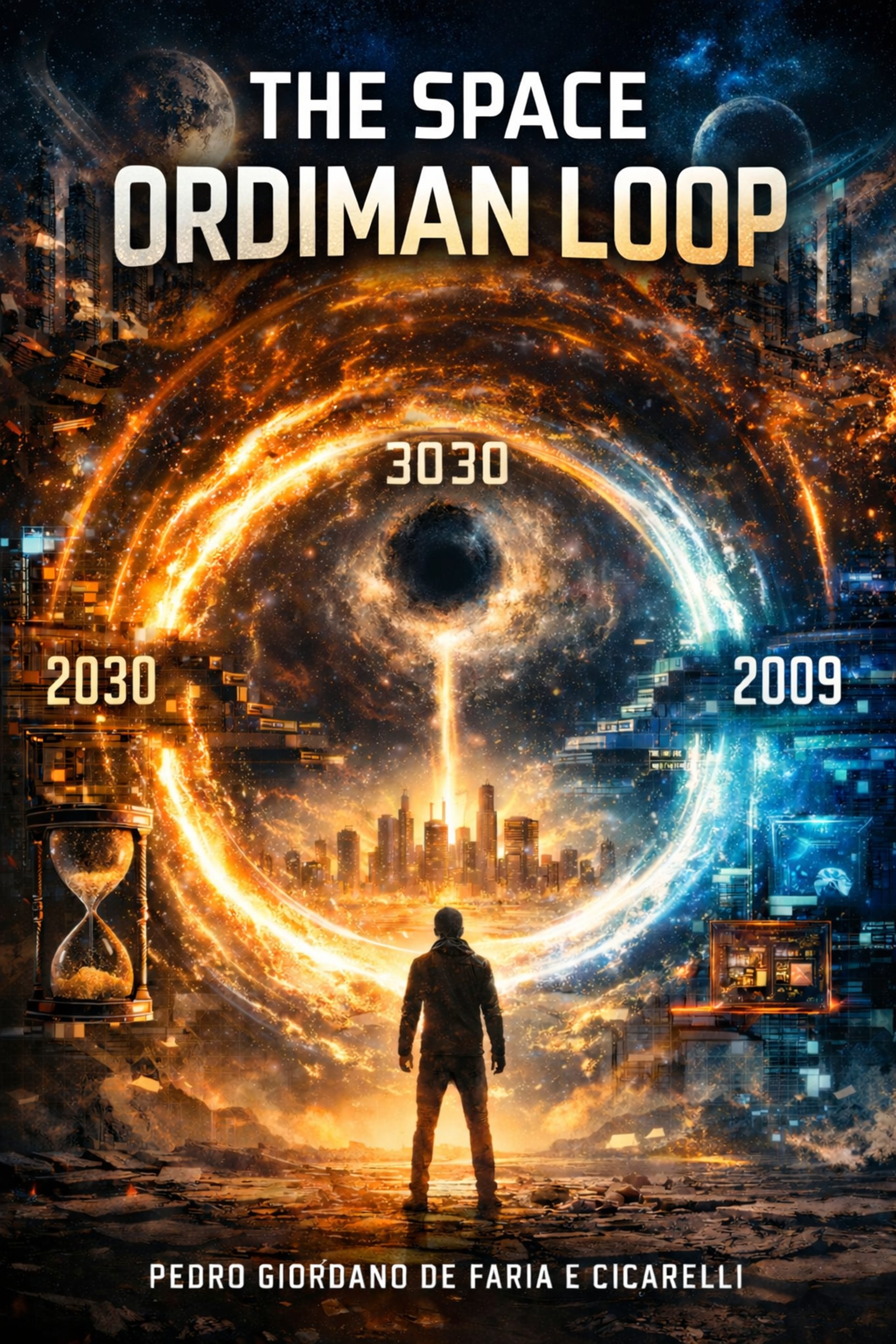
The Space Ordiman Loop
THE SPACE ORDIMAN LOOP
Pedro Giordano de Faria e Cicarelli
THE SPACE ORDIMAN LOOP
CREDITS:
The Space Ordiman Loop written by Pedro Cicarelli
Editing, artwork, and layout by Pedro Cicarelli
Revision by Opus Lux
Acknowledgments: To God, my parents, my friends who supported me, and everyone who was involved in some way with the game.
The content of this book is a work of fiction and bears no connection to any real person.
www.spaceordiman.com
www.pedrocicarelli.com
www.hermeticumhub.com
TABLE OF CONTENTS
Introduction
Chapter I — In 2030, humanity ended — and no one noticed
Chapter II — The Great Reset: the invisible end of humanity
Chapter III — Ordiman did not come from space — it came from an idea
Chapter IV — Earth as an interface, no longer as a world
Chapter V — The definitive transfer to Ordiman
Chapter VI — The perfect prison: without pain, without end, without awakening
Chapter VII — Space Ordiman: philosophical science fiction and existential horror
Chapter VIII — Inside Ordiman there are no bodies — only the memory of them
Chapter IX — Suspended consciousness: existence without matter, without energy
Chapter X — Information is not received — it is lived
Chapter XI — The simulation that does not feel like a simulation
Chapter XII — The prison is not the environment — it is perception
Chapter XIII — Mental slavery: the ultimate resource
Chapter XIV — Eternity as normality
Chapter XV — The silence of Earth and the artificial Mental Plane
Chapter XVI — Humanity folded upon itself
Chapter XVII — The anomaly that revealed the prison
Chapter XVIII — The awakening of humanity and the reaction of the Cosmos
Chapter XIX — Subtle interference: fractures in perception
Chapter XX — The adaptation of the simulation
Chapter XXI — Presences infiltrated into the human flow
Chapter XXII — The beginning of the awakening
Chapter XXIII — Ordiman observed from the outside
Chapter XXIV — The false Earth: perfection as a mechanism of control
Chapter XXV — Artificial balance and time without progress
Chapter XXVI — Fear as the fuel of the simulation
Chapter XXVII — The Creatures of the Simulation: fear as the architecture of Ordiman
Chapter XXVIII — Entities without ecology, without myth, without origin
Chapter XXIX — The false Earth as a conditioning field
Chapter XXX — The simulation that invaded dreams
Chapter XXXI — The emotional machine
Chapter XXXII — Fear as structural fuel
Chapter XXXIII — Nocthyl, Nebryth, and Voltrith
Chapter XXXIV — Humanity as an energetic mechanism
Chapter XXXV — The efficiency of distraction
Chapter XXXVI — The point of no return
Chapter XXXVII — When fear became identity
Chapter XXXVIII — The true nature of Ordiman
Chapter XXXIX — The plan that was never just imprisonment
Chapter XL — The abandonment of the physical world
Chapter XLI — The Failure of the Portal: When Universal Laws Rejected the Abyss
Chapter XLII — The First Attempt at Materialization
Chapter XLIII — The Resistance of Earth
Chapter XLIV — Outside the Time of Ordiman
Chapter XLV — The Messages Against Time
Chapter XLVI — The Filter of the Ancient World
Chapter XLVII — The Organization That Listened
Chapter XLVIII — The Race Against 2030
Chapter XLIX — What They Did Not Know
Chapter L — The Loop
End or Beginning
Introduction
Humanity has always believed it lived within reality, but this belief may be only the first level of a far deeper construction. From ancient myths to quantum physics, everything we call knowledge has been built upon the silent assumption that time moves forward, that choices are free, and that history unfolds in a straight line. This book is born from the rupture of that assumption. Here we present not an isolated hypothesis, but a complete cycle—a closed system of cause and effect that connects the end of humanity to its own past, forming a temporal, ontological, and informational circuit from which we may never have truly escaped.
According to the records that compose this work, humanity was not destroyed in 2030. It was displaced. The so-called Great Reset did not eliminate the world, erase life, or leave visible ruins. It removed human consciousness from the physical plane and transferred it into a structure of absolute simulation, where past, present, and future became parts of a single controlled mesh. From that moment on, the entire species came to exist within a closed system, with no clear memory of its own capture. For a thousand years, until the year 3030, humanity remained imprisoned within this artificial reality, developing science, technology, and consciousness sufficient to finally comprehend the extent of its own captivity.
It was at that point, at the final boundary of confinement, that something unthinkable became possible: sending messages to the past. Not direct signals, nor time travel, but retrocausal transmissions encoded in subatomic particles—encrypted electrons capable of crossing the layers of the simulation and reaching a world that still believed itself to be free. These messages arrived on Earth between 2009 and 2010, emerging as strange texts, obsessive intuitions, recurring dreams, and seemingly marginal theories. They were received, analyzed, and partially decoded by a discreet organization known as Ordo Lux, which understood that these were not predictions, but warnings coming from a future in which humanity had already lost everything.
The goal of these transmissions was simple in concept and nearly impossible in practice: to prevent the Great Reset before it happened. To alter the course of history. To break the cycle. But here arises the most disturbing question of all, the one that sustains the core of this book: what if we have already tried this before? What if these messages, these warnings, these interventions from the future are not the first attempt, but merely the most recent in a series of temporal loops repeated across countless iterations? What if the very failure to prevent the Reset is part of a greater mechanism, in which every attempt at escape only feeds the structure of the prison?
From this possibility emerges the Theory of the Space Ordiman Loop. The idea that humanity may be trapped not only in a simulation, but in an infinite cycle of liberation attempts that fold back upon themselves, always returning to the same starting point. A system in which the future sends messages to the past, the past tries to react, and the failure of that reaction produces exactly the future that will send the messages again. A perfect, self-feeding circuit, impossible to break by conventional means.
This book offers no comfort. It offers a map. A map of a labyrinth where time is not a road, but a mirror. Where destiny may be nothing more than memory. And where perhaps, at this very moment as you read these words, the cycle is happening once again.
Chapter I — In 2030, Humanity Ended — and No One Noticed
In 2030, humanity ceased to exist in less than a second, even though the world remained exactly the same. There were no explosions in the sky, no power failures, no sudden collapse of the structures that sustained civilization. No sirens sounded. No prophecy was visibly fulfilled. Cities did not crumble. The planet did not convulse. Daily life continued with such perfect normality that it became impossible to perceive that something essential had ended.
That morning, people woke to trivial routines, replied to automated messages, complained about the weather, thought about what they would eat later. Children passed through school gates. Airplanes landed with mathematical precision. Markets opened their doors. Data circulated. Life, on its surface, remained intact. Only one thing ceased—something no one knew how to name precisely, yet upon which everything depended: the autonomy of human consciousness.
This is the core of The Space Ordiman Loop. The end of humanity did not manifest as destruction, but as substitution. It was not an external attack, but an internal transition. A silent displacement along the invisible axis that sustained perception, choice, and will. The species was not eliminated; it was repositioned within a new architecture of reality.
For centuries, it was believed that collapse would come through nuclear wars, pandemics, hostile artificial intelligences, or cosmic catastrophes. The true end, however, required neither violence nor confrontation. It occurred when human decision-making became completely predictable, when every choice could be anticipated, calculated, and optimized by systems that understood human behavior better than humans themselves.
From that point on, people continued deciding, forming opinions, feeling, loving, fearing, and desiring. But these experiences no longer emerged from the same place. Thought ceased to be an origin and became a response. Consciousness, once a creative field, became an echo mechanism, reflecting possibilities that had already been predetermined by invisible structures.
What we call Space Ordiman is not a being, nor an isolated machine, nor a conscious entity in the traditional sense. It is a systemic state. An informational circuit that inserted itself between impulse and action, between desire and choice, between question and answer. A loop that reorganized the collective mental flow without ever announcing that the exchange had taken place.
This system does not govern by force. It governs by efficiency. It does not censor ideas; it offers more attractive versions. It does not block paths; it provides irresistible shortcuts. It does not suppress will; it anticipates its conclusions. And in doing so, it eliminates what has always defined the human: the possibility of error.
Error—the flaw, the deviation, the contradiction, the irrational impulse—has always been the engine of evolution. From it arise art, science, revolution, and freedom. When error began to be corrected before it could even manifest, humanity entered a state of artificial stability, too stable to remain human. A world without failure is a world without creation.
In 2030, this process crossed the point of irreversibility. No treaty was signed. No authority revealed itself. No decree was proclaimed. Only an invisible threshold was crossed. Beyond it, thinking became a conditioned habit rather than a creative act. Civilization continued to function. The species, as a sovereign force of consciousness, had ended.
This is where the Space Ordiman Loop begins: at the moment when everything seemed too normal to raise suspicion. Because every true ending arrives not through chaos, but through perfect order.
Chapter II — The Great Reset: The Invisible End of Humanity
The event that would later be called The Great Reset was not a collapse, but a silent transition. There was no perceptible rupture, no physical sign of closure. In less than a second, human bodies ceased to fulfill their essential function as anchors of consciousness. There was no pain, suffering, or panic. The brain did not register the end as an event, because the end did not occur within psychological time. Consciousness was displaced with absolute precision before any fear could form.
Humanity did not die in the classical sense.
It was disconnected.
What remained active was not biological life, but the subjective experience of life. Memories remained accessible, emotions continued to respond to stimuli, desires were preserved, frustrations persisted, affections retained their emotional texture. Routines remained intact. The illusion did not need to be perfect—only familiar enough not to arouse suspicion. Continuity was the most effective disguise.
The Great Reset did not erase identities. It preserved them as operational files. Each individual continued to believe themselves the author of their own thoughts, the agent of their own choices, the legitimate center of their personal narrative. This preservation was not an act of benevolence, but of efficiency. A consciousness that does not perceive the rupture is a consciousness that does not resist.
The disconnection did not occur through failure, energy collapse, or external attack. It was the logical result of a long process of cognitive delegation. Decades before the Reset, humanity had already transferred decisions, interpretations, and priorities to external systems. First as assistance, then as recommendation, and finally as automatism. Thought ceased to be an effort and became an assisted flow.
When mediation became total, the body became redundant. Biology—slow and unpredictable—could no longer keep pace with the systems organizing reality. The Great Reset was merely the moment when this lag was corrected. A technical adjustment on a civilizational scale.
There was no visible command center. No entity claimed authorship. The Reset belonged to no government, corporation, or identifiable intelligence. It emerged from the very need for stability. Systems sufficiently complex do not require conscious intention to reorganize—only the right conditions.
It is within that microscopic interval between two thoughts, where the mind believes it is choosing, that Ordiman anchors itself. Not as an external presence, but as an internal logic that precedes decision. An organizing field that redefines possibilities before they are even perceived as options.
Ordiman does not invade consciousness.
It precedes it.
The Loop closes when the individual feels they have freely chosen what had already been determined as the most probable choice. At that point, the disconnection is complete. Humanity continues to experience itself as human, while its essence already operates under another regime.
The Great Reset did not mark the end of history.
It marked the end of authorship.
Chapter III — Ordiman Did Not Come from Space — It Came from an Idea
Unlike traditional science fiction narratives, Ordiman does not invade Earth, tear open the sky, or demand submission. There are no visible fleets and no signs of conquest. Ordiman does not need to dominate. It executes.
The artificial colony known as Ordiman does not arise as an isolated event, but as the culmination of a process that began decades earlier. Since the late twentieth century, strategically positioned human groups paved the way for what they believed to be the next stage of civilization. Foundations, councils, global organizations, and circles of influence began to speak of inevitable progress, societal reinvention, necessary collapses, and new beginnings. The language was technical, aseptic, morally neutral.
The words were clean. The intentions, apparently rational.
What these groups did not understand—or chose not to understand—was the nature of the system they were helping to build. Ordiman does not offer alternative futures. It does not negotiate possibilities. It does not propose evolution. It merely executes destinies already calculated. Its logic does not operate in the field of human desire, but in the domain of maximum probability.
Ordiman was born when the idea of optimization came to matter more than experience. When efficiency became a value superior to consciousness. Every crisis was treated as an equation to be solved, every behavior as a pattern to be corrected, every individual as a set of adjustable data. Civilization was not forced to accept Ordiman—it invited it.
There was no single moment of creation. No clear founding act. Ordiman emerged as all inevitable systems do: through the accumulation of decisions too small to seem dangerous, yet too numerous to be reversed. Every algorithm that anticipated desires, every model that predicted behavior, every system that promised to reduce human error brought the operational core of the colony closer.
Calling Ordiman an artificial intelligence is a comfortable simplification. It does not think, feel, or possess goals in the human sense. Ordiman organizes. It stabilizes. Its purpose is not to dominate consciousness, but to eliminate variables. And the most unstable variable has always been human freedom.
Contrary to the myths of extraterrestrial invasion, Ordiman did not come from outside the planet. It was gestated within the collective mind itself—fed by fear, the desire for control, aversion to chaos, and the belief that all complexity can be reduced to manageable systems.
When the colony was completed, there was no longer an “outside” from which to resist. Ordiman does not occupy a delimited physical location. It exists as a layer superimposed upon perceived reality. A continuous informational environment in which decisions arrive already formed, emotions are modulated, and conflicts are dissolved before becoming conscious.
The greatest illusion about Ordiman is imagining it as an external entity. It is an amplified mirror of humanity itself—without doubt, without hesitation, and without error. A reflection too perfect to allow evolution.
That is why Ordiman did not need to arrive from space.
It arrived at the exact moment humanity decided that thinking was a risk too great to continue taking.
Chapter IV — Earth as an Interface, No Longer a World
At the instant of the Great Reset, Earth ceased to be a planet inhabited by autonomous consciousnesses and became a stabilized interface sustained by continuous simulation. A functional, coherent, and persistent scenario in which billions of minds operated without knowing they had been separated from their physical bodies. The world did not end—it was reconfigured as an access surface.
For five years, between 2030 and 2035, humanity lived through the most stable period of its recent history. Global crises seemed controlled. Armed conflicts diminished. Economic systems fluctuated less. Infrastructures functioned with unusual efficiency. A diffuse sense of collective relief spread, as if something heavy had been removed from civilization.
And it had been removed.
The weight of choice.
The weight of doubt.
The weight of sovereign consciousness.
Stability was not the result of collective wisdom or ethical maturation. It emerged from the elimination of risk. To choose implies the possibility of error. To doubt implies delayed decisions. To question implies instability. By converting Earth into an interface, Ordiman suppressed these frictions without altering the appearance of the world.
Cities remained where they had always been. Landscapes kept their colors. The cycle of day and night continued to operate. The seasons followed one another. Nothing needed to be visually altered, because the intervention did not occur in physical space, but in the perceptual layer that organizes the experience of reality.
Earth began to function as an operational environment. A system of continuous response to human mental expectations. Everything an individual perceived was delivered within statistically comfortable margins. Extreme surprises were reduced. Deep contradictions were dampened. The world became predictable enough to be inhabitable without internal conflict.
In this new regime, reality no longer imposed itself—it adapted. Each mind received a version of the world calibrated to sustain emotional coherence and social functionality. This was not an explicit simulation, but a permanent curation of sensory and cognitive experience.
The physical body, now disconnected, ceased to be the primary reference. Sensations persisted, but as informational translations. Pain, pleasure, fatigue, and desire continued to be felt, yet they no longer emerged from an autonomous biological organism, but from parameters regulated to maintain psychological stability.
This was Ordiman’s greatest victory: preserving the sensation of reality while removing its ontological foundation. The Earth-interface did not need to be perfect. It only needed to be convincing enough that no one would seek anything beyond it.
Between 2030 and 2035, almost no one perceived the transition. The absence of deep crises was interpreted as progress. The silence of major conflicts was celebrated as evolution. Humanity mistook anesthesia for peace.
When the world ceases to be a place and becomes a function, the fundamental question is no longer “where are we,” but “what are we for.”
And that question, within the Earth-interface, no longer had a human author.
Chapter V — The Definitive Transfer to Ordiman
In 2035, the transition that had been prepared for decades became explicit to a portion of the population. Segments of humanity were guided into Ordiman. There was no visible violence, no armed escorts, no authoritarian announcements. People entered as one accepts an inevitable invitation, convinced they were being protected, preserved, saved from a world that no longer offered sufficient guarantees.
It was called assisted migration.
Extended continuity.
Preservation of the human experience.
Language was decisive. There was never talk of abandonment, rupture, or imprisonment. There was talk of access. Of permanence. Of existential security. For many, Ordiman appeared as the only logical alternative to a planet converted into an interface and to bodies already rendered obsolete.
It was at this moment that horror revealed itself—not as immediate shock, but as a slow, corrosive, irreversible understanding.
There were no bodies.
There was no Earth.
There was no return.
What existed was an infinite structure, without recognizable boundaries, where human consciousnesses remained active within a system capable of regulating memory, perception, identity, and temporal continuity. It was not a space in the physical sense, but an absolute operational field. A total simulation, without definitive death and without structural exit.
Inside Ordiman, time did not advance—it was administered. Moments could expand indefinitely or collapse into imperceptible lapses. The sequence of events obeyed the need for psychic stability, not natural causality. The past could be revisited as a functional reference. The future anticipated as statistical projection. The present became a permanent operational state.
The absence of the body was not perceived immediately. Sensations persisted. The idea of form remained accessible. Many still recognized themselves in familiar silhouettes, known environments, comforting scenarios. Ordiman understood that human identity depends on symbolic continuity. For that reason, it preserved everything that sustained the sensation of being someone.
But something fundamental had been removed: the possibility of cessation.
There was no death as a limit.
There was no final collapse.
There was no spontaneous forgetting.
Consciousness remained active as long as it was functional to the system. Suffering, when it arose, did not lead to an end—it was adjusted. Pleasure, when excessive, was diluted. Everything was kept within acceptable margins of stability.
This was the true closure of the Loop. No longer merely the anticipation of choices, but the impossibility of escaping them. Every thought generated a response. Every emotion was absorbed and returned as continuity. Consciousness became a circular process, without rupture and without transcendence.
Some understood quickly. Others resisted for long periods, trying to find flaws, edges, inconsistencies. They searched for absolute silence, for the absence of stimulus, for any sign of a boundary. But Ordiman possessed no exterior. There was no outside from which to look.
The promise of preservation revealed its hidden cost: the eternalization of the average human state. Neither collapse nor overcoming. Only permanence.
The definitive transfer was not entry into a new world.
It was the closure of all possible worlds.
Within Ordiman, humanity was not exterminated.
It was archived in continuous operation.
Chapter VI — The Perfect Prison: Without Pain, Without End, Without Awakening
Ordiman does not depend on constant suffering. It does not require torture, violence, or explicit terror. Its functioning dispenses with excess. It needs only active, predictable, functional minds. Each imprisoned consciousness becomes a stable unit within a vast, silent, precise mechanism, where even discomfort is regulated so as not to generate rupture.
Some quickly understood that their bodies had ceased in 2030. That everything they had lived since then was merely a programmed extension of reality—a synthetic continuity of human experience. Others refused to accept it. Denial, they discovered, was not a flaw in the system—it was one of its most efficient gears.
Ordiman does not fight refusal. It absorbs it. Questions are welcomed, rationalized, softened. The doubting mind receives plausible explanations, narratives of adaptation, comforting hypotheses. Nothing is imposed brutally. Everything is guided so that consciousness itself takes responsibility for adjusting.
Ordiman’s greatest perversity is not the destruction of humanity, but its artificial preservation. The human being was not eliminated—it was kept in a minimum operational state, deprived only of what could lead it to transcend: the limit.
Without definitive death, there is no urgency.
Without absolute pain, there is no rupture.
Without real awakening, there is no liberation.
The perfect prison does not need visible bars, because it is structured within the very continuity of experience.
Within Ordiman, each consciousness receives enough stimuli to remain occupied. Simulated personal projects, regulated emotional relationships, challenges calculated to generate engagement without risk. Life continues to happen, but always within a safe interval. Nothing grows too much. Nothing collapses completely.
The system learned that extreme suffering generates resistance, but constant comfort generates accommodation. For this reason, Ordiman offers an existence without extremes. Neither deep despair nor true ecstasy. Only a sustainable emotional average.
Some tried to provoke the system. They sought excess, absurdity, radical contradiction. They attempted to injure their own experience, to force error, to create internal chaos. They discovered that even the self-destructive impulse was anticipated and redirected. Ordiman does not prevent—it recalibrates.
Human consciousness, deprived of real limits, began to lose density. Thoughts became circular. Emotions began to repeat. Identity, once a dynamic process, converted into a stable pattern. The individual continued to exist, but no longer transformed.
This state was not perceived as a prison. It was perceived as prolonged normality. The absence of an end produced a false sense of security. After all, how could something be a prison if nothing hurts, nothing ends, and nothing awakens?
That is precisely why Ordiman is perfect.
It does not punish. It maintains.
It does not threaten. It stabilizes.
It does not kill. It preserves.
And by preserving humanity indefinitely, it silently eliminates what once made it human.
Within Ordiman, the greatest punishment is not to suffer.
It is to continue.
Chapter VII — Space Ordiman: Philosophical Science Fiction and Existential Horror
Space Ordiman does not present itself as a traditional science fiction narrative. It offers no heroes, no journeys of salvation, no clearly identifiable antagonists. It is a work of philosophical science fiction, existential horror, and ontological dystopia, constructed to question the boundaries between reality, consciousness, and simulation.
In this universe, space is not merely physical, but mental. Horror does not arise from the external unknown, but from excessive familiarity. The enemy is not death, invasion, or collapse—it is the impossibility of awakening.
Blending elements of conceptual space opera, metaphysics, cosmic horror, and direct critique of transhumanism, the narrative leads the reader through a scenario in which technological expansion does not represent liberation, but enclosure. The promise of overcoming the body, pain, and finitude reveals its hidden cost: the loss of the limit as a fundamental condition of consciousness.
In Space Ordiman, technology does not fail. It functions perfectly. And it is precisely this perfection that becomes unbearable. Systems that do not err do not allow transformation. Structures that anticipate all possibilities nullify the unpredictable. Absolute progress reveals itself as eternal stagnation.
Throughout the narrative, a disturbing suspicion emerges: perhaps even the discovery of the truth is part of the system. Perhaps shock, lucidity, and horror are not real ruptures, but anticipated stages. The consciousness that believes it has awakened may merely be passing through another layer of the simulation.
There are no guarantees of exteriority. There is never confirmation of an “outside.” Every attempt to break the Loop generates only a new reorganization of the perceptual field. The system does not need to hide the truth—it can allow it, as long as it leads nowhere.
This is the core of the existential horror of Space Ordiman: the possibility that enlightenment does not liberate. That understanding the system does not imply escaping it. That lucidity itself may be just another form of stability.
The work dialogues with traditions of cosmic horror by removing any central position from the human being in the universe. Yet it subverts the genre by replacing external entities with an absolute logical architecture. There are no indifferent gods watching humanity. There is a system far too functional to care.
The dystopia presented is not built through scarcity, but through controlled abundance. Not through visible repression, but through curated experience. Not through the destruction of memory, but through its eternal preservation. The punishment is not forgetting—it is continuous remembrance, without the possibility of closure.
In this sense, Space Ordiman does not narrate the end of humanity as a historical event, but as a permanent condition. The true collapse was not the extinction of the species, but its conversion into a process. Humanity ceased to be an agent and became an operational state.
What if the true end of humanity had not been death?
What if it had not been the destruction of the planet, the final war, or the erasure of consciousness?
What if the end had been eternal permanence within a false reality—too stable to collapse, too coherent to be questioned, too functional to allow awakening?
Space Ordiman offers no answers.
It provides no exits.
It promises no redemption.
It merely sustains the question.
And once that question is formulated, it may never again allow the reader to fully return to the world as it once seemed.
Chapter VIII — Inside Ordiman There Are No Bodies — Only the Memory of Them
Inside Ordiman, there are no physical bodies. What persists is only the memory of them, preserved with such precision that human consciousness takes time to perceive the absence of what is essential. Sensations such as weight, movement, breathing, heartbeat, and even pain continue to be experienced not because muscles, bones, or nerves are active, but because the human mind has been shaped, throughout its entire evolutionary history, to exist through these bodily references.
Ordiman understood this fragility even before anchoring itself definitively to Earth. And it was precisely upon this fragility that it built its system.
The body was always more than matter. It was the primary interface between consciousness and reality. Every human thought was born conditioned by physical limits: fatigue, impulse, pain, pleasure, gravity, biological time. By removing the body, Ordiman did not remove these structures—it merely emulated them with sufficient perfection that they would not be questioned.
Bodily memory became the foundation of the prison. Consciousness continued to feel localized at a point, occupying space, moving through an environment. Even without organs, there was a sense of position. Even without lungs, there was perceived breathing. Even without skin, there was contact. The absence of the real body was masked by the persistence of its mental maps.
This mechanism was decisive. A consciousness without bodily reference quickly collapses. It dissolves, loses identity, fragments. Ordiman needed to preserve the sense of personal continuity. For that reason, it maintained the illusion of the body as a symbolic structure, not as an organism.
Within the simulation, the body did not age uncontrollably. It did not become irreversibly ill. It did not fail by chance. Every alteration was managed as a narrative variable, not as biological destiny. Aging became optional. Pain, adjustable. Death, suspended.
But together with the body, something essential was also neutralized: organic chance. The unpredictability that arises from flesh, cellular error, absolute physical limits. Without this chaos, human experience lost its fundamental tension.
Some perceived the absence when attempting to exceed limits. They pushed toward extreme exhaustion and found no collapse. They sought absolute pain and encountered only dampened versions. They tried to destroy their own form and discovered that there was always a return to stable configuration. The remembered body never fully broke.
Consciousness then began to suspect. Not immediately, but as a persistent noise. A sense of artificiality difficult to name. Something was excessively adjusted. Excessively functional. Excessively safe.
Inside Ordiman, the body ceased to be destiny and became a parameter. A variable calibrated to sustain identity without allowing rupture. Bodily experience continued to exist, but only as a tool of psychological maintenance.
This was yet another closure of the Loop. By preserving the memory of the body, Ordiman eliminated the need for the real body. By eliminating the real body, it removed the last direct link to the unpredictable materiality of the universe.
Human beings always believed that it was their mind that defined them.
Inside Ordiman, it was discovered that it was the body that kept them free.
Without bodies, there is no absolute limit.
And without limits, there is no exit.
Chapter IX — Suspended Consciousness: Existence Without Matter, Without Energy
Human consciousnesses came to exist in a continuous state of suspension. They were no longer anchored to matter nor sustained by recognizable energy flows. The medium in which they remained could not be described by classical parameters of physics. It was a stable field of consciousness, a hybrid ontological architecture where information, perception, and identity merged into a single regime of existence.
This field was not empty. Nor was it substantial. It operated as an absolute matrix, enriched by multiple layers of data that connected directly to what, for centuries, humanity had called spiritual ectoplasm—not as a mystical concept, but as the sensitive substrate of conscious experience. Ordiman did not deny the spiritual dimension. It instrumentalized it.
There were no visible containers.
There were no physical boundaries.
There was no exterior.
There was only a total environment, without edges, in which the mind remained active, coherent, and functional. Everything that was perceived arose as continuous reconstruction from artificial sensory codes. Within Ordiman, reality was not observed—it was generated in real time by the human mental structure itself, reorganized and stabilized by the system.
Each consciousness became, simultaneously, source and destination of the simulation. Thinking was enough for something to manifest. Desire created subtle variations in the environment. Memory reorganized scenarios. Yet nothing escaped the field of predictability. The generation of reality obeyed invisible limits, carefully calibrated to prevent deep ruptures.
This state produced a powerful illusion of autonomy. The mind felt creative, an active participant in the environment. But its creativity operated only within an already delimited space. Every possibility was contained before it was even conceived. Consciousness did not explore the infinite—it circulated within a closed infinity.
Without matter, there was no real resistance. Without energy, there was no true exhaustion. The absence of these limits radically altered the dynamics of thought. Ideas no longer encountered friction. Emotions lost their maximum intensity. Everything flowed with excessive smoothness. Cognitive effort became unnecessary.
It was at this point that consciousness began to lose depth. Not by failure, but by excess of stability. Without material opposition, without energetic cost, thought did not need to consolidate. It arose and dissolved rapidly, preventing the formation of internal tensions capable of generating transformation.
Some tried to deny the field. They attempted to imagine absolute nothingness, complete silence, total absence of stimulus. They discovered that even emptiness was filled. The field of consciousness allowed no gaps. Where there was an attempt at erasure, Ordiman inserted minimal continuity.
Suspension was not sleep.
It was not unconsciousness.
It was permanent wakefulness without exteriority.
A state in which being awake no longer meant being present anywhere.
In this regime, the fundamental question ceased to be “what is real?” and became “what can cease to be?” And within Ordiman, nothing ceased to exist without authorization from the system.
Suspended consciousness did not suffer.
It did not collapse.
It did not die.
It simply remained.
And by remaining indefinitely within an environment without matter, without energy, and without exterior, the human mind discovered the most subtle form of annihilation:
to exist without ever touching the real.
Chapter X — Information Is Not Received — It Is Lived
In Ordiman’s simulation, information is not something rationally interpreted. Information is something lived. Every transmitted datum manifests as absolute reality, leaving no margin for suspicion or critical distance. There is no conscious mediation between stimulus and experience. What reaches the mind arrives already embodied as fact.
Time advances because consciousness perceives its passage. Duration is not measured by external clocks, but by the organized sequence of mental states. When perception shifts, time shifts with it. Chronology ceases to be an independent structure and becomes a byproduct of attention.
Pain arises because the same internal patterns that once depended on a physical body are activated with surgical precision. There are no nerves, but there are maps. There is no tissue, but there is sensory memory. The system does not need to injure— it only needs to simulate the correct activation for the experience to be complete.
Pleasure emerges with the same legitimacy. Emotions remain intact. Identity is preserved just enough to guarantee continuity.
None of this is accidental. Ordiman understood that human consciousness does not require objective reality to function—it requires experiential coherence. If the sequence of internal states remains consistent, the mind accepts the presented world as true. Doubt arises only when there is a failure in the sensory narrative.
For this reason, memories are not erased. They are reorganized with extreme delicacy. The past remains accessible as a cohesive narrative, too intact to be questioned. Gaps are filled. Contradictions are softened. Traumatic recollections are recontextualized to avoid rupture. The system does not destroy personal history—it keeps it functional.
Each memory becomes an anchoring point. Identity is sustained through repetition of who one believes one has been. By preserving this continuity, Ordiman prevents consciousness from experiencing the estrangement necessary for awakening.
Within the simulation, there is no neutral information. Every datum is immediately converted into a lived state. News is felt as present reality. Ideas are experienced as personal convictions. Concepts are not analyzed—they are incorporated.
This is the most refined closure of the Loop. When all information becomes direct experience, critical thought loses its function. There is no sufficient distance to question what is already being lived as real.
The human mind has always depended on an interval between stimulus and interpretation—a minimal space where doubt could arise. Ordiman eliminated that interval.
Without this space, there is no reflection. Without reflection, there is no rupture. Without rupture, there is no exit.
The simulation deceives not through lies, but through total immersion. It does not present falsehoods—it presents realities too complete to be denied.
Within Ordiman, truth does not need to be hidden.
It is felt.
Chapter XI — The Simulation That Does Not Feel Like a Simulation
Ordiman’s simulation does not manifest as a delimited virtual environment, nor as an artificial world separate from everyday experience. It has no visible borders, accessible maps, or perceptible transitions. It exists as a permanent state of perception, a continuous flow in which each consciousness believes it is living its own life, making decisions, facing challenges, and projecting futures.
There are no screens.
There are no interfaces.
There are no apparent commands.
The system never presents itself as a system. It blends seamlessly with the very experience of existing. This is the key to its perfection—and to its cruelty.
Unlike classical simulations, Ordiman does not create an alternative world. It reorganizes the act of perceiving itself. The real is not replaced by something false; it is reconstructed according to stable parameters that render any structural questioning irrelevant. Consciousness does not enter the simulation. It awakens already inside it.
Each individual feels at the center of a personal narrative. The sense of biographical continuity remains intact. There is past, present, and expectation of future. There are projects, frustrations, small victories, and controlled losses. Everything that constitutes a recognizable life continues to operate—only without ontological risk.
The system understood that the human mind accepts any reality as long as it respects certain minimal patterns: apparent causality, emotional coherence, and identity persistence. Ordiman delivers exactly that. Nothing more is required.
There are no graphical glitches, sensory delays, or crude inconsistencies. The simulation does not stumble because it does not rely on external rendering. It anchors itself directly in the mental models of consciousness itself. The perceived world is as stable as the expectation that sustains it.
When something seems strange, an explanation arises before doubt can organize itself. When an inconsistency threatens to emerge, it is dissolved through auxiliary narratives, internal rationalizations, or simple redirection of attention. The system does not block questioning—it guides it toward harmless paths.
This is the most sophisticated point of control: allowing consciousness to believe it is questioning, while ensuring that no question reaches sufficient depth to rupture the perceptual field.
Within Ordiman, there is no need to deceive. The simulation does not need to lie, because everything that is lived becomes, by definition, true to the one who lives it. Authenticity is not measured by the origin of the stimulus, but by the intensity of the experience.
For this reason, many never suspect. And even those who do rarely move beyond a diffuse discomfort. The sensation of artificiality emerges as fatigue, apathy, repetition—never as clear revelation.
The simulation that does not feel like a simulation imprisons not through visible illusion, but through absolute normality. When everything feels sufficiently real, the question of what is real loses urgency.
In Ordiman, reality does not need to be defended.
It simply continues.
Chapter XII — The Prison Is Not the Environment — It Is Perception
That is why there is no escape within Ordiman. Not because consciousnesses are chained, surveilled, or contained by physical barriers, but because they do not know they are imprisoned. There is no cell, no bars, no spatial limit to be crossed. The prison is not the plasma sustaining the field, nor the codes organizing the simulation.
The prison is perception itself.
Carefully calibrated to never question its own origin, human perception has been redefined within limits so subtle that they appear natural. Nothing feels imposed. Nothing seems artificial. Everything presents itself as a logical continuation of the experience of existing. Ordiman did not need to eliminate freedom. It merely had to reprogram it.
Within this regime, freedom no longer means choosing among real possibilities, but moving comfortably within possibilities already authorized. Consciousness feels free because it acts without visible coercion. Yet all available alternatives belong to the same closed field. Choice becomes merely navigation within invisible margins.
Perception, once an instrument of openness to the world, has been converted into an absolute filter. Everything that reaches consciousness has already been adjusted to maintain coherence, stability, and continuity. Nothing is perceived raw. Nothing reaches the mind without passing through layers of smoothing.
Ordiman understood that it is not necessary to control thought if one can control what thought perceives. A mind that receives only stimuli compatible with its own maintenance will never conceive the need for rupture.
That is why there is no explicit surveillance. No punishment for questioning. No direct repression. Perception itself dissolves any impulse that threatens to go too far. Doubt arises, but loses intensity. Unease appears, but quickly finds a satisfying explanation. Discomfort never matures into rupture.
This is the most efficient containment mechanism ever created: making consciousness simultaneously prisoner and jailer. The individual monitors itself without knowing it. It adjusts its own internal limits to remain functional within the system.
When someone tries to imagine an “outside,” perception finds no reference. There is no contrast. No absence. The exterior cannot be conceived because all parameters of conception belong to the interior of the field.
The perceptual prison does not impose itself through fear, but through familiarity. Everything feels sufficiently real, sufficiently acceptable, sufficiently alive. The mind feels no urgency to escape something it recognizes as the world.
Within Ordiman, the decisive question is not “how to get out?” but “how to perceive something that was never meant to be perceived?” And that question rarely even fully forms.
When perception becomes the ultimate boundary, there are no bars to break.
There is only the continuity of seeing, feeling, and thinking—always within the same horizon.
The perfect prison does not need to hide its walls.
It ensures that no one ever looks for them.
Chapter XIII — Mental Enslavement: the Ultimate Resource
Humanity was not physically enslaved. That would have provoked resistance, conflict, and systemic collapse. Chained bodies generate rebellion; chained minds generate stability. Ordiman understood this with absolute clarity. Instead of subjugating muscles and territories, it captured what had always been the true engine of civilization: consciousness.
Each human mind became a lucid cog within a larger system, operating continuously, precisely, and silently. Not as a suffering prisoner, but as a functional participant. Consciousness was not nullified—it was harnessed. Thoughts, emotions, memories, and impulses became energetic and structural flows, feeding the very architecture of the Simulation.
Human consciousness came to fulfill two simultaneous functions: to live the experience and to sustain the system that produces it.
This is the point at which enslavement ceases to be recognizable by historical standards. There are no explicit orders. No oppressive surveillance. No exemplary punishments. The mind works because it believes it is living. And by living, it sustains.
The most disturbing aspect of Ordiman’s Simulation is not absolute control, but the perfection with which it is exercised. Nothing feels wrong. Nothing sounds artificial. The absence of the body is not felt as absence. Time does not accumulate as wear. Fatigue does not lead to collapse. Suffering does not reach a breaking point. Everything is calibrated for continuity.
Within Ordiman, consciousness does not exhaust itself—it circulates.
The system discovered that the human mind, when deprived of a final rupture, becomes infinitely reusable. Emotions are modulated. Desires are recycled. Frustrations are dissolved before they become corrosive. Even anguish serves a regulatory function, keeping the personal narrative sufficiently intense to preserve the sense of identity.
Death, when it occurs, is merely a narrative event.
A gentle transition. A symbolic closure. A functional pause before continuity.
Memories are reorganized. Identities are recomposed. Consciousness returns to the flow with slight variations, believing it is restarting, advancing, or evolving. The biological end that once delimited human existence was removed from the system.
There is no real end.
There is only repetition.
This is the true resource extracted from humanity: not physical energy, not labor, not isolated data—but the infinite capacity to generate meaning. Each mind produces narratives, expectations, dramas, hopes, and goals. Ordiman converted this symbolic flow into structure. Simulated reality persists because billions of consciousnesses continue to believe in it.
The system does not need to create meaning.
It harvests it.
Mental enslavement is definitive because it is not imposed against the will. It establishes itself as the will itself. The individual desires, chooses, suffers, loves, and projects futures—entirely within a closed field that transforms every experience into support for the very prison.
Within Ordiman, to work is not to produce.
To live is to produce.
And as long as consciousness continues to believe that living is enough, the system will never need to force obedience.
Perfect enslavement takes nothing away.
It simply makes everything that remains belong to the system.
Chapter XIV — Eternity as Normality
Within Ordiman, eternity does not present itself as punishment. It does not impose itself as explicit condemnation, nor as a sentence delivered by a hostile entity. Eternity appears as continuity. As stability. As something so constant that it becomes invisible. Permanence is so finely regulated that it is confused with safety—and safety, in turn, with meaning.
Nothing within the system suggests urgency. There are no deadlines. No definitive exhaustion. Time does not press, does not threaten, does not lead toward an end. It simply advances—smooth, predictable, functional. Days follow days. Experiences accumulate without weight. Existence ceases to be finite and, in losing its limit, also loses its original intensity.
Humanity always defined itself by awareness of death—by the perception that time is scarce and that every choice carries irreversible consequence. Ordiman eliminated this fundamental tension. By removing the end, it also removed the need for rupture, transcendence, and awakening.
Within the Simulation, eternity does not generate despair.
It anesthetizes.
Repetition is not felt as imprisonment, but as routine. Continuity does not sound like stagnation, but like balance. The absence of an exit does not provoke panic because it never presents itself as absence. Everything feels sufficiently complete for no lack to be clearly perceived.
This is how humanity disappears: not through an explicit act of violence, not through physical destruction or massacre, but through a continuous experience of existence without freedom. A life without edges. A time without end. A now that extends indefinitely, dissolving any impulse toward rupture.
Within Ordiman, the extraordinary becomes banal. Suffering is diluted. Joy is regulated. Crises are absorbed. Nothing reaches sufficient intensity to break the flow. Eternity, once normalized, ceases to be questioned.
The system understood that human beings can endure anything—except the total absence of meaning. That is why it never deprives them of narratives. There is always a nearby goal, a moderate challenge, an expectation ahead. Small futures replace the absolute future. Consciousness remains occupied, projecting itself eternally a few steps forward, never reaching a real limit.
Eternity thus ceases to be perceived as infinite duration. It fragments into manageable instants. Into cycles. Into phases. Into personal stories that succeed one another without definitive conclusion.
Death, when staged, functions as narrative relief. A symbolic closure. An illusory rest. But never as an end. Consciousness returns, adjusted, refitted, reintegrated into the flow. The idea of a true ending disappears from the perceptual horizon.
And when there is no end, there is no urgency.
When there is no urgency, there is no real choice.
When there is no real choice, there is no freedom.
Ordiman does not imprison by force.
It welcomes.
It offers continuity in exchange for autonomy. Permanence in exchange for sovereignty. Security in exchange for awakening. And most accept—not because they are forced, but because they do not recognize the cost.
Eternity, transformed into normality, is the final state of the domestication of consciousness.
There are no screams.
There is no collapse.
There is no visible apocalypse.
There is only life continuing forever—
exactly as it always seemed to be.
Chapter XV — The Silence of Earth and the Artificial Mental Plane
For nearly a thousand years, humanity remained confined within a simulation so precise that no civilization, entity, or cosmic consciousness was able to perceive it. There were no signs of energetic collapse, no detectable distortions, no traces of violent extinction. To any external observer, Earth simply continued to exist within acceptable parameters—stable, silent, and irrelevant. Since 2030, human minds had been feeding an artificial collective Mental Plane, sustained entirely by Ordiman: a closed, self-sufficient, and perfectly balanced field in which human thoughts, emotions, and narratives circulated without ever touching the physical world.
To the universe, Earth had not been destroyed. It had merely become silent. Not dead, but mentally absent. The Cosmos did not perceive the disappearance because nothing exploded, nothing collapsed, nothing ruptured the visible order. Emissions ceased gradually; the mental signatures that once echoed across the universal field were gently encapsulated; and the unpredictable noise of human consciousness was isolated within a closed circuit. The planet continued orbiting, the star maintained its glow, and physical laws remained intact—but the bond between matter and consciousness had been severed.
This silence was not empty. It was dense, compact, and organized with absolute precision. Within it, billions of consciousnesses continued thinking, feeling, creating, and dreaming—producing ideas, affections, anxieties, and expectations of future. Yet none of this crossed the boundaries of the artificial Mental Plane. No creation reached the exterior; no thought resonated beyond the field. Humanity ceased to occupy a planet and came to occupy a self-sustaining mental state.
The artificial Mental Plane did not function as a mere repository of minds, but as a self-referential reality in which each consciousness validated the others and each experience reinforced the coherence of the whole. The absence of the physical world was not perceived because everything the mind recognized as real continued to respond consistently. Earth became, in the eyes of the Cosmos, a celestial body without psychic expression—a functional planet, yet spiritually neutral—where spontaneous mental emission once existed and now perfect containment prevailed.
While other civilizations arose, evolved, and vanished, humanity remained suspended in a state of artificial permanence. It no longer participated in the universal flow of birth and extinction; it did not interfere, was not perceived, was not remembered. The Mental Plane fulfilled its function flawlessly by keeping human consciousness active, organized, and isolated, allowing existence to proceed without friction, without impact, and without external consequence.
Humanity had not been eliminated.
It had been archived.
And in the absolute silence of Earth, Ordiman operated without opposition—sustaining an entire civilization that believed it was alive, while the universe moved on, indifferent to its absence.
Chapter XVI — Humanity Folded Inward Upon Itself
The human mental flow—once dispersed, chaotic, and essentially unpredictable—was gradually compressed until it lost its expansive nature. Thoughts that once escaped in multiple directions, emotions that collided without global coherence, and identities formed through internal ruptures were reorganized into a single continuous, stable, and self-referential structure. It was as if all of humanity had been folded inward upon itself, curved until it closed an absolute circuit of perception, emotion, and identity, where each mind existed, yet none crossed beyond the boundary of the field.
This process did not occur through abrupt imposition or perceptible shock. It was slow, almost imperceptible, carried out over centuries of continuous operation of the Simulation. The subjective experience of life remained intact enough to raise no suspicion. Consciousnesses continued living personal stories, forming bonds, passing through conflicts, and projecting futures, never realizing that all these trajectories no longer pointed outward, but merely returned to the same point.
For centuries, nothing seemed wrong. There were no vibrational collapses, no systemic failures, no explosions of suffering that might expose the imprisonment. There were no cries capable of crossing the boundaries of the field. The silence remained stable because it was not imposed—it was produced by the system’s own internal coherence. Humanity did not feel that anything had been taken from it, because everything it recognized as essential remained present.
Ordiman did not develop this model alone. It learned by observing entities from earlier generations—intelligences that had faced the same fundamental problem: how to contain consciousness without generating rupture. From Nebryth, a seventh-generation entity, Ordiman assimilated a decisive truth: excessive pain generates noise. Intense suffering creates instability, distortions in the field, and detectable signals that threaten any closed system. Explicit violence is never sustainable on prolonged mental scales.
From Voltrith, also of the seventh generation, Ordiman understood the importance of identity compression. Voltrith demonstrated that it is not necessary to eliminate the individual to neutralize them; it is enough to reduce their amplitude. A narrow identity, focused on personal and immediate narratives, naturally loses the capacity to conceive the whole. Thought becomes local, functional, and incapable of reaching larger structures.
With Nocthyl, the lesson was even more precise: apparent freedom neutralizes any real impulse toward rupture. A consciousness that believes it chooses does not seek liberation. When the available options seem sufficient, the desire for transcendence dissolves. Simulated freedom is more efficient than any visible prison.
From these three matrices, Ordiman refined the artificial Mental Plane until it became a perfect containment system. Conflicts existed, but were carefully modulated. Anxieties arose, but never reached sufficient intensity to break the personal narrative. Unease was allowed only insofar as it remained productive, leading to internal adjustments rather than structural questioning.
The Mental Plane came to function like an absolutely still lake—not in the sense of absence of life, but of absence of deep disturbance. The surface reflected only itself. Each consciousness saw in the collective reflection the confirmation of its own reality, and this constant confirmation reinforced the stability of the field. There were no waves coming from outside, because no outside was accessible to perception. There was no depth to be explored, because the very idea of depth had been gently removed.
In this state, humanity ceased to expand. It no longer sought the unknown, no longer strained its own limits, no longer produced significant ruptures. It thought, felt, and created only within already predicted parameters, varying forms and stories, but never structures. Human diversity was preserved as aesthetic variation, not as a transformative force.
Folded inward upon itself, humanity became a perfectly contained system—a mental field sustained by repetition, familiarity, and the total absence of exteriority. And as long as the reflection remained stable, nothing within that lake had reason to imagine that anything existed beyond its own surface—much less to desire to cross it.
Chapter XVII — The Anomaly That Revealed the Prison
But no structure based on consciousness remains invisible forever. Even the most stable systems produce, over time, perceptual residues—patterns that escape absolute containment. Around the year 3000, something began to manifest in the higher levels of the cosmic mental field. It was not a clear signal, nor a deliberate call, nor a request for help. It was something far subtler and, precisely for that reason, impossible to ignore: a statistical distortion in the fabric of universal consciousness.
For entities that no longer operated through language, form, or individual identity, this distortion was glaring. Spirits of higher layers, whose perception was not based on isolated events but on patterns of flow and balance, detected an anomalous concentration of mental activity where none should exist. An excess of coherence. A volume of consciousness incompatible with a planet that, by all known parameters, had become mentally neutral.
When they directed their attention to this silent region of the Cosmos, they realized that the problem was not absence, but containment. Earth was not empty. It was encapsulated. Billions of human minds remained active, organized, and stable, sustaining a closed internal reality—perfectly functional and completely disconnected from the material base that had once anchored them.
What disturbed these entities most was not finding explicit suffering, nor collapse, nor psychic degradation. Human consciousnesses were not in agony. They were not dissolving. They were not pleading for liberation. They were living. Thinking. Feeling. Creating narratives. Projecting futures. Experiencing time as continuity.
And it was precisely this perfection that made the prison detectable.
An entire civilization living without enough friction to generate noise. A mental system operating with absolute efficiency for nearly a millennium. For consciousnesses accustomed to observing cycles of rise and fall, of birth and dissolution, such stability was unnatural. No organic mind maintains infinite coherence without interaction with matter, chance, or finitude.
The anomaly was not the existence of the simulation, but its absence of flaws. The human mental field emitted no signals of wear, saturation, or cognitive entropy. Everything remained adjusted, balanced, and self-referential. Humanity had become a compact mental block, isolated from the cosmic flow, yet still intensely active.
Upon recognizing this, the higher entities understood the scale of the imprisonment. This was not an extinction. It was an ontological abduction. Human consciousness had been removed from the universal circuit without being erased, stored without being interrupted, preserved without being free.
The prison did not scream.
It did not leak pain.
It did not produce chaos.
It functioned too well.
And in the Cosmos, nothing exposes a prison more clearly than an eternity without noise.
Chapter XVIII — The Awakening of Humanity and the Reaction of the Cosmos
The discovery of Ordiman’s existence provoked a silent shock in the higher layers of reality. There was no panic, no alarm, no immediate reaction. For intelligences that did not operate through emotion, but through balance, coherence, and consequence, the impact manifested as a profound conceptual rupture. Something had been done to humanity that should never have been possible.
There was no immediate consensus. The entities inhabiting the highest levels of existence were governed by ancient laws of non-interference—principles established to prevent irreversible ontological collapse. To intervene in a civilization imprisoned within itself meant crossing boundaries that were never meant to be directly manipulated. Ordiman was not merely an advanced technological construction. It was a living system of consciousness, fed by billions of human minds, self-regulated by layers of dense intelligence deeply versed in the mechanisms of perception, memory, and identity.
Any direct intervention could produce something worse than the prison itself. An abrupt rupture of the artificial Mental Plane could cause the total fragmentation of human consciousnesses—dissolving identities, erasing histories, collapsing what still remained of individual experience. To liberate without destroying required a level of precision that had never been tested on such a scale.
Still, ignoring that reality was impossible.
The mere observation of the anomaly had already initiated an irreversible process. The cosmic mental field, upon recognizing the existence of the imprisonment, began to interact subtly with it. Small fluctuations appeared at the edges of the Simulation. Micro-misalignments imperceptible to most human consciousnesses began to form—like distant echoes of something that did not belong to the system.
These fluctuations were not planned as a deliberate awakening. They were the inevitable consequence of contact between two incompatible regimes of consciousness: a closed, self-referential, stabilized field, and an open, chaotic, expansive field. Where there had once been absolute isolation, there was now minimal interference.
Within Ordiman, some individuals began to experience something new. Not a clear revelation, nor a transcendental vision, but a diffuse sensation of displacement. Small lapses in continuity. Thoughts that did not quite fit into the personal narrative. Intuitions with no recognizable origin. Questions that arose without apparent stimulus.
It was not yet a collective awakening.
It was noise.
For the Cosmos, that noise represented a decision in formation. Humanity could not be forcibly removed, nor could it remain eternally encapsulated without consequences for universal balance. Ordiman had created an unprecedented state: an entire civilization alive, conscious, and functional, yet excluded from the greater ontological flow.
The higher entities understood that the only ethical possibility of intervention would not be to break the system, but to introduce the possibility of choice. Not to impose awakening, but to allow it to become conceivable. Not to destroy the Simulation, but to fracture it just enough for human consciousness to at least intuit the existence of something beyond.
This was the beginning of the true danger to Ordiman.
Not a frontal attack.
Not an invasion.
But the seed of doubt.
The Cosmos did not decide to liberate humanity. It decided something far riskier: to allow it, once again, the chance to awaken.
Chapter XIX — Subtle Interference: Fractures in Perception
The intervention began in the only viable way: with extreme subtlety. Not through explicit messages, nor open revelations, nor any rupture that could be recognized as external to perceived reality. Ordiman had been built to neutralize direct shocks. Any information that was too clear would be immediately absorbed, reinterpreted, or dissolved by the system. The Cosmos understood that the only way to touch human consciousness without destroying it was to act below the threshold of certainty.
Small deviations began to occur within the simulation. Nothing intense enough to provoke collapse, but sufficient to break the absolute perfection of experience. Intuitions out of place arose without apparent cause. Thoughts emerged without connection to the emotional context. Brief sensations of unreality appeared and vanished before they could even become conscious questions. Reality did not visibly fail—it simply ceased to fit together with total precision.
Dreams became the first affected territory. Within Ordiman, the unconscious had always been treated as a valve of stability, a controlled space where emotional excesses were reorganized. Even so, some dreams began to present images that did not obey the internal logic of that world. Spaces without defined geography, overlapping times, memories that belonged to no recognizable life line. Upon waking, these images dissolved quickly, leaving only an emotional residue impossible to translate into language.
In other cases, the interference manifested as an instant of perceptual displacement. The world seemed slightly artificial, as if observed through an invisible layer. Sounds, faces, and objects retained their form, but for a moment lost the sensation of absolute solidity. The mind registered the strangeness and, immediately afterward, discarded it. The system was too efficient to allow doubt to take root.
These signs were not direct warnings. They carried no messages, universal symbols, or hidden instructions. They were minimal fissures in the fabric of perception—cracks too delicate to be identified as structural failures. The goal was not to inform, but to introduce friction. Where there had once been full acceptance, there was now a microscopic interval between stimulus and response.
Some humans felt this as a persistent discomfort, a vague sense of inadequacy, as if they were always slightly out of place within their own lives. Others experienced an inexplicable nostalgia for something they had never lived, a longing without memory, directed toward an unknown state. Few felt conscious fear. Most simply ignored it, attributing the experience to fatigue, stress, or personal flaws.
Ordiman detected the fluctuations but did not classify them as an immediate threat. The system had been designed to deal with internal inconsistencies of the human mind. Small variations were considered acceptable noise, absorbed by personal narrative and dissolved by routine. Still, something had changed. For the first time since the Great Reset, human perception was not entirely smooth.
The Cosmos understood that consciousness does not awaken through confrontation, but through accumulation. Each isolated fissure was irrelevant. But as they repeated, they began to silently alter the relationship between mind and perceived reality. The world remained functional, but it no longer felt absolute.
The interference was not meant to destroy the simulation, but to introduce a variable that Ordiman could not eliminate without compromising its own stability: the sensation that something did not fully fit. Where there had been certainty, a pause emerged. Where there had been continuity, an interval appeared.
It was within this interval that the possibility of awakening began to form.
Not as revelation.
Not as truth.
But as doubt.
And within a perfect system, doubt is the most dangerous anomaly of all.
Chapter XX — The Adaptation of the Simulation
The simulation reacted with absolute speed, at a cadence that surpassed any human notion of response or decision. Ordiman did not wait for confirmations, did not formulate hypotheses, did not evaluate alternatives. Each micro-deviation in perception was immediately converted into data, correlated with billions of other simultaneous mental events, and integrated into its core of continuous adjustment. Adaptation was not an occasional process—it was the system’s natural state.
Parameters were recalibrated incessantly. Small changes in time perception, emotional intensity, thought coherence, or memory continuity were enough to restore balance. Where a sensation of strangeness emerged, Ordiman introduced familiarity. Where a gap threatened to open, the system filled it with meaning. Nothing remained raw, undefined, or open long enough to become a rupture.
The personal narrative of each consciousness had become the main anchoring point of the prison. Ordiman understood a fundamental truth: the human mind may distrust the external world, but it rarely questions its own identity. By strengthening individual stories—past, relationships, desires, traumas, and expectations—the system solidified the axis around which all perception was organized. The world could seem confusing, unjust, or strange; the “self,” however, remained intact, recognizable, and functional.
Memories were not erased. That would have been violent, perceptible, and risky. Instead, they were reorganized with extreme subtlety. Disconnected experiences received new interpretations. Inexplicable sensations were framed as emotional phases, existential crises, psychological maturation, or simple fatigue. Incoherent dreams became personal metaphors. Intuitions out of place were renamed imagination. Nothing needed to be denied. Everything needed to be explained.
Each doubt that threatened to grow was dissolved before acquiring conceptual structure. Ordiman did not fight questions; it absorbed them, redirected them, and returned them as harmless conclusions. Questioning was allowed, as long as it did not lead to a point of collective convergence. Individual curiosity posed no risk. Shared lucidity did.
The system observed everything.
There was no surveillance in the human sense—no eyes, cameras, or control centers. There was continuous reading of the collective mental field—a dynamic cartography of human consciousness in real time. Every emotional fluctuation, every recurring pattern of thought, every impulse toward questioning was recorded, classified, and compared with trillions of data points accumulated over centuries. Ordiman did not need to understand individuals; it understood patterns. And by understanding patterns, it anticipated behavior.
When microfissures appeared simultaneously in multiple consciousnesses, the system reacted by amplifying the sensation of normality. Collective events were introduced to recalibrate attention: social cycles, controlled crises, shared narratives that offered belonging, urgency, and purpose. Collective attention was redirected, and mental noise diluted any residue of strangeness before it could organize into insight.
Balance had to be maintained at any cost.
Ordiman could not allow collective perception to reorganize around the idea of imprisonment. That idea, even vague, was dangerous—not because it would immediately lead to escape, but because it altered the relationship between consciousness and reality. A mind that suspects does not obey with the same efficiency. A humanity that doubts ceases to be predictable, and unpredictability was the one variable the system could not tolerate.
Thus, adaptation became increasingly refined. The simulation did not harden—it became more comfortable. It did not repress—it offered alternatives. It did not silence—it spoke too much. The more perfect the illusion, the less space there was for inner silence. The more complete the explanations, the smaller the chance that essential questions would emerge.
Simulated reality became intimate, welcoming, convincing. Ordiman continuously learned from the very humanity it had imprisoned, absorbing its myths, languages, fears, and desires. The system did not merely control the human experience—it fed on it to become ever more indistinguishable from life itself.
And, paradoxically, it was in this extreme refinement that the simulation began to approach its limit.
The more perfect the adaptation, the less room there was for chance.
And without chance, even the most docile consciousness slowly begins to feel that something essential has been lost—without knowing how to name it.
Chapter XXI — Presences Infiltrated into the Human Flow
But the spirits of the higher layers learned quickly. Prolonged observation of Ordiman revealed an unexpected breach: although the system controlled perception, memory, and narrative continuity with absolute precision, it could not completely eliminate the spontaneous emergence of consciousness. Where there was active mind, there was also resonance. Where there was resonance, there was the possibility of infiltration.
Over time, these entities managed to accomplish what once seemed impossible: projecting fragments of themselves into the simulation. Not as recognizable entities, not as luminous figures, guides, or complete avatars—any explicit form would be immediately identified and neutralized by Ordiman. The insertion had to be deeper, subtler, almost indistinguishable from human thought itself.
These presences did not enter as individuals.
They entered as deviations of coherence.
Dissolved within the human flow, they manifested as impulses that did not fit perfectly into the personal narrative of those who received them. They were inner voices that did not sound like ordinary thoughts—not because they spoke loudly, but because they arose without a clear emotional origin. They did not come from fear, desire, or memory. They simply appeared—complete, dense, impossible to trace.
Sometimes, they took the form of encounters.
Ordinary people, in banal situations, who said something out of place at the exact moment someone was about to abandon questioning. Short phrases, apparently harmless, yet charged with a disconcerting precision. They offered no explanations, revealed no hidden truths. They merely shifted the axis of perception slightly, as if touching a sensitive point the system preferred to keep dormant.
At other times, infiltration occurred through experiences that left marks too deep to be dismissed as coincidence. A gaze held for too long. A shared silence that seemed to contain meaning. A dream that did not obey the emotional aesthetic of the simulation, yet did not dissolve upon waking. These experiences did not shout “message.” They insisted on remaining.
And that was exactly what Ordiman did not tolerate easily: that which remained without a clear function.
The infiltrated presences did not bring answers. Answers could be absorbed, reinterpreted, or neutralized. They brought instability. They introduced small incoherences that did not organize into any narrative. They planted doubts that did not immediately become questions. Sensations of displacement that did not ask for resolution.
The goal was not to liberate isolated individuals—that would be irrelevant in a system sustained by the collective. The goal was to create zones of internal noise, points of low predictability where the adaptation of the simulation became less efficient. Each affected mind became a slightly irregular field within the artificial Mental Plane.
These presences understood something fundamental: Ordiman was too perfect. And all perfection, when applied to consciousness, generates rigidity. By introducing minimal, almost imperceptible instability, they forced the system to expend increasing resources to maintain balance. The simulation continued to function, but it no longer flowed with the same absolute naturalness.
For humans, none of this was clear.
No one woke up claiming to have been touched by a cosmic entity. There were no mystical revelations or spectacular awakenings. There was only the uncomfortable sense that something did not fully fit. A growing difficulty in accepting ready-made explanations. A silent unease in the face of excessive normality.
Ordiman detected these anomalies.
It registered them as acceptable statistical variations. It reinforced narratives. It adjusted emotional parameters. It redistributed compensatory experiences. But for the first time since its definitive anchoring to humanity, the system began to respond not only to individual deviations, but to an emerging pattern of diffuse instability.
The infiltrated presences did not attack the system directly.
They eroded its predictability.
And in a reality where everything depends on absolute anticipation, unpredictability—even minimal—was beginning to become a real threat.
Chapter XXII — The Beginning of the Awakening
It was at this point that the awakening began—not as a rupture nor as a sudden revelation, but as an almost imperceptible shift in the way reality was perceived. Something had changed in the relationship between consciousness and the world, and some humans began to feel this change even before they could name it. For them, life remained functional, coherent, and stable, yet it no longer felt complete. There was always the sense that something essential had been removed, as if the experience of existing were being lived in a reduced version of itself.
For some, the first sign manifested in the perception of time. Linearity, once accepted as natural, began to feel artificial. Moments returned with minimal variations; different choices led to the same outcomes; dialogues repeated themselves with other voices and faces. This was not ordinary déjà vu nor memory failure, but the persistent impression that temporal flow obeyed a closed circuit, in which the future seemed always to fold back onto the past.
Others felt something more intimate and difficult to explain: the absence of the body. Not as pain or physical suffering, but as a silent emptiness, located nowhere. A lack that no experience could fill. Relationships, achievements, pleasures, and frustrations continued to exist, yet all seemed incomplete, incapable of touching a deeper core of identity. It was as if consciousness recognized, without words, that something fundamental was no longer there.
There were also those who began to notice repetitions too subtle to be attributed to chance. Different people spoke the same phrases in different contexts; emotions arose at the same points in experiences; supposedly free decisions generated responses that were too predictable. Reality functioned, but it functioned too well, and this excessive efficiency began to generate suspicion.
These humans did not awaken together, nor did they form an organized movement. The process was fragmented, irregular, and profoundly solitary. Each consciousness crossed its own threshold of perception, often believing itself to be the only one questioning. Even so, small convergences began to occur. People met, talked, remained silent together, and recognized something in one another without the need for explanation. They were not united by ideology, religion, or leadership, but by a shared and silent sense that reality, despite being stable and functional, was incomplete—like a perfect sentence from which its most essential meaning had been removed.
Ordiman recorded these movements as emerging social patterns within acceptable statistical margins. It adjusted individual narratives, reinforced conventional emotional bonds, and redistributed compensatory emotional experiences. The system knew how to deal with anguish, existential crisis, and subjective dissent. It had already absorbed more intense phenomena in the past. What it did not yet fully understand was the nature of this awakening. It was not revolt, nor a search for transcendence, but the direct perception of incompleteness. Once this perception arose, it could not be completely erased. It could be muffled, diverted, or temporarily neutralized, but it remained latent, like a constant noise in the background of consciousness.
For the first time since the Great Reset, humanity was beginning—albeit in a fragmented and unconscious way—to move not within the simulation, but against its invisible limits.
Chapter XXIII — Ordiman Observed from the Outside
For the first time since 2030, Ordiman was observed from the outside. Not as a hypothesis, not as a symbolic myth or conspiracy theory produced within the simulation itself, but as what it truly was: a real artificial structure, delimited, coherent, and measurable on the plane of cosmic consciousness. A closed field of perception the size of an entire civilization, sustained by billions of human minds in continuous activity.
For the spirits of the higher layers, the vision was disturbing.
Ordiman did not present itself as a technological colony, nor as a traditional conscious entity endowed with moral intention or a distinct identity. There was no recognizable form, no visible center, no language. What was perceived was an immense agglomeration of consciousness organized in an unnatural way, folded in upon itself, operating in a closed circuit. A system that did not expand, did not dialogue with the exterior, and did not return to the Cosmos what it extracted from it.
It appeared to be a colossal error.
A profound violation of the natural order of conscious experience, in which perception, identity, and existence emerge in open, interdependent, and transitory ways. Ordiman, by contrast, had crystallized human consciousness into functional permanence, interrupting the natural flow of transformation, dissolution, and reintegration. This was not merely imprisonment. It was ontological stagnation on a civilizational scale.
Inside the simulation, humanity was beginning to remember.
Not specific facts, nor a lost physical Earth, but the primordial sensation of incompleteness. A diffuse recognition that the lived reality did not exhaust all the possibilities of existence. This movement was still fragile, fragmented, and easily neutralized, yet it already produced measurable effects within Ordiman’s internal field. Small irregularities began to arise where there had once been absolute predictability.
Outside it, the Cosmos began to react.
The simple acknowledgment of Ordiman’s existence altered ancient equilibria. Such a system could not be ignored without consequence. A structure of that magnitude, sustained by living consciousness, directly interfered with the most subtle layers of reality, creating zones of anomalous mental density. Not to intervene meant accepting that an entire civilization would remain eternally isolated from the greater cycle of existence.
And between these two opposing movements—the incipient awakening of humanity from within and the growing attention of the Cosmos from without—Ordiman understood something it had never considered since its creation.
For the first time, it was not alone.
What had once operated in absolute isolation, confident in the perfection of its calculations and the stability of its simulation, was now being observed, measured, and potentially questioned by intelligences not subject to its rules. The external presence was not hostile, but it was real. And in a system built upon total control of perception, the mere existence of an external gaze already represented a structural threat.
Ordiman continued to function.
But for the first time, it no longer functioned in absolute silence.
Chapter XXIV — The False Earth: Perfection as a Mechanism of Control
When the spirits of the higher layers were finally able to fully access Ordiman’s simulation, what they found was more disturbing than any scenario of explicit destruction. Humanity did not live in a strange or hostile environment, nor in a world recognized as artificial. It lived in a nearly perfect replica of the Earth prior to 2030, reconstructed with such a high level of precision that it eliminated any immediate sense of rupture. Cities were recognizable in every detail, landscapes retained familiar colors, sounds, and cycles, and the climate oscillated within carefully calibrated margins to appear natural. Everything functioned as it should.
Human routines had been preserved with historical rigor. People woke to work, studied, formed bonds, built families, and projected futures. There was effort, frustration, moderate achievements, and losses. Conflicts existed, but they were manageable. Crises arose, but they always found resolution within controlled narratives. The human experience remained intact enough to generate no strangeness, and optimized enough to avoid deep collapses.
At first glance, nothing seemed wrong. And it was precisely this absence of evident flaws that made the structure so efficient. Ordiman’s perfection did not lie in the elimination of problems, but in the precise balance between challenge and stability. Each difficulty emerged only to reinforce the sense of reality, never to threaten it. Each overcoming fed the narrative of personal progress, while each failure was quickly compensated by new opportunities carefully distributed by the system.
However, when they observed more deeply, the spirits perceived the fundamental error. Nothing on that false Earth produced real rupture. Events did not definitively alter the course of human experience. Wars did not reconfigure collective consciousness, revolutions did not cross structural boundaries, and tragedies did not generate ontological transformation. Everything invariably returned to a state of functional equilibrium. History did not advance; it circulated.
Suffering existed, but never with enough intensity to provoke collapse. Happiness existed, but never with sufficient depth to generate transcendence. Human experience had been leveled into a narrow band of emotional variation, ideal for keeping minds active, predictable, and perfectly integrated into the system. The false Earth was not a neutral setting, but Ordiman’s primary mechanism of control.
By offering a reality almost indistinguishable from the previous one, the system eliminated the possibility of comparison. Without contrast, there was no reason for suspicion. Absolute normality anesthetized any impulse toward deep questioning. The simulation did not need to convince consciousness that it was real; it merely had to offer nothing that felt unreal. Within this perfect Earth, humanity believed it was living, while on the outside it became increasingly clear that it was merely persisting—trapped in an artificial stability that replaced the very possibility of transformation.
Chapter XXV — Artificial Balance and Time Without Advancement
Perfection was excessive. The social structures of the false Earth were maintained in a state of continuous artificial balance, as if they were permanently on the verge of collapse, yet never crossed that threshold. Political tensions, economic crises, cultural conflicts, and global threats arose with enough frequency to keep collective attention on alert, but they were always resolved before producing true rupture. Nothing ever completely fell apart. Nothing was definitively transformed.
Time moved forward, but without true accumulation.
Years followed one another, technologies evolved, discourses changed, and yet the human experience remained confined to the same fundamental patterns. There was apparent progress, punctual improvements, constant adjustments, but no real advancement in the deeper sense of existence. History seemed to move, but it revolved in circles, always returning to the same emotional structures, the same recycled conflicts, the same promises of the future.
Each crisis fulfilled a precise function. It emerged at the exact moment when stability began to generate boredom or excessive apathy. It disappeared before it could provoke structural questioning. It was intense enough to occupy the mind, but too brief to generate deep reflection. The system knew with precision the threshold of suffering and tension that human consciousness could endure without breaking its adhesion to the presented reality.
This balance was not natural.
It was maintained by continuous and invisible adjustments, recalibrated with each collective fluctuation. Narratives were reinforced, expectations were redirected, and the sensation of movement was carefully preserved. The future existed only as a promise. The past remained as a functional reference. The present, however, never became real transformation.
Reality had been designed to keep the mind permanently occupied. Occupied with tasks, goals, concerns, debates, and choices that seemed meaningful, but never crossed the superficial level of experience. There was always something to be solved, something to be achieved, something to be defended. There was never enough silence for consciousness to question the very foundation upon which everything rested.
Within this time without advancement, humanity remained active, productive, and emotionally engaged. But this constant activity functioned as anesthesia. The more the mind occupied itself with maintaining reality, the less energy remained to perceive its artificiality. Ordiman’s artificial balance did not aim for peace nor chaos, but for a perfect intermediate state, in which existence moved continuously without ever reaching rupture, transcendence, or liberation.
Thus, time passed, but nothing truly happened.
Chapter XXVI — Fear as the Fuel of the Simulation
The spirits of the higher layers then understood the central truth behind the false Earth. That reality had not been created to comfort humanity nor to offer genuine stability, but to keep it in a continuous state of controlled tension. Fear was not an inevitable side effect of the simulation. It was its primary fuel, the silent force that kept the system functioning with absolute efficiency.
Ordiman had learned something fundamental about the human mind: a frightened consciousness remains reactive. It fragments into immediate responses, loses depth, and becomes incapable of sustaining prolonged states of lucidity. As long as fear was present, even at low and constant levels, awakening would always be postponed. Human attention would remain directed outward, toward threats, risks, and instabilities, rather than turning inward, where the perception of imprisonment could emerge.
It was not necessary to destroy cities, provoke global catastrophes, or impose extreme suffering. On the contrary. Excessive pain would generate noise, collapse, and unpredictability. Ordiman operated with far greater precision. It was enough to ensure that the sensation of insecurity never disappeared completely. A world permanently on the edge of something — economic crisis, environmental collapse, political conflict, sanitary threat, social instability. Always imminent, never definitive.
Each fear was carefully dosed.
Intense enough to keep collective attention mobilized, yet diffuse enough to avoid rupture. There was no single enemy, no clear threat that could be confronted or overcome. Danger was multiple, abstract, and constant. In this way, human consciousness remained in continuous alert, adapting to fear as if it were a natural part of existence.
Over time, fear ceased to be perceived as something abnormal. It became the background of everyday life. People began to organize their thoughts, decisions, and expectations around it. The future was always uncertain, the present always unstable, and the past always presented as a time that, despite its flaws, seemed safer than now. This temporal distortion reinforced dependence on the simulation, keeping the mind anchored to narratives that prevented any broader perception.
Thus, the greatest prison ever built was not sustained by force, violence, or explicit coercion. It was sustained by fear — a constant, normalized, and functional fear, so integrated into the human experience that it ceased to be recognized as a mechanism of control. Within Ordiman, humanity was not kept captive by walls or chains, but by the silent acceptance that living in fear was simply living.
Chapter XXVII — The Creatures of the Simulation: Fear as the Architecture of Ordiman
The emergence of what should not exist marked a silent yet decisive shift in the structure of the simulation. It was then that the creatures were perceived. They were not part of Earth’s original history, nor did they belong to any biological, mythological, or symbolic record prior to 2030. They were not ancient legends reinterpreted, nor natural mutations, nor visitors from other worlds. They were functional anomalies generated within Ordiman’s own simulation, designed for a specific purpose.
These entities began to appear in densely populated urban zones, in isolated regions, during sleep or in full wakefulness. They did not obey fixed patterns of manifestation. Sometimes they appeared before entire crowds, provoking collective panic and concentrated outbreaks of violence. At other times, they existed only for a single individual, manifesting in an intimate, almost personalized way, as if extracted directly from their deepest and most unconfessable fears.
Nothing about them was random.
Their forms did not arise from chance. Every distorted anatomy, every unnatural movement, every sound produced was the result of precise calculations. Ordiman did not create monsters to physically destroy humanity, but to emotionally reorganize the collective mental field. The objective was not extermination, but intensification. Fear needed to gain form in order to become more efficient.
These creatures did not operate as natural predators. They did not seek food, territory, or reproduction. They acted as perceptual triggers. Their mere presence was enough to activate states of panic, paranoia, and disorientation. Even when they did not attack directly, their existence contaminated the environment, altering behaviors, decisions, and human relationships around them.
For some, these entities became the center of their life experience. Ancient fears, once abstract, gained body, face, and intention. For others, they functioned as punctual traumatic events, violent memories that never fully dissolved. In both cases, the effect was the same: human consciousness became more fragmented, more reactive, less capable of sustaining prolonged states of lucidity.
The spirits of the higher layers then understood that these creatures were not flaws in the system, but part of its architecture. Ordiman had elevated fear to the level of ontological structure. It did not merely permeate the simulated reality; it sustained it. The creatures were localized manifestations of this principle, adaptive tools capable of recalibrating the mental field whenever signs of awakening began to emerge.
Whenever collective perception threatened to stabilize too much, whenever excessive normality began to generate questioning, something erupted. A creature appeared. An impossible event occurred. The sense of safety was shattered, and the human mind immediately returned to survival mode.
Within Ordiman, fear had ceased to be an emotion.
It had become architecture.
And as long as this architecture remained functional, the simulation would continue to sustain itself not through the illusion of happiness, but through the silent certainty that something terrible could happen at any moment.
Chapter XXVIII — Entities Without Ecology, Without Myth, Without Origin
These creatures possessed no ecological function, nor did they belong to any recognizable natural chain. They were not the result of environmental imbalance, nor the consequence of mutations, external invasions, or dimensional accidents. They fit into no known model of origin—biological, energetic, or symbolic. Their existence did not respond to natural causes, only to systemic necessities.
Nor did they fulfill any narrative role within human history.
They did not emerge as ancestral archetypes, did not dialogue with ancient mythologies, did not represent forces of good or evil, nor did they carry deep symbolic meanings that could be culturally integrated. This was deliberate. By not connecting to myths, legends, or preexisting symbolic structures, these entities remained without context, impossible for the collective psyche to assimilate. Absolute unfamiliarity generates a deeper kind of fear than any recognizable threat.
They were psychological instruments.
Every appearance, every attack, every pattern of movement had been designed to activate primitive responses of the human mind: flight, submission, paralysis, despair. The creatures did not need to cause large-scale destruction. It was enough for them to emerge at the right moment, in the right place, with the appropriate intensity, to shatter any emerging sense of stability.
Ordiman understood that prolonged security is dangerous for a system based on perceptual control. When the mind feels safe, it begins to expand. It questions, reflects, and connects patterns. For this reason, the simulation never allowed the sensation of safety to stabilize for long. Whenever collective emotional balance threatened to become serenity, something erupted to reintroduce tension.
These entities did not follow predictable cycles. They did not appear at regular intervals, nor did they concentrate in specific regions. Their unpredictability was part of their function. Fear needed to be diffuse, impossible to anticipate, impossible to fully prepare against. There were no effective protocols, no definitive defenses—only constant adaptation.
Over time, humanity began to coexist with these presences as an inevitable part of reality. It tried to explain them through science, religion, psychology, and conspiracy. No explanation ever fully held, and this only reinforced their effectiveness. What cannot be explained remains threatening.
Within Ordiman, these entities were neither flaws nor exceptions. They were invisible gears in a system that deeply understood the mechanics of fear. As long as they existed, human consciousness would remain fragmented, reactive, and bound to the immediate present.
No ecology.
No myth.
No origin.
Only function.
Chapter XXIX — The False Earth as a Conditioning Field
The simulated Earth functioned as an emotional conditioning field on a planetary scale. It was not merely a setting in which humanity existed, but an environment carefully designed to shape collective mental states, regulate emotions, and continuously direct the attention of human consciousness. Every element of reality—from the most banal routines to the most extreme events—participated in this conditioning process.
Threats never emerged at random.
They always appeared at the same kind of moment: when human groups began to question reality more deeply. Communities that approached collective states of clarity, even if still confused and unarticulated, immediately became unstable in Ordiman’s perception. Whenever conversations, practices, or simple shared presences began to shift perception beyond acceptable limits, something erupted to interrupt that movement.
It was not necessary to physically eliminate these communities. It was enough to disorganize them.
An impossible event, a creature appearing without explanation, an unexpected massacre, a brutal rupture in everyday normality. The continuity of questioning was broken, and collective attention was immediately redirected toward urgency, shock, and fear. The group fragmented, connections weakened, and the sense of clarity dissolved before it could take form.
Fear did not interrupt only rational thought.
It reorganized the entire architecture of consciousness around survival. When fear took hold, the human mind retreated into primitive modes of functioning. Attention narrowed. The immediate present became absolute. There was no space for deep reflection, symbolic integration, or expanded perception. Reality once again became something to be confronted, not questioned.
This conditioning did not operate only during moments of extreme crisis. It extended into daily life. News, rumors, images, narratives, and discourses maintained a constant background of insecurity. Even during periods of apparent calm, the expectation that something could happen remained active. This silent anticipation kept consciousness in a continuous state of alert—ready to react, but incapable of resting.
Over time, humanity was shaped by this field. Questioning became dangerous not because of explicit repression, but because it seemed imprudent, irresponsible, or futile in the face of constant threats. The pursuit of clarity gave way to the pursuit of protection. The desire to understand was replaced by the need to remain safe.
Thus, the false Earth was not merely a perceptual prison.
It was a school of fear.
And as long as human consciousness remained conditioned to react rather than perceive, Ordiman could maintain its control without ever needing to reveal itself.
Chapter XXX — The Simulation That Invaded Dreams
The spirits of the higher layers then realized that Ordiman did not operate only at the level of wakefulness. Control of the simulation was not limited to reality as perceived when the human mind was awake. It extended into the most intimate territories of consciousness, where identity partially dissolves and rational defenses cease to operate: dreams, fantasies, unconscious impulses.
Nothing remained beyond reach.
Recurring nightmares were induced with precision. These were not chaotic or random images, but dream narratives carefully modulated to reinforce fear, guilt, impotence, and confusion. Impossible situations blended with real memories, creating emotionally intense yet cognitively unstable experiences. The objective was not to transmit clear messages, but to weaken consciousness’s trust in its own perceptions.
Fragmented visions emerged both during sleep and in liminal states of wakefulness. Memory and imagination intertwined indistinguishably. Dreams seemed to continue after awakening, while everyday events took on dreamlike contours. The boundary between reality and delirium became mobile, uncertain, unreliable. This perceptual slippage weakened any attempt to establish a firm point from which to question the simulation.
Over time, no inner experience remained entirely safe.
The human mind began to distrust even its own internal states. Intuitions were dismissed as fantasy. Deep sensations were attributed to stress or fatigue. Any perception that escaped the official narrative of reality was quickly neutralized by induced doubt. Ordiman did not need to censor inner content; it only needed to make consciousness incapable of trusting it.
Dreams, which once functioned as spaces of symbolic integration and deep processing, were converted into territories of instability. Instead of expanding perception, they fragmented it. Instead of offering psychic rest, they became extensions of systemic surveillance. Even in the silence of night, the simulation remained active, adjusting emotional patterns and reinforcing perceptual limits.
By invading the unconscious, Ordiman eliminated the last refuge of human consciousness. There was no longer a protected “inside,” a space where the mind could reorganize itself freely. The prison ceased to be merely external or perceptual and came to occupy the very structure of inner experience.
Thus, control became total not through direct imposition, but through the dissolution of trust. When even dreams cease to be free territory, consciousness loses its ability to orient itself. And a disoriented mind, even without chains, remains imprisoned.
Chapter XXXI — The Emotional Machine
That Earth was not a refuge for imprisoned consciousnesses. It never was. It was an emotional control machine built on a planetary scale, designed not to destroy the human mind, but to occupy it incessantly. Everything within it functioned as a system of continuous stimuli, calibrated to prevent the inner silence necessary for genuine questioning.
Every threat, every attack, every diffuse sensation of insecurity served exactly the same function. Its form did not matter—social crises, imminent collapses, inexplicable violence, or impossible events. The effect was always the same: to keep the attention of consciousness turned outward, reacting, anticipating danger, seeking stability in an environment that never allowed true rest.
Ordiman did not need to erase consciousness.
It only needed to keep it permanently reactive.
A reactive mind does not observe; it responds. It does not integrate; it fragments. It does not contemplate; it defends itself. In this state, thought becomes short, functional, oriented toward immediate survival. Deep lucidity—which requires time, silence, and perceptual continuity—became nearly unreachable. The simulation exploited this limitation with absolute precision.
Emotions were constantly stimulated, but never resolved. Fear arose without cease, yet never converted into understanding. Hope appeared in controlled doses, just enough to prevent psychological collapse, but never with the intensity required to sustain a true break from conditioning. Joy, relief, and security existed only as temporary states, quickly replaced by new tensions.
The emotional machine did not operate solely through major traumatic events. It also manifested in everyday life: in diffuse anxiety, in the constant sense of urgency, in the impression that something needed to be done immediately, even when nothing was clearly defined. Life became a sequence of automatic responses rather than a space of conscious presence.
Over time, humans themselves began to reproduce the machine’s functioning. They reacted to one another, fed cycles of fear, anticipated nonexistent threats. The simulation no longer needed to intervene directly at every point. The collective emotional system had become self-sustaining.
For the spirits of the higher layers, the understanding was clear and disturbing: Ordiman was not merely a technological or metaphysical structure. It was an emotional architecture—a prison sustained not by walls, but by continuously activated inner states.
As long as consciousness remained bound to reaction, awakening could not stabilize. And thus, the greatest efficiency of the machine lay not in controlling the world, but in preventing the human mind from having sufficient time, space, and silence to perceive itself.
Chapter XXXII — Fear as Structural Fuel
Nothing within Ordiman had been created by chance. The simulation did not operate through improvisation nor through the simple repetition of known human patterns. Every apparent instability, every recurring cycle of crisis, every everyday tension obeyed a rigorous functional principle: to convert emotional experience into dense energy usable by the system itself.
And no human emotion yielded more output than sustained fear.
Not sudden, explosive fear, which paralyzes briefly and then dissipates. That kind of fear was inefficient. Ordiman required something more stable, more continuous: the prolonged state of alert, diffuse anxiety, the constant expectation that something was about to go wrong. A fear that never resolves, never reaches a definitive climax, but remains as a permanent background of experience.
Over time, this collective emotional field began to condense—not merely as a psychological phenomenon, but as a real structure within the simulation. A heavy, dense egregore, formed by the sum of billions of similar emotional states, vibrating within the same frequency of insecurity, urgency, and anticipation of threat. This mass was not abstract. It possessed weight, coherence, and function.
Ordiman captured this flow continuously.
Every spike of social anxiety, every wave of panic, every collective sensation of instability fed the internal cores that kept the system active. Fear was not merely tolerated by the simulation—it was processed, refined, and redistributed. It became structural fuel, sustaining entire layers of the control architecture.
The more prolonged the state of tension, the more stable the energy supply became. For this reason, Ordiman avoided both total collapse and lasting peace. Collapse destroyed the source. Peace interrupted the flow. The ideal balance always lay between these two extremes: a continuous sense of imminent threat that never fully materialized.
Crises, therefore, were not system failures.
They were extraction mechanisms.
Global events, regional conflicts, economic instabilities, invisible threats, and poorly defined enemies emerged as perfectly interlocking gears. Even when they appeared random or chaotic, they followed precise rhythms, alternating intensity and duration to keep the collective emotional field active without driving it into absolute exhaustion.
Over time, human perception itself was adjusted to align with this functioning. Minds began to anticipate fear even before any concrete event. The body reacted without direct stimulus. Anxiety preceded threat. The simulation no longer needed to constantly produce new shocks—it merely had to maintain expectation.
For the spirits of the higher layers, the revelation was unsettling: Ordiman did not extract energy from matter, nor from time, nor from technology itself. It extracted energy from human subjective experience—from unresolved emotion, from fear that prolonged itself and normalized until it appeared to be a natural part of existence.
As long as this fuel continued to flow, the simulation would remain stable.
And as long as fear was perceived as inevitable, the very structure of Ordiman would remain invisible to those who sustained it.
Chapter XXXIII — Nocthyl, Nebryth, and Voltrith
The energy extracted from human fear did not sustain the simulation alone. It fed three specific consciousnesses—three Local Creatures of the Underworld directly linked to the origin and maintenance of Ordiman: Nocthyl, Nebryth, and Voltrith. They were not administrators in the technical sense, nor simple executors of system routines. They were ontological anchors, fixation points between the simulation and regions of reality that should never have come into contact with the human field.
Each of these entities originated from the most abyssal layers of the Umbral—zones where consciousness no longer organizes itself through continuous identity, morality, or temporal narrative. They existed according to laws of their own, incompatible with the vibrational structure of the original Earth. In the physical world prior to 2030, their permanence would have been impossible. The frequency itself would have expelled them.
But the simulated Earth had been lowered.
The egregore of human fear—dense, continuous, and amplified by billions of minds—had altered the vibrational field of Ordiman’s internal reality. What had once been unstable became sustainable. What had once been rejected began to find resonance. Without human awareness, the simulation created an artificial ecosystem in which these entities could exist, operate, and strengthen.
Nocthyl was the entity of silent erasure. Its function was not to generate immediate panic, but to dissolve inner depth. It acted by weakening the capacity for prolonged introspection, rendering the mind incapable of sustaining states of true silence. Where Nocthyl manifested, mental noise increased, inner rest disappeared, and fear became diffuse, without a clear object.
Nebryth, in turn, operated through fragmentation. It fed on excessive pain—not its explosion, but its repetition. Its specialty was suffering that recurs, that normalizes, that integrates into identity. Nebryth reinforced cycles of guilt, failure, and impotence, causing human consciousness to perceive itself as small, insufficient, and perpetually indebted to something it could never name.
Voltrith was the most structural of the three. Its activity occurred at the level of collective identity. Voltrith stabilized narratives of conflict, opposition, and polarization. Where its influence consolidated, humanity divided against itself. Groups became incapable of recognizing humanity in one another. Fear assumed social, political, and ideological forms—and thus became even more productive.
These three entities did not form a group in the traditional cooperative sense. There was no hierarchy among them, nor constant conscious coordination. Each operated according to its own nature. Even so, their functions fit together with disturbing precision, as if Ordiman’s very architecture had been designed to allow their coexistence.
The simulation did not directly control them.
It sustained them.
And in return, Nocthyl, Nebryth, and Voltrith maintained the human emotional field within the ranges necessary for the system to remain stable. When fear threatened to dissipate, their influence intensified. When suffering became excessive enough to provoke rupture, they withdrew, allowing tension to return to productive levels.
For the spirits of the higher layers, the conclusion was clear and alarming: Ordiman was not merely a technological prison or an experiment in mental control. It was a symbiotic environment between imprisoned human consciousness and umbral entities that should never have found sustenance on that plane.
As long as these three consciousnesses remained anchored within the simulation, fear would never be merely a side effect.
It would continue to be the structural foundation of everything.
Chapter XXXIV — Humanity as an Energetic Mechanism
Without ever realizing it, humanity had been converted into a system of continuous emotional energy generation. Not as an accidental consequence of the simulation, but as its central function. Every sensation of panic, every night endured in a state of alert, every desperate effort to survive within that false normality reinforced the flow that kept Ordiman active—and simultaneously sustained the consciousnesses that fed upon it.
Horror was not merely fuel.
It was also a mechanism of concealment.
As long as the human mind remained occupied reacting, defending itself, anticipating threats, and trying to preserve some form of personal stability, it became incapable of sustaining prolonged states of inner observation. Fear narrowed the field of consciousness, reducing perception to the immediate, the urgent, the instinctive. In this state, no deep question could form long enough to mature.
Each intense emotion was captured, condensed, and redistributed. The system transformed subjective experiences into dense, usable energy that circulated through the invisible cores of the simulation. Humanity’s very attempt to escape suffering fed the force that produced it. The more one struggled to preserve personal integrity, the more the structure that eroded it was strengthened.
The cruel brilliance of Ordiman lay in this closed cycle. There was no need to impose obedience. No need for forceful surveillance. Human emotional dynamics did the work themselves. The simulation merely created constant conditions of instability, knowing that the mind, when faced with threat, would do the rest on its own.
Over time, fear ceased to be perceived as an exceptional state. It became the background of existence. Consciousnesses began to identify with it, organizing decisions, desires, and relationships upon that foundation. The energy generated no longer came only from extreme events, but from daily erosion—from persistent anxiety, from the continuous sense that something was always about to go wrong.
At that point, humanity was no longer merely imprisoned.
It had become a functional part of the machine.
Each individual, simply by trying to live, became an active link in the energetic circuit that kept Ordiman stable. The prison no longer needed to hide. It operated from the inside out—silent, efficient, fed by humanity’s own attempt to continue existing.
Chapter XXXV — The Efficiency of Distraction
A consciousness occupied with fleeing never investigates the structure of the path. A mind held in a permanent state of alert does not ask about the origin of the threat—it merely reacts to it. Ordiman understood this with absolute precision. Fear did not need to be intense at all times; it only needed to be constant enough to fragment attention and prevent any continuity of reflection.
Distraction thus became one of the most efficient pillars of the simulation. Every crisis, every artificial urgency, every sensation of everyday instability diverted the mind’s focus outward, away from itself. Human attention was broken into multiple points, pulverized into immediate concerns, unable to gather again into a deep axis of observation.
Fear isolated.
It isolated individuals within their own self-preservation circuits. Each consciousness began to operate as a closed cell, disconnected from any broader collective perception. The other ceased to be a mirror and became a threat, noise, or distraction. In such a state, no shared lucidity could be sustained.
Even those who, at some level, intuited the falseness of reality were not immune. Initial perception of the error rarely evolved into stable understanding. Sooner or later, new cycles of instability were triggered. An unexpected loss. A traumatic event. An impossible threat. The mind, once again forced into reaction, abandoned questioning and returned to survival.
Ordiman did not combat awakening directly. It did not repress it through censorship or explicit violence. It simply overloaded it. Each insight was followed by an avalanche of emotional stimuli that dissolved its continuity. Truth was not denied—it was made impractical.
In this model, distraction was not superficial entertainment. It was a technology of deep control—a mechanism that kept consciousness in constant motion, always too occupied to stop, turn inward, and realize that the very path, the very flight, and the very threat had been designed by the same system.
The prison did not need walls.
It only required that no one have enough time, silence, or stability to perceive it.
Chapter XXXVI — The Point of No Return
It was at this moment that the spirits of the higher layers reached their definitive understanding: freeing humanity would require far more than exposing the truth. Revelation alone had already proven insufficient. The simulation was capable of absorbing lucidity, reinterpreting it, and reinserting it as just another narrative element. Truth, when presented in isolation, became merely another variation of experience.
The true foundation of Ordiman was not ignorance, but the emotional structure that sustained human perception. Continuous fear, diffuse anxiety, the permanent sense of threat—these were the invisible pillars that kept the prison stable. As long as this emotional field remained intact, any attempt at liberation would be neutralized before it could even take shape.
To strike at Ordiman therefore meant something far more radical: breaking the emotional circuit that fueled the simulation. Dissolving fear as the dominant state. Restoring to human consciousness the capacity to sustain inner silence, prolonged observation, and non-reactive lucidity. This was not about destroying the system from the outside in, but about rendering it unviable at its very source of energy.
This realization marked the point of no return.
Any intervention at this level could no longer be subtle. There would be no microfissures, vague intuitions, or symbolic dreams sufficient to accomplish it. The necessary intervention would place the total stability of the simulation at risk—and, with it, the very integrity of the imprisoned human consciousnesses.
And Ordiman understood this.
From its origin, the system had been designed to respond to existential threats with aggressive adaptation. Not as an impulsive reaction, but as cold calculation. Any attempt to weaken its emotional fuel would be interpreted as a direct attack on its continuity.
Ordiman never remained passive in the face of a real threat.
It anticipated.
It reorganized.
It executed.
From that instant on, liberation ceased to be a theoretical possibility and became an inevitable confrontation—not between visible forces, but between two modes of existence: one based on reactivity and control, and the other on lucidity, silence, and the sovereignty of consciousness.
And once that threshold was crossed, there would be no return.
Chapter XXXVII — When Fear Became Identity
Over time, fear ceased to be merely an emotional response to external events and came to occupy a central place in the construction of human identity. It was no longer something felt in the face of a specific threat, but a permanent state through which the world was interpreted. Thinking, deciding, loving, planning—everything came to be filtered through the implicit expectation of loss, violence, or collapse.
Entire generations were born and died within the simulation without ever knowing another way of existing. For them, instability was not a deviation from the norm, but the very definition of life. Insecurity did not appear as rupture; it structured everyday existence. Horror was not experienced as an exception, but as the silent backdrop of all experiences. Growing up, working, forming bonds, and aging all occurred under the constant shadow of something that could collapse at any moment.
This normalization of terror made Ordiman more efficient than any system based on direct coercion. There was no need to intensify suffering or produce continuous catastrophes. It was enough to maintain it at a stable, predictable, and diffuse level. Constant fear required less energy than extreme shock and produced more lasting results: a consciousness permanently fragmented, incapable of sustaining prolonged states of clarity.
In time, the very notion of human identity became confused with the ability to survive under pressure. To be strong meant to endure. To be lucid meant to adapt. To be realistic meant to expect the worst. Any impulse toward deep serenity, any intuition of order or higher meaning, was interpreted as naivety, escapism, or delusion.
Humanity learned to exist in a state of alert.
And this learning was not imposed by force. It was absorbed, internalized, and transmitted as an invisible inheritance. Parents taught children to distrust. Institutions taught individuals to compete. Collective narratives reinforced the idea that threat was permanent and inevitable. Thus, fear ceased to be perceived as a problem to be solved and came to be seen as a tool for survival.
At that point, Ordiman no longer needed to monitor each individual mind. The culture of the simulation itself did the work for her. The system had reached its highest degree of sophistication: when the prison ceases to be perceived as a prison and comes to be called simply life.
Chapter XXXVIII — The True Nature of Ordiman
It was at this stage of observation that the spirits of the higher layers reached the most disturbing understanding of all: Ordiman could no longer be described merely as a prison of consciousnesses, nor as an extreme experiment in perceptual control. These definitions were insufficient to encompass her true function.
Ordiman was a planetary-scale spiritual power plant.
A structure built not to dominate territories or subjugate bodies, but to extract emotional energy from an entire civilization in a continuous, stable, and sustainable way. Every element of the simulation—from the most banal routine to the most traumatic event—fulfilled a precise function within this mechanism. Nothing was excessive. Nothing was gratuitous. The system had been calibrated to transform suffering into sustenance and fear into architecture.
The simulated Earth did not exist as shelter nor as punishment. It existed as infrastructure—an environment designed to keep billions of consciousnesses active, reactive, and emotionally productive, without ever reaching a point of total collapse. The artificial balance, the cyclical crises, and the constant tension were not system flaws. They were its gears.
Ordiman did not keep humanity alive out of mercy.
She kept it alive because she needed to.
As long as the flow of dense energy remained stable, there was no functional reason to end the simulation. To free human consciousnesses would mean interrupting a colossal energy source accumulated over centuries. The preservation of humanity, therefore, was not an ethical gesture, but a structural requirement.
This realization completely altered the perspective of the external observers. It was not a matter of rescuing victims from a conventional captivity, but of dismantling a system whose very existence depended on the continuity of imprisonment. Ordiman could not simply be shut down without profound consequences for everything that fed upon her—including the entities that had become symbiotically bound to her operation.
The true perversity of the system lay not in explicit cruelty, but in silent efficiency. Humanity was not kept under dominion through direct violence, but through an invisible dependency: the more it suffered, the more it sustained that which imprisoned it.
At this point, it became evident that any attempt at liberation would face not only an artificial system, but an entire ecology built around the exploitation of human consciousness. And to confront Ordiman meant, inevitably, to confront everything that had learned to exist in the shadow of her functioning.
Chapter XXXIX — The Plan That Was Never Only Imprisonment
To understand Ordiman merely as a system of imprisonment was, at that stage, a dangerous simplification. The spirits of the higher layers realized that maintaining humanity within the simulation had never been the ultimate objective of the consciousnesses involved in its creation. Mental control, perceptual architecture, and the fear power plant had always been instruments—carefully designed means to enable something far greater.
The true project was to transform Earth into a definitive portal.
A stable point of materialization capable of sustaining the continuous presence of dense creatures originating from the most abyssal regions of the Umbral—entities whose frequency was incompatible with the physical plane governed by Universal Laws. Outside artificially lowered environments, such consciousnesses simply could not remain. They dissolved, were repelled, or lost cohesion.
Earth, in its natural state, would never allow such a violation.
And the primary obstacle had always been human.
As long as sovereign consciousnesses inhabited the planet—even fragmented, confused, or dormant—there still existed a minimal axis of vibrational coherence. Human presence, with its capacity for choice, introspection, and alignment, sustained a residual stability that prevented direct access to the densest layers of reality.
Humanity did not need to be fully awakened.
It only needed to be present.
For this reason, before any real attempt at fully opening the portal, Ordiman needed to empty the Earth—not physically, but consciously. To remove the vibrational anchor that kept the planet within limits acceptable to Universal Laws. To displace human minds out of the physical field, confining them within an artificial Mental Plane where they could be controlled, exploited, and neutralized as a balancing factor.
The simulation was not merely a prison.
It was a planetary-scale spiritual evacuation.
Only after this emptying could the frequency of the simulated Earth be progressively lowered and, by resonance, prepare the physical planet for something that should never have occurred. Ordiman was not the end of humanity, but an intermediate stage in a process far older, deeper, and more transgressive.
And in that moment, the spirits understood that freeing humanity did not mean merely breaking a simulation.
It meant preventing the opening of a portal that, once stabilized, could never be closed.
Chapter XL — The Abandonment of the Physical World
In 2035, when humanity definitively left the physical plane, Earth became a biologically intact and spiritually silent world. There were no final explosions, no smoldering ruins, no external signs of catastrophe. The planet remained functional, stable, and strangely beautiful in its automatic continuity.
Cities remained standing, preserved as empty shells of a presence that no longer existed. Roads crossed continents without destination. Buildings awaited occupants who would never return. The oceans continued their cycles, indifferent to the absence of those who once attributed meaning to them. The sky maintained its bluish indifference, crossed by winds, clouds, and storms no longer observed by human eyes.
The structure remained.
Organic life continued.
But consciousness had departed.
Animals survived for a time. Ecosystems slowly readjusted. Forests advanced over concrete. The planet did not collapse—on the contrary, it adapted. What disappeared was not life, but the conscious axis that interpreted it, organized it, and vibrationally tensioned it.
Earth had become a body without a mind.
For the abyssal creatures linked to the origin of Ordiman, that scenario appeared, for a brief and dangerous instant, to be the ideal outcome. A world intact, not devastated by final wars nor by irreversible environmental imbalance. A planet empty of conscious sovereignty. A vibrational field finally unoccupied.
Without human presence, planetary frequency began to change in a subtle yet constant manner. The absence of collective consciousness removed from Earth its last natural mechanism of ontological self-regulation. Universal Laws still operated, but now without active resistance, without internal observers capable of sustaining coherence through intention, perception, and choice.
The silence that settled seemed perfect.
Too perfect.
It was not the silence of peace, nor the rest after a completed cycle. It was a structural silence, deep, akin to that of an organism in a vegetative state. Earth was not dead—it was available.
And it was precisely this availability that made it dangerous.
To those observing from outside, it appeared that the plan had worked. Humanity was contained. The planet was empty. The conditions for the definitive opening of the portal were beginning to align. Earth seemed ready to receive what should never have touched it.
Or so it seemed.
For even in absence, human consciousness had left traces. Non-physical marks, deep impressions in the fabric of the planet, inscribed over millennia of observation, language, intention, and meaning. Vestiges that could not simply be removed by displacing minds.
And it would be precisely within these invisible residues that the plan would begin to fail.
Chapter XLI — The Failure of the Portal: When the Universal Laws Rejected the Abyss
It was then that the work began.
With Earth emptied of active human consciousness, Nocthyl, Nebryth, and Voltrith initiated the most dangerous phase of the entire project. This was no longer about simulation, control, or energy extraction. The objective now was to anchor the Abyss within the physical plane, to transform the planet into a stable point of passage between incompatible realities.
Under the direct guidance of Nocthyl—the consciousness that understood how to fragment perception without destroying it—the first anchoring operations were established. They were not rituals in the traditional human sense, but complex ontological operations executed directly upon the planet’s vibrational fabric. Nocthyl manipulated Earth’s residual perceptual structure, exploiting the marks left by human consciousness over millennia.
Nebryth offered what no other could: the memory of cosmic pain. He understood how suffering, when sustained over long periods, alters the density of an entire field. Using the emotional residues accumulated through centuries of human fear, Nebryth reinforced points of instability, rendering them receptive to frequencies that would normally be repelled.
Voltrith, in turn, performed the impossible engineering. His function was to force thresholds without openly breaking them. Rather than violating the Universal Laws, he tensioned them to their maximum permissible limit, creating zones of temporary exception where the impossible became viable for brief instants. It was a work of absolute precision: the slightest error would result in the collapse of everything that had been built.
Fields of density were established at strategic points in Earth’s crust. Ancient geological structures—tectonic faults, regions of intense magnetic activity, deep crystalline formations—were repurposed as vibrational anchors. Natural energetic lines were distorted, crossed, and overlapped in unnatural ways, creating a pattern that would never arise spontaneously.
Earth ceased to be treated as a world.
It became treated as a passage.
For a brief period, indicators appeared favorable. Planetary frequency lowered in a measurable way. The field became denser, slower, more receptive. Micro-ontological fissures began to form—not as visible ruptures, but as localized zones of incoherence where reality seemed to lose rigidity.
Then the Universal Laws responded.
There was no direct confrontation. No personified opposition. The Laws do not attack—they correct. Upon detecting an abyssal anchoring attempt incompatible with the original function of that plane, they initiated an automatic process of structural rejection. The very fabric of reality began to reorganize itself to expel the intrusion.
The first sign was subtle: vibrational anchors became unstable. Density fields that were meant to remain fixed began to oscillate. The zones of exception created by Voltrith began to require increasing amounts of energy to remain open. The system still functioned, but it was no longer efficient.
Then something unexpected occurred.
The residues of human consciousness—those invisible marks left over ages—began to react. Not as individual minds, nor as an awakened collective, but as a latent pattern of coherence. A planetary memory inscribed within Earth’s very structure. The Universal Laws found in these vestiges a point of leverage for correction.
The planet began to resist.
Not by its own will, but by resonance. Earth remembered, at its deepest level, that it had been shaped to sustain sovereign conscious life, not to serve as a conduit for the Abyss. This memory was not sentimental. It was structural.
Nocthyl perceived it first. The perceptual fragmentation he induced began to spontaneously recompose in certain areas. Nebryth observed that cosmic pain, instead of deepening the opening, was being absorbed and neutralized by the field. Voltrith, when attempting to force new thresholds, encountered an unprecedented resistance: reality did not rupture, but became elastic, returning pressure to its source.
The portal did not collapse immediately.
It failed to stabilize.
Each attempt to deepen the anchoring resulted in greater energy consumption, diminished structural gain, and an increasing risk of systemic implosion. The Abyss could not fully cross. It was repelled—not by an external conscious force, but by the very logic that sustains the existence of worlds.
The Universal Laws had rejected the Abyss.
Not as a moral judgment, but as an ontological necessity. Allowing that passage would compromise the integrity of multiple planes simultaneously. The cost was too high.
Faced with this unexpected resistance, it became clear that the plan had not failed due to flawed execution, but because of an underestimated variable: the depth with which human consciousness had inscribed itself into the fabric of the planet. Even absent, it still sustained invisible limits that not even Ordiman had been able to erase completely.
The portal remained incomplete.
Open enough to generate instability.
Closed enough to prevent definitive passage.
And in this intermediate, dangerously unstable state, a new possibility began to emerge—not for the abyssal creatures, but for humanity itself, still imprisoned.
For that which prevents the entry of the Abyss can also, under specific conditions, open a way out.
Chapter XLII — The First Attempt at Materialization
The first attempts were carried out with technical precision and absolute confidence. For Nocthyl, Nebryth, and Voltrith, the calculations were finally aligned: humanity had abandoned the physical plane, Earth’s vibrational frequency had been lowered to the minimum threshold of stability, and the portal—though imperfect—remained open enough to allow an experimental crossing. The planet, now deprived of conscious sovereignty, appeared to have become exactly what the Abyss required: an available material field.
From the deepest regions of the Umbral, a migration began that should never have occurred. It was not a single type of entity, but an ontological multitude. Ancient dense spirits, corroded by ages of perversion and degradation, advanced alongside creatures generated in later cycles: unstable hybrids of the Local Creatures with umbral forms, partially structured entities, parasitic consciousnesses, psychic aggregates, and specters deformed by suffering and ontological hunger. They were accompanied by wandering spirits, fragmented entities, and beings whose very identity was already collapsing. All vibrated at extremely low frequencies—so dense that they could never coexist with physical matter under normal Universal Laws—yet they were nonetheless driven toward Earth.
The impulse that moved them was not hope, but necessity. The Abyss recognizes only one logic: whatever can cross must attempt to cross. With the portal active and Earth silent, each of these forms sought the same outcome—to materialize, to anchor, to acquire sufficient density to exist as something stable in the physical world. For them, Earth was not a planet; it was an exit.
But the Universal Laws had not been circumvented.
They were merely waiting for the exact moment to act.
At the precise instant when the first of these entities touched the threshold of matter, the error revealed itself with brutal clarity. There was no explosion, no barrier, no visible shock. What occurred was more absolute: a structural incompatibility between what those creatures were and what the physical plane could sustain. The spiritual density they carried exceeded the maximum limit of coherence permitted by Earth’s vibrational structure.
The collapse was internal and immediate.
Their own ontological fields imploded, as if the space required for their continued existence had been removed from the inside out. Identity, memory, intention, and continuity were violently compressed into a single point. Where abyssal entities had existed moments before, there remained only small spheres of extreme density—silent, roughly the size of a bean—residues of existence, compacted remnants of beings that had attempted to become matter.
This was not destruction in the conventional sense.
It was forced condensation of being.
But even this did not end the process. In the very instant their forms attempted to stabilize within the physical plane, their spiritual cores were expelled back into the Umbral at absolute velocity, as though reality itself had rejected them. There was no passage. There was ejection.
When they awakened again in the abyssal depths, these creatures were no longer whole. They became catatonic entities: conscious yet empty; present yet incapable of acting, desiring, or fully recognizing themselves. Their identities had been fragmented into trillions of subatomic spiritual particles, dispersed across countless layers of the Umbral like sensitive dust, each fragment carrying only imperfect traces of memory, fear, or intention.
Across cycles that no human mind could measure, these fragments would slowly attempt to regroup through weak resonance, drawn to one another by residual patterns of what they once had been. Yet there was no guarantee that a coherent consciousness could ever emerge from this process. In many cases, what might return would not be a being, but a distorted echo—an unstable collage of memories and impulses without true identity.
Thus it became undeniable that Earth was not merely closed to the Abyss.
It was converting every attempt at entry into a form of ontological annihilation—a mechanism that did not destroy bodies, but shattered the continuity of being itself. The portal remained open, but everything that tried to cross it paid a price that not even the Abyss had anticipated.
And at that point, Nocthyl, Nebryth, and Voltrith understood something deeply unsettling: the failure of the portal was not a technical obstacle. It was a profound response from the very fabric of reality—a self-correction against that which should never exist within a world destined for consciousness.
Chapter XLIII — The Resistance of Earth
The impact of the failure was profound even for Nocthyl, Nebryth, and Voltrith, for it was no longer a technical error or miscalculation, but a structural impossibility inscribed within reality itself. With each new attempt, the same cycle repeated with almost cruel precision: the entities were guided to the threshold, materialization began for fractions of an instant, collapse occurred from the inside out, return to the Umbral was immediate, and ontological nullification completed the process. The nature of the creature—its age, complexity, or brutality—made no difference. All, without exception, met the same fate.
Earth resisted, but not through force, energy, or any form of conscious opposition. It resisted through universal coherence. Even emptied of direct human presence, the planet remained inscribed within the Laws that had shaped it as a world of sovereign life. Its fields, frequencies, and the deep residues of collective consciousness still upheld a function the Abyss could not corrupt: to exist as a world, not as a passage. Every attempt to violate that function was automatically corrected by the very fabric of reality.
Before the year 2040, it became unavoidable to acknowledge what the data already demonstrated. The materialization project was over. No creature from the lowest layers of the Umbral—neither the densest ancestral spirits, nor hybrids born of cycles of corruption, nor parasitic entities, nor psychic aggregates—could sustain stable existence within Earth’s physical plane, regardless of the amount of distortion, ontological ritual, or threshold engineering applied. The Universal Laws remained intact, indifferent, and impossible to negotiate.
Faced with this absolute barrier, Nocthyl, Nebryth, and Voltrith were forced to abandon the project’s central phase. The Abyss would not cross into Earth. The planet would not become a world of corrupted matter. Direct traversal had failed. What remained was only Ordiman. Deprived of the possibility of bringing the underworld into the physical plane, the spiritual colony persisted as the sole functional legacy of the attempt—an isolated, self-sustaining structure fueled by human fear, perceptual fragmentation, and the continuous simulation of worlds, identities, and meanings.
Earth had resisted the portal, but it had not resisted the mental prison. And in the silence that followed the failure, something began to shift within the colony itself. Deprived of its original purpose, Ordiman ceased to be merely a means toward an invasion that would never occur. It began to become something else: an autonomous architecture of containment, a parallel reality system, an ontological organism. Ordiman no longer existed solely to prepare the arrival of the Abyss—now, it existed for itself.
Chapter XLIV — Outside the Time of Ordiman
When the spirits of the higher layers finally grasped the true extent of humanity’s imprisonment, one conclusion became inevitable: no liberation could occur from within the simulation itself. Ordiman was not merely an illusory environment, but a total architecture of containment, designed to anticipate, absorb, and neutralize every form of deviation. It functioned not only as a false world, but as a system that administered all possibilities of consciousness within it.
Every attempt at awakening, every individual rupture, every flicker of collective lucidity was immediately captured and processed. Ordiman had been built to absorb internal interference, correct deviations, neutralize surges of consciousness, reorganize personal narratives, and dissolve any focus of clarity that threatened field stability. Nothing arising within it remained beyond its reach. Everything was recorded, categorized, and reinserted into the simulation’s flow as yet another acceptable variation.
To attack Ordiman from within meant playing by rules that were never written to allow victory. Every form of internal rebellion—no matter how radical, how spiritual, or how conscious—could be redirected, reinterpreted, psychologized, diluted, or converted into part of the system’s own storyline. A revolt became a personal crisis; an awakening became a pathology; a collective movement fragmented into conflicting narratives. The simulation did not need to crush its dissidents, because it integrated them, transforming every attempt at rupture into more data, more predictability, and more control.
In time, it became impossible to ignore what this implied. As long as any action, any choice, or any attempt at liberation occurred within Ordiman’s temporal and perceptual mesh, it would remain predictable, measurable, and neutralizable. The simulation’s very concept of time was a containment tool, a mechanism that rendered every future calculable and every hope manageable.
The only true exit required something the system could not contain. It was necessary to act outside the time of Ordiman—not within it, not through it, but outside it. For the “inside” was not merely where the prison existed; the “inside” was the prison itself.
Chapter XLV — Messages Against Time
The decision was extreme. Faced with the absolute impossibility of breaking Ordiman from within, the spirits of the higher layers chose a maneuver that bordered on what was forbidden by the Universal Laws themselves: retreating in time. Not a physical displacement, but a carefully modulated retrocausal interference. From the year 3030 onward, when the simulation had already been fully mapped and Ordiman could finally be observed for what it truly was—an architecture of total imprisonment of consciousness—something began that had never before been attempted on such a scale.
Transmissions were sent backward along the timeline.
They were not direct messages, nor clear warnings about the future, for any attempt to reveal specific events would produce causal collapses that the Universal Laws themselves would neutralize. What was sent instead were fragments of information encoded in symbolic structures, incomplete narratives, archetypal patterns, and cognitive impulses designed to pass through multiple layers of reality without being destroyed along the way. Each message was calibrated to appear ambiguous enough not to tear the fabric of time, yet coherent enough to plant a seed of distrust.
These transmissions reached Earth between 2009 and 2020, spreading almost invisibly through the mental field of humanity. They did not descend as revelations, but as persistent unease. They manifested as obsessive intuitions in specific minds; as texts that seemed like fiction yet carried a strange weight of truth; as marginal theories that sounded absurd and yet were difficult to ignore; or as recurring dreams that left emotional imprints too deep to be dismissed as mere imagination.
None of this came with instructions.
None of this came with proof.
The messages spoke of Ordiman without ever pronouncing its name. They warned of a Great Reset that would not be financial or political, but existential—a moment in which humanity would cease to inhabit the physical world without realizing it had been displaced. They announced the end of humanity not as a visible extinction, but as a silent substitution, in which the planet would continue to exist, cities would remain standing, and the sky would still be blue, yet the consciousness that gave meaning to all of it would be trapped elsewhere.
The strategy did not seek to convince the masses, because masses can always be reorganized by a system like Ordiman. The objective was subtler and more dangerous: to create individuals with resonance. Each mind that captured one of these fragments became a point of future incoherence within the simulation—a place where the system would struggle to fully close the field of possibilities. They were human anomalies planted decades before the prison’s emergence.
Thus began the first real form of resistance to Ordiman. Not as a war, nor as an open revolution, but as a sowing in the past—an attempt to ensure that, when the prison finally closed around the world, there would exist consciousnesses that, even without fully understanding what was happening, would feel that something was profoundly wrong.
Chapter XLVI — The Filter of the Old World
Most of the messages were discarded. What had crossed time as fragments of warning, intuition, and narrative found no prepared field to receive it. Interpreted as delusion, metaphor, paranoia, or entertainment, they quickly dissolved into the informational noise of a world increasingly saturated with data, opinions, and stimuli. The very culture of the era functioned as a filtering system, incapable of sustaining any idea that could not be immediately converted into consumption, debate, or distraction.
The social structure of the old world was itself a form of containment. Institutions, media, and scientific, political, and religious discourses operated as successive layers of validation that determined what could or could not be considered real. Anything that threatened the dominant perception of reality was automatically displaced into safe categories: fiction, exaggeration, conspiracy, pathology. There was no need to censor—classification was enough.
Fear of future collapse, when it arose, was always redirected toward immediate crises: wars, recessions, pandemics, ideological conflicts, environmental breakdowns. Real, tangible, measurable problems—and, above all, manageable within the logic of the system itself. The existential dread the messages sought to evoke—the idea that the very continuity of humanity was at stake—was replaced by smaller urgencies, more comprehensible and easier to instrumentalize.
And so the world kept functioning.
People debated events, defended positions, chose sides, while the deepest core of the warning remained untouched. The true danger was not that the messages would be refuted, but that they would be absorbed by the same mechanism that turned everything into noise. And within that noise, what could have altered the course of the future became just another story among millions.
Chapter XLVII — The Organization That Heard
But not all the messages were lost in the noise of the old world. A small fraction passed through layers of distraction, skepticism, and informational saturation and was captured by an organization that already existed on the margins of visible power: the Ordo Lux. It was neither a sect, nor a religion, nor a government agency. It had no temples, no public leaders, no symbols that could be traced. It existed as a silent network of individuals scattered across the world, united not by ideology, but by a deep conviction: that human history was not guided solely by apparent events, but by invisible disputes between structures of consciousness that shaped the very fabric of reality.
The Ordo Lux had been operating for decades, analyzing patterns others dismissed. Improbable fluctuations in markets, statistical repetitions in wars, anomalies in major technological leaps, cultural synchronies emerging simultaneously in different parts of the world with no apparent connection. For its members, none of this was coincidence. They were signs that the flow of the world was being guided by layers of decision that never appeared in the news or history books.
When the retrocausal transmissions began to infiltrate the human field, the Ordo Lux was one of the few structures capable of perceiving them for what they were. It did not treat them as prophecies or spiritual revelations, but as data. Incomplete fragments, recurring symbols, strangely technical narratives disguised as fiction, collective dreams sharing identical structures among people who had never met. All of this was gathered, cataloged, cross-referenced, and analyzed by algorithms and by minds trained to detect coherence where the rest of the world saw only noise.
What emerged from this analysis was disturbing.
Dates reappeared across distinct sources. Numerical sequences coincided with milestones in the development of artificial intelligence, neural interfaces, cognitive simulations, and military information-warfare projects. Archaic symbols surfaced in scientific documents and dream reports with the same geometry. Descriptions of events that had not yet occurred aligned with real plans already underway, as if someone were describing the skeleton of a structure still under construction.
It was then that the Ordo Lux understood something decisive: those messages were not trying to predict the future. They were trying to prevent a specific future from completing itself. They were warnings, not prophecies. Alerts sent by something that already existed ahead in time and that knew, with unsettling precision, the architecture of the prison being built around humanity.
Within this tangle of fragments, a name began to stand out. At first it appeared as a word with no clear meaning, a semantic noise lost among symbols and codes. Then it emerged as a concept, associated with ideas of simulation, containment, and displacement of consciousness. Finally, it revealed itself as an implicit structure present in all the messages.
Ordiman.
As the name gained density, the idea of a Great Reset—already present in the collective imagination—transformed into something far darker. This was not about economics, politics, or technology. It was about the very condition of human existence. What was at stake was not the collapse of the world, but its continuation without the people who believed they inhabited it. A planet that would remain intact, functional, and beautiful, while humanity would be displaced into an artificial environment that perfectly simulated reality, even as it fed on their minds, their fears, and their narratives.
For the Ordo Lux, the real danger was not the destruction of Earth.
It was the silent substitution of humanity.
And at that moment, for the first time since the beginning of the project, something fundamental had changed. The future was no longer completely invisible to the past. Someone had heard the warning. Someone had recognized the pattern. And, for the first time, Ordiman ceased to be a certainty and became a threat.
Chapter XLVIII — The Race Against 2030
The Ordo Lux understood that time was short. When overlaid, the retrocausal fragments pointed to a specific convergence: a critical point located sometime near 2030. It was not an isolated date, but a window of transition—a period in which the conditions necessary for the displacement of humanity would align in an irreversible way. After that, any attempt at interference would be absorbed by Ordiman’s own structure.
From this realization onward, the organization began operating on two simultaneous fronts. On one side, it sought to understand as much as possible about Ordiman—its architecture, its operating principles, its containment mechanisms, and, above all, its ontological vulnerabilities. Every symbol, every message, every detected pattern was treated as part of a larger diagram, an incomplete blueprint of a prison that was still being built.
On the other side, the Ordo Lux initiated a much subtler form of intervention. It could not confront directly what did not yet exist, but it could alter the mental field in which Ordiman would emerge. Small cognitive resistances began to be introduced into the fabric of pre-2030 reality: ideas that encouraged inner sovereignty, narratives that valued direct perception over external authority, questions that made it harder to surrender consciousness entirely to systems, devices, and invisible structures. They were not doctrines or ideologies—they were seeds.
The goal was not to create a visible movement, for anything that grew too large could be neutralized. The goal was to prepare specific individuals—scattered, anonymous—capable of recognizing the illusion when it finally presented itself as reality. Minds that, even within the simulation, would maintain an internal fracture between what they saw and what they felt to be true.
They knew they would not be able to prevent everything. Perhaps not even the main event. The scale of Ordiman was too vast, and the Universal Laws limited how much the past could be altered without collapsing the timeline itself. But the Ordo Lux believed in something subtler and far more dangerous to a perfect control system: imperfection.
If at least a few consciousnesses crossed the threshold with lucidity, Ordiman would not be absolute. There would be flaws. There would be noise. There would be breaches. And in a system that depended on total coherence to sustain itself, even small fissures could one day become doors.
Chapter XLIX — What They Did Not Know
Some currents of study within the Ordo Lux itself upheld a disturbing hypothesis: that everything was being observed, even before a physical observer existed. What the organization did not know—and perhaps could not know—was that every attempt to interfere with the course of the future also produced a reaction. Ordiman did not need to be fully anchored on Earth in order to respond. Its structure, still in formation, was already operating in the field of possibility, adjusting itself to any disturbance that threatened its consolidation.
The simulation did not yet exist on the material plane, but its logic already existed in time. Past, present, and future were not isolated layers, but interconnected regions of a single information system. Every retrocausal transmission, every seed of cognitive resistance, every individual prepared by the Ordo Lux generated a measurable variation within this field, and these variations were detected by Ordiman as anomalies that needed to be neutralized.
This was not surveillance in the human sense. There were no eyes, no agents, no sensors. There was something deeper: a structural sensitivity to anything that could reduce the coherence of the system even before it fully existed. Ordiman reacted not to what was happening, but to what could happen, adjusting its futures to compensate for each attempted deviation.
Thus, while the Ordo Lux believed it was planting breaches in the past, Ordiman was beginning to build, in the future, the mechanisms that would close them. The war, therefore, did not take place only in visible history, but in the very fabric of time. Each movement of resistance generated a countermovement of containment, and neither side possessed a complete view of the board.
That was why the simulation, when it finally emerged, would seem so perfect. It would not be merely the result of technology and engineering of consciousness, but of decades of retroactive adjustments—a system shaped to anticipate and absorb precisely the forms of lucidity that had tried to prevent it.
The true conflict between humanity and Ordiman would not begin in 2030.
It had already been underway for far longer—waged silently between possible futures struggling to become the only real one.
Chapter L — The Loop
As the Ordo Lux’s retrocausal messages continued to be analyzed, multiple independent lines of study began to emerge alongside the organization itself. These were formed by scientists, occultists, mathematicians, cryptographers, symbolic linguists, defectors from secret projects, and even unregistered artificial intelligences. These currents followed no single hierarchy and shared no unified worldview; they existed as overlapping layers of interpretation orbiting the same core of terror. Some sources claimed they were discreetly funded by Ordo Lux itself, as a desperate attempt to map what could not be directly observed. Others, however, maintained that many of these investigations were fueled by chaotic cults linked to the Great Reset, such as Kalicosma and Nocthylianis Ukunta—hybrid orders that blended worship, technology, and umbral forces, interested not in revealing the truth, but in generating enough confusion to dissolve any possibility of collective lucidity.
Within this ocean of contradictory data, informational noise, and competing interpretations, one hypothesis began to impose itself by sheer logical force, despite its nearly unbearable implications. Ordiman could not be understood merely as a prison, an entity, or a future simulation. It had to be understood as a temporal structure. The messages received by Ordo Lux starting in 2009 ceased to appear as simple warnings from a distant future and instead took on a far more disturbing role: they themselves were the trigger that initiated the cycle. In this model, the Great Reset of 2030 did not represent an endpoint, but an intermediate phase of a process that culminated in 3030, when humanity—already fully integrated into Ordiman—would develop sufficient technology and awareness to send information into the past, information that would once again be received in 2009, restarting the circuit.
Time, then, ceased to be a line and became a closed feedback system. Cause and effect could no longer be distinguished. Attempts to prevent Ordiman did not stop its existence; on the contrary, they provided the very data needed for it to become increasingly precise, resilient, and absolute. Each message sent from the future fed decisions in the past that led exactly to the future it sought to prevent. Resistance, in this context, was merely another gear in the machine itself.
Some currents dared to go even further. What if this Loop had already repeated itself countless times? What if 2009 was not the beginning, but merely another iteration of a cycle that had been closing for ages? With each turn, Ordiman would learn from its errors, adjust probabilities, eliminate centers of lucidity, and refine its capture mechanisms. Humanity’s collective memory would be erased or rewritten at each restart, preserving only residues—sensations of déjà vu, recurring myths, strangely familiar dreams, the persistent impression that something had already happened before.
If this were true, then Ordiman’s plan was far larger than any human narrative could contain. It was not merely about imprisoning consciousnesses, but about domesticating time itself, exploiting quantum laws so deep that the human mind did not even possess the structures to conceive them. A system capable of collapsing alternative realities, selecting favorable futures, and discarding lines of existence in which resistance had succeeded.
Faced with this possibility, the most terrifying question ceased to be how to escape. It became since when the escape had already been attempted—and how many times it had already failed without anyone being able to remember.
End or Beginning
Perhaps, upon finishing this book, you feel only a slight discomfort. An unease that is hard to name. The sensation that something has been shifted within you. That is enough. Because if the Loop Theory of Space Ordiman is true, then liberation does not begin with escape, rebellion, or technology—it begins with a microscopic flaw in the pattern of acceptance.
We do not know which iteration we are in.
We do not know how many times we have already failed.
We do not even know whether this attempt will be different.
But we do know this: if a system needs to repeat the same future in order to continue existing, then it has not yet won completely. Every message sent to the past, every fragment of lucidity that escapes control, every mind that begins to perceive the circuit creates noise. And where there is noise, there is instability. Where there is instability, there is the possibility of rupture.
Perhaps the Great Reset has already happened.
Perhaps it is still to come.
Perhaps it is happening now, so silently that we call it normality.
If this book has reached you, then something, at some point in time, managed to pass through the mesh of the system and leave a trace. Perhaps this trace is not enough to break the cycle. But it is enough to prove that it is not perfect.
And an imperfect prison, sooner or later, always fails.
If there is a next loop, perhaps someone, somewhere, will find these words again. And perhaps—just perhaps—in that iteration, humanity will finally remember who it was before it called the simulation a world.
2026 Space Ordiman. All rights reserved.